
From Rebellion to Confederacy
Punjab did not learn to rebel from one leader alone. It learnt through generations of pressure, loss, resistance, and memory.
Before the rise of the 12 Sikh Misls or the formation of a unified Confederacy, Punjab was already a land fighting for its freedom. The notion of rebellion was not born in the 1700s, for it had been rehearsed in the decades prior. However, the early uprisings which laid the foundations for the future of Punjab are seldom remembered, and often collapsed before their impact was documented.
A region conditioned to resist:
Prior to the Sikh control of Punjab, the Mughal Empire held imperial authority wherein the region occupied a complicated position. On one hand it was strategically vital for the empire, and on the other it was relentlessly exploited. Over time, as the Mughal Empire destabilised, the Punjabi peasantry evolved from agrarian labourers to soliders and survivors as well.
By the late 1600s, Mughal power over the Punjab region was eroding. Heavy taxation under Emperor Aurangzeb I drained the population, and the succeeding emperors struggled to maintain control over an overstretched empire. Short reigns, internal rivalries, and court factions created an administrative weakness that left various provinces of the empire, like Punjab, subject to unrest and revolt.
Rebellion was becoming a pattern, not yet a movement.
Uprisings flared in response to excessive taxation, jagirdari abuses, and local oppression. They were spontaneous, reactive, and often locally contained. What they lacked was not courage, but continuity. There was no enduring political alternative to Mughal rule — only resistance against it. Without stable leadership structures or long-term administrative vision, rebellion remained a reaction, not a transformation
The uprisings within Punjab flared in response to the administrative weaknesses of the Mughal Empire, which frequently manifested through local oppression, excessive taxation, and jagirdari abuses. The revolts were spontaneous, reactive, and relatively small-scale. They did not lack courage, they lacked continuity. There was no political alternative to the Mughal rule over Punjab - only resistance to it. Without stable leadership or long term visions, rebellion remained a reaction in Punjab.
A Volatile Punjab - Before Banda Singh:
Banda Singh entered Punjab in the early 1700s, when unrest was growing in the region. Rural communities were armed, dissatisfied, and resentful of the Mughal administration. Local resistance movements existed and they were not exclusively Sikh yet.
What Banda Singh bought to Punjab was not rebellion, it was focus. Through the endorsement of Guru Gobind Singh and the Panj Piyare, he became a symbolic centre around which Punjabi resistance could unify. Under his leadership, rebellion crossed the unspoken threshold and moved from a scattered reaction to the first visions of sovereignty.
But it is important to note that this movement did not arise in isolation. It drew strength from a population that had militarised itself in response to hardship. Banda Singh’s role was that of a catalyst - he did not create resistance, he revealed its potential.
Breaking Imperial Authority:
The fall of Samana, and the capture of Sirhind were the first irreparable fractures in the authority that the Mughal administrative system held in Punjab. Specifically, Sirhind, governed by Wazir Khan, was the second strongest city in Punjab. Its defeat signalled the collapse of imperial control - the Mughal state was no longer untouchable; it was vulnerable for the first time.
It was through Banda Singh that the idea of Mughal permanence in Punjab was defeated. Rebellion was no longer a final resort for the desperate - it was an act of reclamation.
Conclusion:
Punjab’s journey towards confederacy was not written by one leader. But Banda Singh Bahadur’s movement changed how the region saw rebellion and laid the framework that made the later rise of the misls, and consequent Sikh Empire possible.
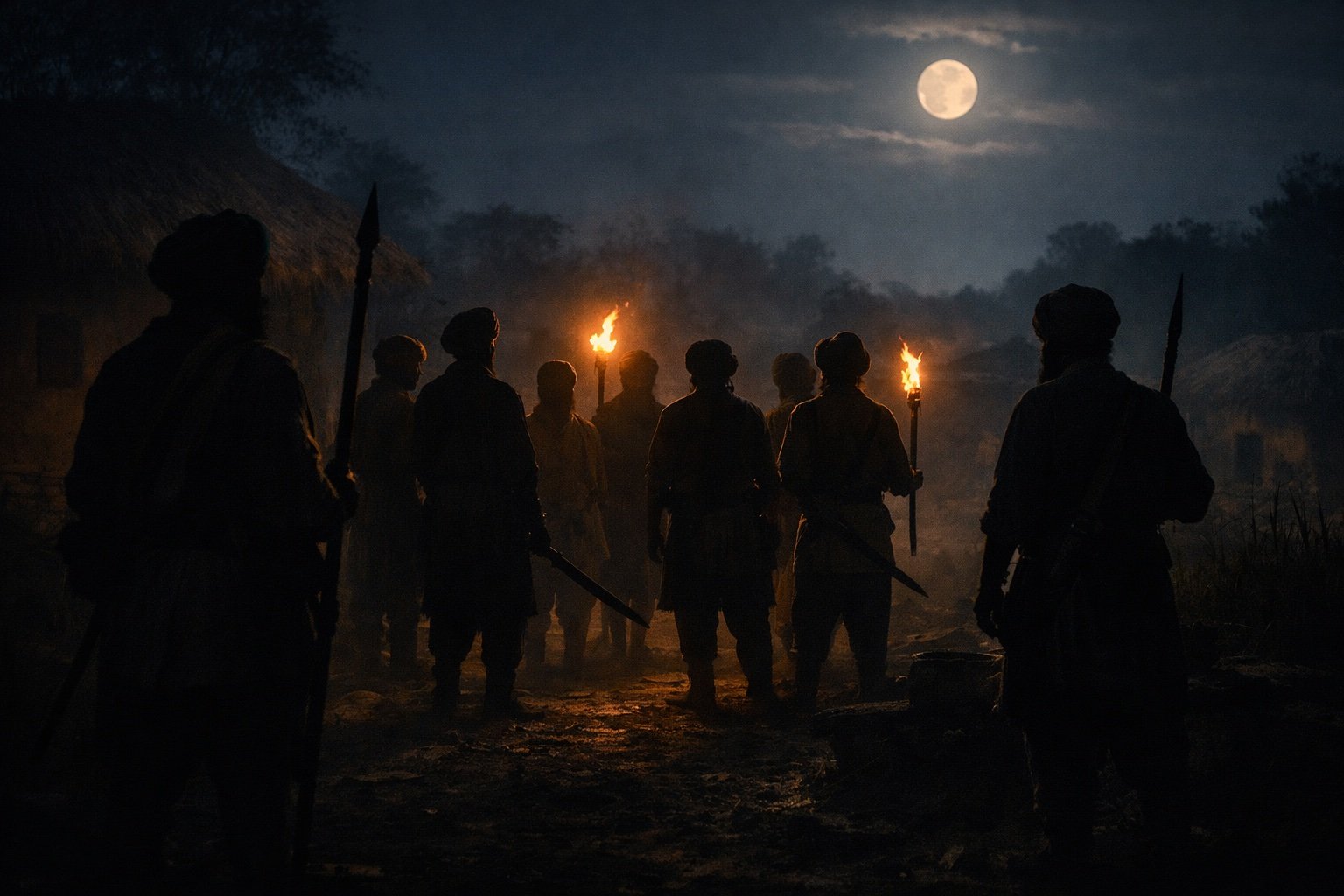
A depiction of peasant - soldiers gathering in the night.
From fragmented revolts to an organised confederacy.
Dedicated to the region that alchemised rebellion into liberation. With great admiration - TrishSaab-
Lachhman Dev. Madho Das. Banda Singh Bahadur.
Villager. Ascetic. Warrior.
A man whose sword cut through oppression.
The clash of empires. A fight for justice. Unwavering conviction.Victory came at a price: betrayal, defeat, martyrdom. His story - a blend of glory and tragedy - was etched into the pages of history. Yet it was overshadowed by the rise of the golden age.
Read On …
