
1947 - The Partition of Punjab
Note: This post explores the events and political developments that connected the final years of the British Raj to the division of Punjab. It is the conclusion to the British Raj series, explaining how colonial rule came to an end and why Punjab became one of the provinces most affected by the events preceding, and the 1947 partition.
For a more detailed analysis, the Partition of Punjab series continues the story in greater detail.
The Final Years of British Rule
By the end of the Second World War, the Raj’s position in India had changed dramatically. The war had placed enormous financial strain on the colonial government, while Indian demands for independence had become increasingly difficult to suppress.
Political movements that developed over decades gained momentum during the 1940s. The Indian National Congress continued to advocate for an independent and united India, while the All-India Muslim League increasingly argued that Muslims required their own independent state to safeguard their political interests.
As negotiations continued, the colonial authority gradually accepted that its rule in India was coming to an end. The question was no longer whether independence would be granted, but under what political arrangement it would occur.
Why Punjab Became Central
Punjab occupied a unique position within British India. It was one of the empire's most important agricultural provinces, supplied large numbers of soldiers to the British Indian Army, contained major railway connections, and shared a long frontier with Afghanistan.
Unlike many other provinces, however, Punjab's population was deeply interconnected. Muslims formed the overall majority, while large Sikh and Hindu communities were spread across towns, cities, and villages throughout the province. In many districts these communities had lived alongside one another for generations.
As discussions over India's future increasingly focused on the possibility of partition, Punjab presented an exceptionally difficult challenge. Any border would divide existing communities, economic networks, transport systems, irrigation canals, and historic cities.
Political Developments
In 1940, the All-India Muslim League introduced the Lahore Resolution, calling for independent states in the Muslim-majority regions of British India. Although it did not explicitly mention Pakistan, it marked a major turning point in the movement that eventually led to its creation.
Following the Second World War, elections further strengthened both the Congress and the Muslim League, while efforts to negotiate a constitutional settlement repeatedly failed.
In Punjab, political alliances became increasingly fragile as communal identities began to play a greater role in provincial politics. Although many Punjabis continued to value shared regional ties, political divisions increasingly reflected broader debates occurring across British India.
Drawing the Border
When the Raj decided to transfer power in 1947, Punjab itself would have to be divided.
To determine the new boundary, the government appointed Sir Cyril Radcliffe to chair the Punjab Boundary Commission. Having never previously visited India, Radcliffe was given only a few weeks to produce one of the most consequential borders of the twentieth century.
The Commission considered district populations, administrative boundaries, communications, and other practical considerations. Yet no possible boundary could fully reflect the complex demographic, economic, and historical realities of Punjab.
Cities, villages, railway lines, canal systems, and communities often crossed any logical dividing line. Whatever decision was made would inevitably leave major groups of people on the opposite side of the new border.
Independence
On 14 and 15 August 1947, colonial in the Indian subcontinent formally came to an end.
Two independent nations emerged: India and Pakistan. Punjab, however, was no longer a single province. It was divided between East Punjab in India and West Punjab in Pakistan, separated by the Radcliffe Line.
The British Raj had ended, but the consequences of its final political settlement were only beginning to unfold.
The End of an Era
For almost a century (1849 - 1947), British rule had reshaped Punjab through administrative reforms, new legal institutions, railways, irrigation systems, military recruitment, education, and economic change. Many of the developments explored throughout this series emerged during this period and continue to influence the region today.
Yet the final act of the British Raj transformed Punjab more profoundly than any individual reform. The division of the province permanently altered its political geography and marked the beginning of a new chapter in Punjabi history.
The British Raj had come to an end, but the border it left behind would redefine the Punjabi identity forever.
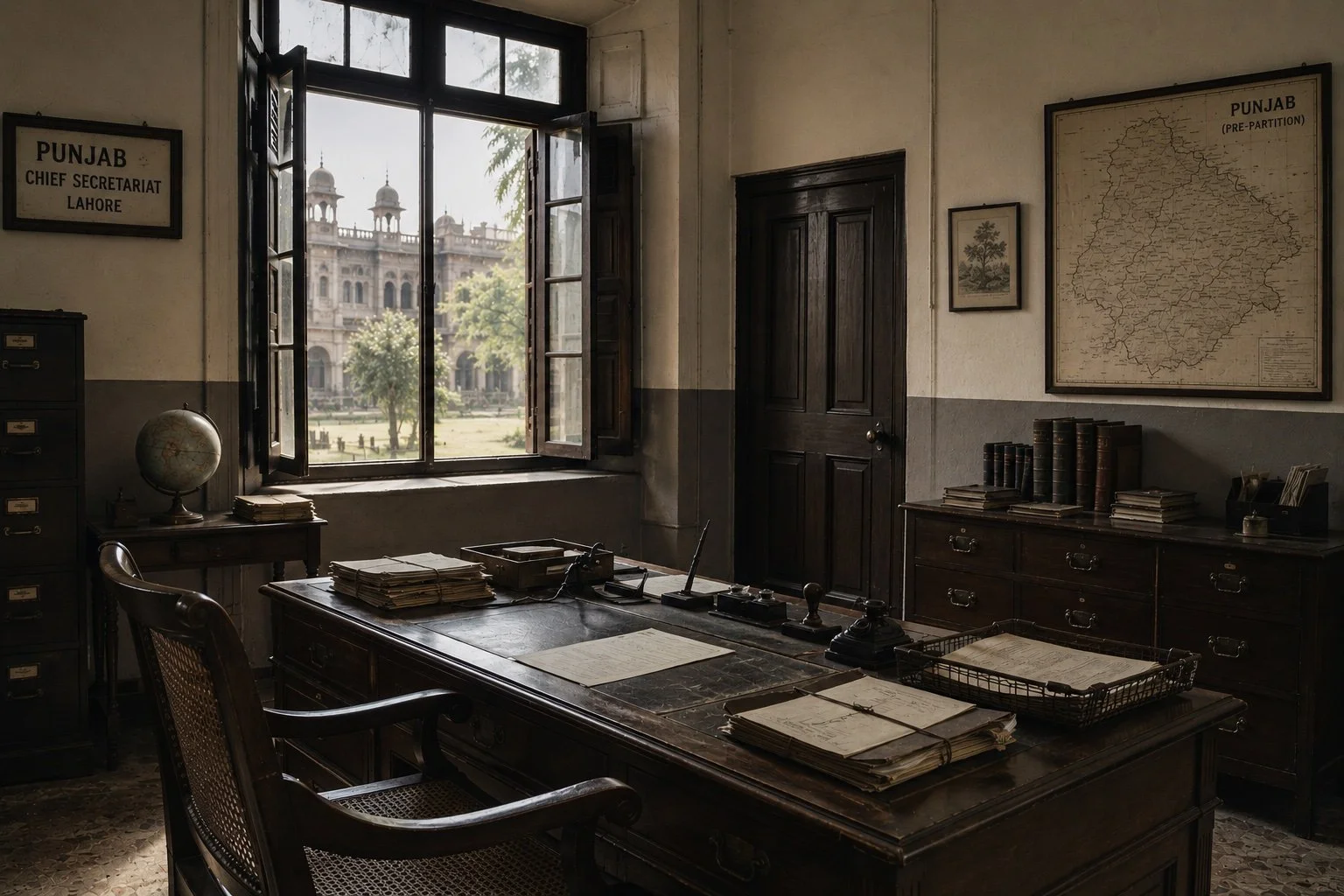
To the empire that ruled, and the province that remembered,
With Great Respect,
TrishSaab