
The Census and Classification of Punjab
After annexation, the British East India Company inherited one of the most diverse regions in South Asia. Punjab’s population differed by religion, language, occupation, clan, caste, tribe, and locality. To govern effectively, the Colonial government sought to measure, record, and classify the population. Through censuses, surveys, settlement reports, and administrative records, Punjab became one of the most documented provinces in British India.
While these efforts provided valuable information, they also reshaped how people were viewed by the state. Communities that had overlapping identities were often placed in fixed categories within official records.
COUNTING A PROVINCE
The first attempts to systematically record Punjab's population began shortly after annexation. By the late 1800s, regular censuses were being conducted across British India.
Officials recorded information such as:
• Religion
• Language
• Occupation
• Caste
• Tribe or clan
• Literacy
• Place of residence
The administration believed that accurate statistics would allow them to govern more efficiently, collect revenue, recruit soldiers, and understand social conditions throughout the province. For the first time in Punjab's history, millions of people were being counted and categorised by a central government on a regular basis.
RELIGION AND IDENTITY
Religion became one of the most important categories within the census.
People were generally recorded as Muslim, Sikh, Hindu, Christian, or belonging to another recognised faith. While religious identity had always existed in Punjab, many communities historically possessed multiple overlapping identities that were shaped by locality, clan, occupation, and shared cultural traditions. The census encouraged clearer religious distinctions by requiring individuals to be placed within a single category.
Over time, census statistics became increasingly important for political representation, education, employment, and public debate. Communities began paying close attention to their recorded numbers, as population figures could influence political influence and government policy.
As a result, religious identity became more visible in public life than it had been previously.
CASTE, CLAN, AND TRIBE
The colonial administration also attempted to classify Punjab's social structure.
Officials documented hundreds of communities, including Jatt, Rajput, Arain, Gujjar, Awan, Khatri, Lohar, Tarkhan, Chamar, and others.
These classifications often reflected existing social realities, but colonial administrators frequently treated them as rigid and permanent categories. In reality however, Punjabi society was often more flexible than official records suggested. Local identities, kinship networks, occupations, and regional traditions often overrode a person’s caste label.
The census transformed many of these identities into official administrative categories that appeared repeatedly in government reports and records.
THE MARTIAL RACES THEORY
Following the 1857 Uprising, colonial attitudes toward military recruitment changed significantly.
The colonial government began to favour recruitment from communities it considered naturally suited for military service. This became known as the Martial Races Theory.
Several Punjabi groups were classified as martial races, including Jatt, Rajput, Awan, Dogra, and others. British officials argued that these communities possessed qualities such as physical strength, discipline, courage, and loyalty. Recruitment into the army expanded rapidly throughout Punjab, turning the province into one of the most important military recruiting grounds in the empire.
It is important to note that historians generally view Martial Races Theory as a colonial belief rather than a scientific reality. However, its influence on Punjab's military and social history was significant and long-lasting.
AGRICULTURAL TRIBES
Classification also influenced land ownership.
Certain communities were classified as agricultural tribes, based off the belief that they were traditionally connected to farming and rural life. This distinction became particularly important with the Punjab Land Alienation Act 1900, which restricted the transfer of agricultural land to groups classified as non-agricultural.
Supporters argued that the policy protected rural farmers from debt and land loss. Critics argued that it reinforced colonial classifications and created legal divisions between communities. Regardless of perspective, the official classifications increasingly shaped economic opportunities throughout the province.
THE CRIMINAL TRIBES ACT
Under the Criminal Tribes Act, certain communities across British India were flagged as criminal tribes. Colonial authorities believed that criminal behaviour was clustered in certain communities, and localities. As a result, members of these communities often faced surveillance, registration requirements, movement restrictions, and social stigma.
LANGUAGE AND THE POLITICS OF IDENTITY
Language also became increasingly important during the colonial period. Punjabi remained the language spoken by most people across the province, but administration, education, and public life often involved other languages and scripts. Urdu became the primary language of administration throughout much of British Punjab. Punjabi continued to be widely spoken, while Hindi and various regional languages also played important roles in different communities.
PUNJAB IN THE IMPERIAL VIEw
By the early 1900s, British officials increasingly regarded Punjab as one of the most distinctive provinces of British India.
Unlike Bengal, which was associated with administration, education, and political activism, or Bombay, which was known for trade and commerce, Punjab became closely linked with agriculture, military recruitment, and frontier defence.
The province supplied a disproportionate number of soldiers to the Indian Army, produced vast quantities of agricultural goods through its canal colonies, and occupied a strategic position along the north-west frontier.
THE LEGACY OF CLASSIFICATION
The census did not create Punjab's communities, religions, languages, or social groups. These identities already existed long before the arrival of the British. However the colonial state recorded, organised, and institutionalised them on an unprecedented scale.
By counting and classifying millions of people, the administration transformed complex social realities into administrative categories. These categories influenced military recruitment, land ownership, education, political representation, and public policy throughout the Raj.
Many of the identities recorded in colonial censuses would continue to shape politics and society well into the twentieth century. The census was therefore more than a statistical exercise. It was one of the ways in which the British Raj sought to understand, manage, and govern Punjab - leaving behind records that continue to influence how the province's history is studied today.
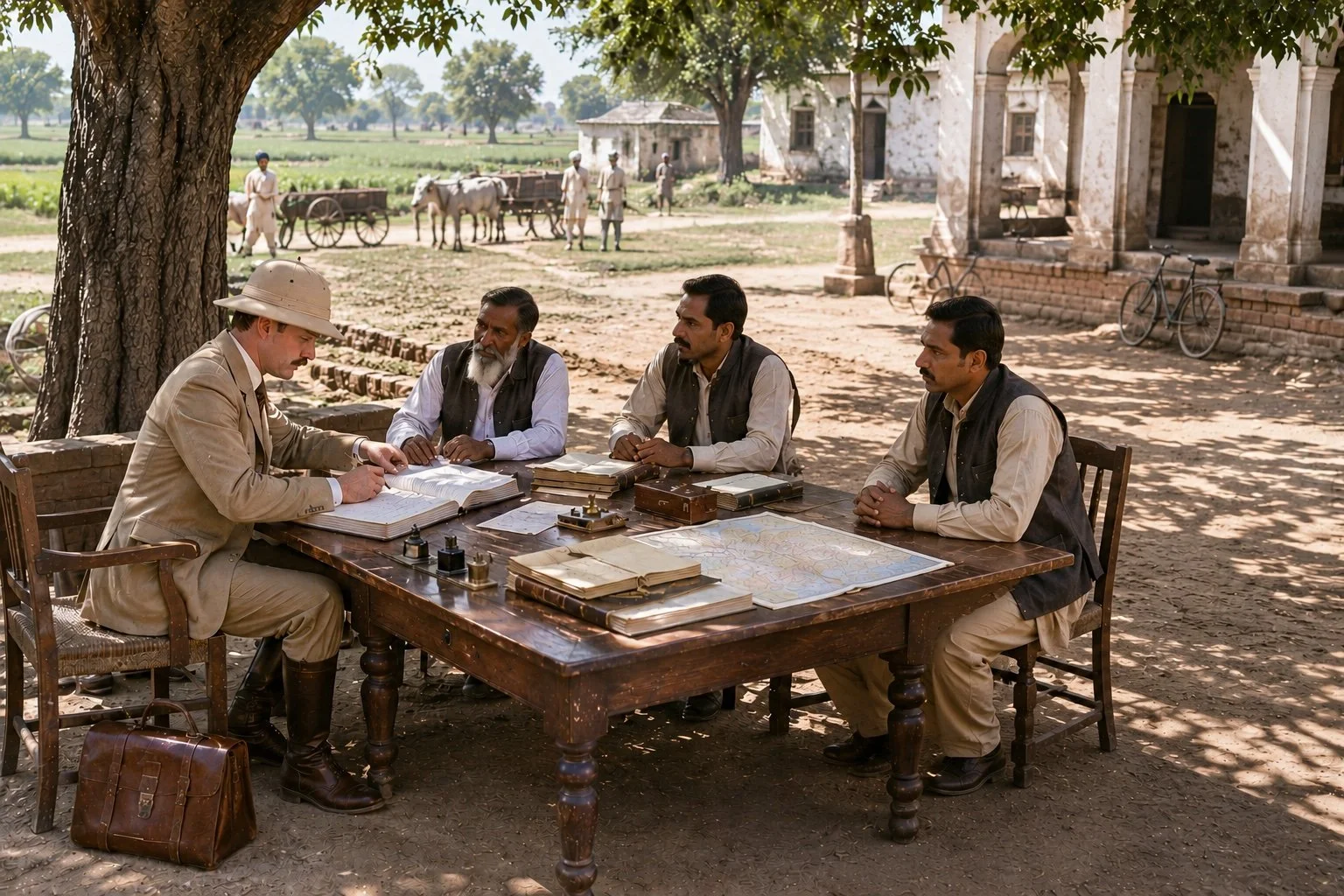
A depiction of an officer recording data from a rural village.
To every community who’s story became part of Punjabi history,
With acknowledgment, Trish Saab