
Part I - The Arrival: The Fall of The Sikh Empire (1849)
By the mid 1800s, The British East India Company had become the dominant political and military power in the Indian subcontinent. Beginning as a commercial trading enterprise in 1600, the company had grown into an imperial authority with its own armies, administrators, taxation system, and ambitions.
Despite the company’s growth, one major power remained outside its direct control in northern India: The Sikh Empire of Punjab.
For decades, the Sikh Empire was both a military rival and a strategic buffer between British India and the north-western frontier. However, after Maharaja Ranjit Singh’s death in 1839, political instability in Lahore, gave the company reason to believe that the Sikh Empire would not remain an independent imperial authority indefinitely. In 1849, after two Anglo-Sikh Wars, the British East India Company formally annexed Punjab into the British Empire.
The fall of the Sikh Empire marked the end of an independent Punjabi kingdom, and the beginning of direct British Rule over Punjab.
THE EAST INDIA COMPANY IN INDIA
The East India Company was founded in London on the 31st of December 1600, under a royal charter granted by Queen Elizabeth I. Its initial purpose was commercial. During the 1600s, the company established factories in main cities like Surat, Madras, Bombay, and Calcutta, to protect British commercial interests and facilitate trade in textiles, spices, tea, silk, and other goods.
As the Mughal imperial authority declined, however, the political balance in India began to shift - regional kingdoms emerged, conflicts intensified, and European trading companies began to intervene in local politics. In an attempt to protect its commercial interests, the British East India Company began recruiting Indian soldiers - sepoys, under British officers. Over time, these forces grew into large armies.
By the early 1800s, the East India Company controlled vast territories across the subcontinent, either directly or through allied princely states. Governors, military commanders, and Company officials viewed expansion necessary to secure trade routes, maintain political stability, and protect imperial interests. Punjab, however, remained outside the control of the company.
THE SIKH EMPIRE AND BRITISH CONCERNS
Under Maharaja Ranjit Singh, the Sikh Empire became a major regional power, and by the 1830s, it was divided into 4 provinces controlling Lahore, Multan, Kashmir, and Peshawar. The Sikh Empire also had one of the most modern and disciplined armies in the subcontinent. To British officials, it was both an obstacle and a buffer.
The Empire prevented British expansion beyond the Sutlej River, vide the Treaty of Amritsar (1809), but it also shielded British India from invasions through the northwestern frontier. Despite this, company officials remained wary of the strength of the Khalsa Army and the possibility of instability after Maharaja Ranjit Singh’s death.
THE FIRST ANGLO-SIKH WAR
In December 1845, the tensions between the Sikh Empire and the British East India Company escalated into the first Anglo-Sikh war. The exact causes of the conflict remain debated, with the Punjabi side (mostly the Khalsa Army) arguing that the company’s military buildup along the frontier made war inevitable, and the Company arguing that Punjabi forces crossing into British controlled territory was an act of aggression.
Between December 1845, and February 1846, major battles took place at Mudki, Freozeshah, Aliwal, and Sobraon. Despite the Khalsa armies fierce resistance, the British East India Company was victorious. The war formally ended with the Treaty of Lahore (1846).
Under the treaty, the Sikh Empire was forced to cede territory between the Beas and Sutlej rivers, pay a war indemnity, reduce the size of the Khalsa Army, and accept the temporary presence of British troops in Lahore - the capital of the empire.
The Lahore Durbar was unable to pay the full indemnity, which led to additional conditions outlined in the Treaty of Amritsar (1846).
An additional agreement, the Treaty of Bhyrowal (1846) was also signed, permanently placing a resident in Lahore, and granting the British East India Company authority over Punjabi affairs.
Although the Sikh Empire technically continued to exist, Punjab was under indirect control of the British East India Company.
THE SECOND ANGLO-SIKH WAR
By 1848, the underlying tensions escalated again.
The first rebellion broke out in Multan, under the governorship of Diwan Mulraj Chopra, and spread into wider resistance against external influence over Punjabi affairs and administration. To the British officials, this unrest was proof that the existing system of indirect control was failing.
This escalated into the Second Anglo Sikh War; major battles include Ramnagar, Chillianwala, and finally Gujrat. The battle of Gujrat was decisive where the Khalsa forces were significantly overwhelmed by the Company’s artillery, leading to Punjabi resistance collapsing rapidly. In the weeks that followed, remaining groups of the Khalsa Army surrendered.
On the 14th of March 1849, under the command of General Sher Singh Attariwala (and other cheifs) the remaining soldiers of the Khalsa Army surrendered their swords to British General Walter Raleigh Gilbert near Rawalpindi.
For the Governor General Lord Dalhousie, the second war confirmed that Punjab could no longer exist under independent administration, and the province was incapable of being indirectly managed through the Lahore Durbar.
THE ANNEXATION OF PUNJAB
On the 29th of March 1849, the British East India Company formally annexed Punjab into British India. The existing Maharaja Duleep Singh was removed from the throne and the Lahore Durbar was dissolved. The treasury of the empire was incorporated into that of the British Empire. The currency of the Sikh Empire was withdrawn and replaced with British-Indian units. Administration of Punjab was entire under the British East India Company, and a new colonial government was established under the Board of Administration led by Sir Herny Lawrence, John Lawrence, and Charles Mansel - marking the beginning of direct British rule in the region.
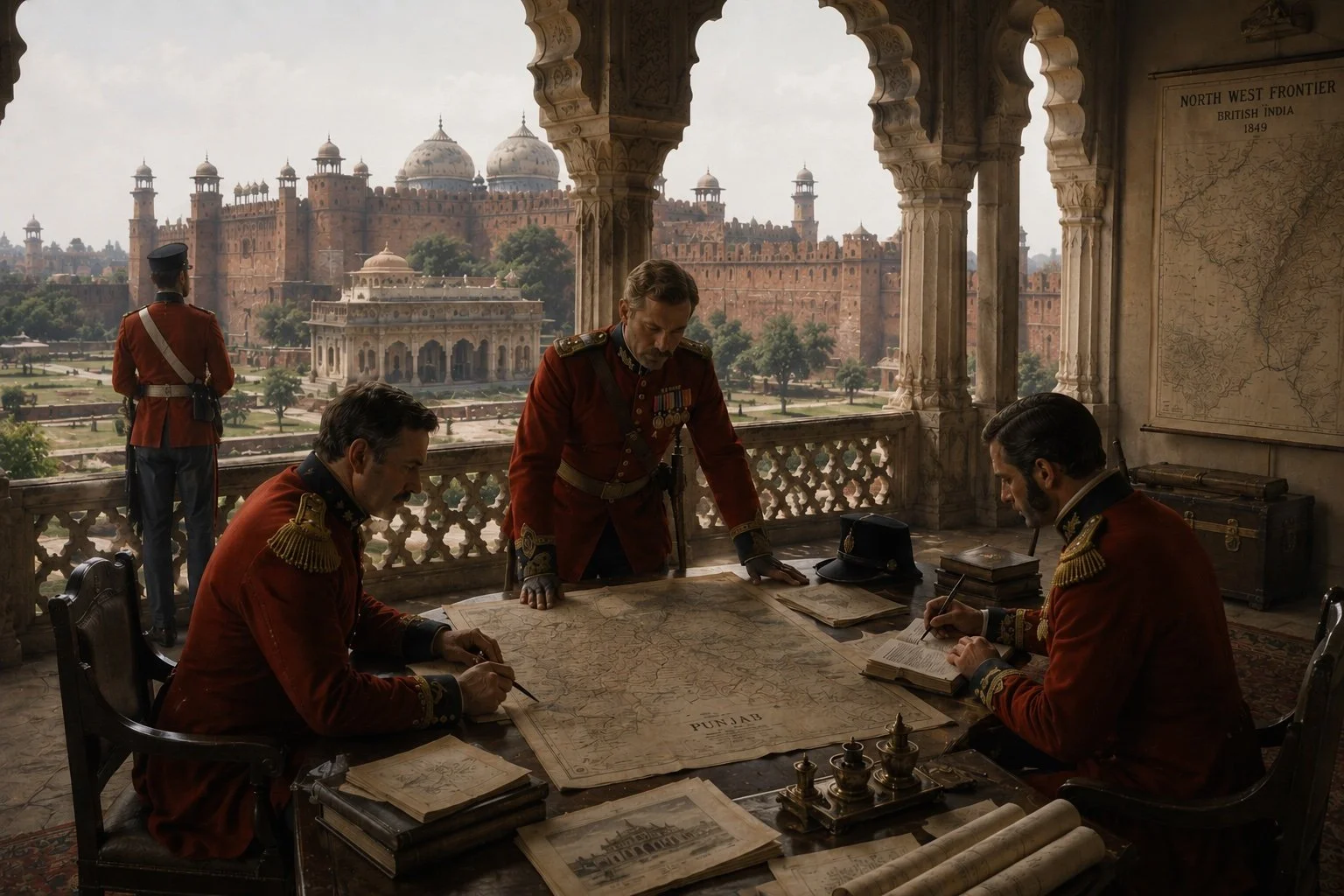
A depiction of British East India Company troops and officials in the Lahore Fort.
To the empire that gave way to another,
With remembrance - Trish Saab