
Part V - The Road To Partition: Punjab’s Political Division
As the Raj entered its final years, Punjab became one of the most politically complex provinces in India.
Earlier, many of Punjab's political leaders had worked across religious lines, focusing on agriculture, local administration and provincial interests. By the 1940s, however, constitutional reforms, expanding elections and growing debates over independence encouraged the rise of competing political movements. Different parties increasingly sought to represent particular communities, social classes, or visions for India's future.
Rather than moving towards a single political goal, Punjab became increasingly divided over what should happen once British rule came to an end.
The Unionist Party
For much of the British Raj, the Unionist Party was the dominant political force in Punjab.
Founded in 1923 by Sir Fazl-i-Hussain and later led by figures such as Sir Sikandar Hayat Khan - The Premier of Punjab (1937-42) and Sir Khizar Hayat Tiwana - Prime minister of Punjab (1942-47), the party was unusual because it was not organised around religion. Instead, it brought together Muslim, Sikh and Hindu landowners, particularly from rural Punjab.
The Unionist party believed that Punjab's farming communities shared more in common with one another than they did with politicians elsewhere in India. Their policies focused heavily on agriculture, irrigation, rural development and protecting farmers from debt. They generally worked alongside the colonial administration, believing that gradual reform and political stability best served Punjab's interests.
The Indian National Congress
The Indian National Congress was the largest nationalist movement in British India and campaigned for independence from British rule.
Although it presented itself as a secular organisation representing all Indians, its support within Punjab was strongest among many urban Hindus, educated professionals, students, lawyers and sections of the growing middle class.
The Congress promoted the idea of a united and independent India, arguing that religious identity should not determine the country's political future. Through protests, civil disobedience and political negotiations, it became the leading voice of the wider independence movement under leaders such as Mahatma Gandhi and Jawaharlal Nehru.
However, some Punjabis believed that Congress did not always fully appreciate Punjab's unique religious diversity and provincial interests, leading many voters to support alternative political movements.
The All-India Muslim League
The All-India Muslim League initially struggled to gain widespread support in Punjab, where the Unionist Party remained popular among many Muslim landowners.
During the 1930s and 1940s, however, this began to change. Under the leadership of Muhammad Ali Jinnah, the League increasingly argued that Muslims required constitutional safeguards to protect their political rights within a future independent India.
The Lahore Resolution of 1940, passed in Punjab, called for independent states in Muslim-majority regions of the subcontinent. Although its exact meaning was debated at the time, it later became closely associated with the demand for Pakistan.
As uncertainty surrounding independence grew, increasing numbers of Punjabi Muslims shifted their support towards the Muslim League. By the mid-1940s, it had become the province's largest Muslim political organisation.
The Shiromani Akali Dal
The Shiromani Akali Dal represented many Sikh political interests during the final decades of British rule.
Its origins lay in the Gurdwara Reform Movement of the 1920s, which sought to return the management of Sikh gurdwaras to the Sikh community. Over time, however, the party became increasingly involved in wider political questions concerning Punjab's future.
As discussions about independence intensified, Sikhs became concerned that they would become a permanent minority, whether within a united India or a divided Punjab. The Akalis therefore focused on protecting Sikh religious institutions, political representation and historical centres within Punjab.
Although opinions differed among Sikh leaders, the movement increasingly sought constitutional safeguards to ensure that Sikh voices would continue to be represented after British rule ended.
Other Political Movements
Alongside the major parties, several smaller organisations also influenced Punjab's political landscape.
The Communist Party of India and associated peasant organisations attracted support among sections of industrial workers and farmers, advocating for labour rights, land reform and economic equality rather than religious politics.
The Hindu Mahasabha promoted Hindu political interests and opposed the partition of India, although it remained considerably smaller than Congress within Punjab.
Earlier organisations and revolutionary groups inspired by figures like Bhagat Singh also contributed to political debate, reflecting the wide range of ideas circulating throughout the province.
Together, these movements demonstrated that Punjab's politics extended far beyond a simple contest between two or three parties.
The Struggle for Representation
As elections expanded under constitutional reforms, questions of political representation became increasingly important.
Punjab had communities of Muslims, Hindus and Sikhs in substantial numbers, each with their own political organisations and priorities. Separate electorates, reserved seats and constitutional negotiations encouraged political leaders to campaign on behalf of particular communities while seeking greater influence within provincial government.
Political competition gradually shifted away from broad provincial cooperation and towards securing representation for individual religious and social groups.
Increasingly, many Punjabis voted not simply for policies, but for the parties they believed would best protect their community's future.
The Collapse of Shared Politics
The provincial elections of 1946 revealed how dramatically Punjab's political landscape had changed.
The Muslim League won an overwhelming majority of Muslim seats, Congress dominated many Hindu constituencies, and the Akalis secured much of the Sikh vote. Meanwhile, the once-powerful Unionist Party suffered a decisive decline.
The election reflected more than changing political preferences. It demonstrated that Punjab's communities were increasingly placing their trust in parties that represented their own interests rather than those seeking cross-community cooperation.
The political consensus that had characterised much of the earlier Raj had largely disappeared, and for the first time Punjabi society was divided by religious and political beliefs.
Legacy
By the final years of the British Raj, Punjab was no longer united by a single political vision. Competing parties represented different communities, priorities and ambitions for the province's future. Cooperation became increasingly difficult as debates over independence, representation and constitutional change intensified.
This political fragmentation did not cause Partition, but it created the uncertainty and division that made compromise increasingly difficult.
The future of Punjab would soon be decided amid one of the most significant political transformations in its history.
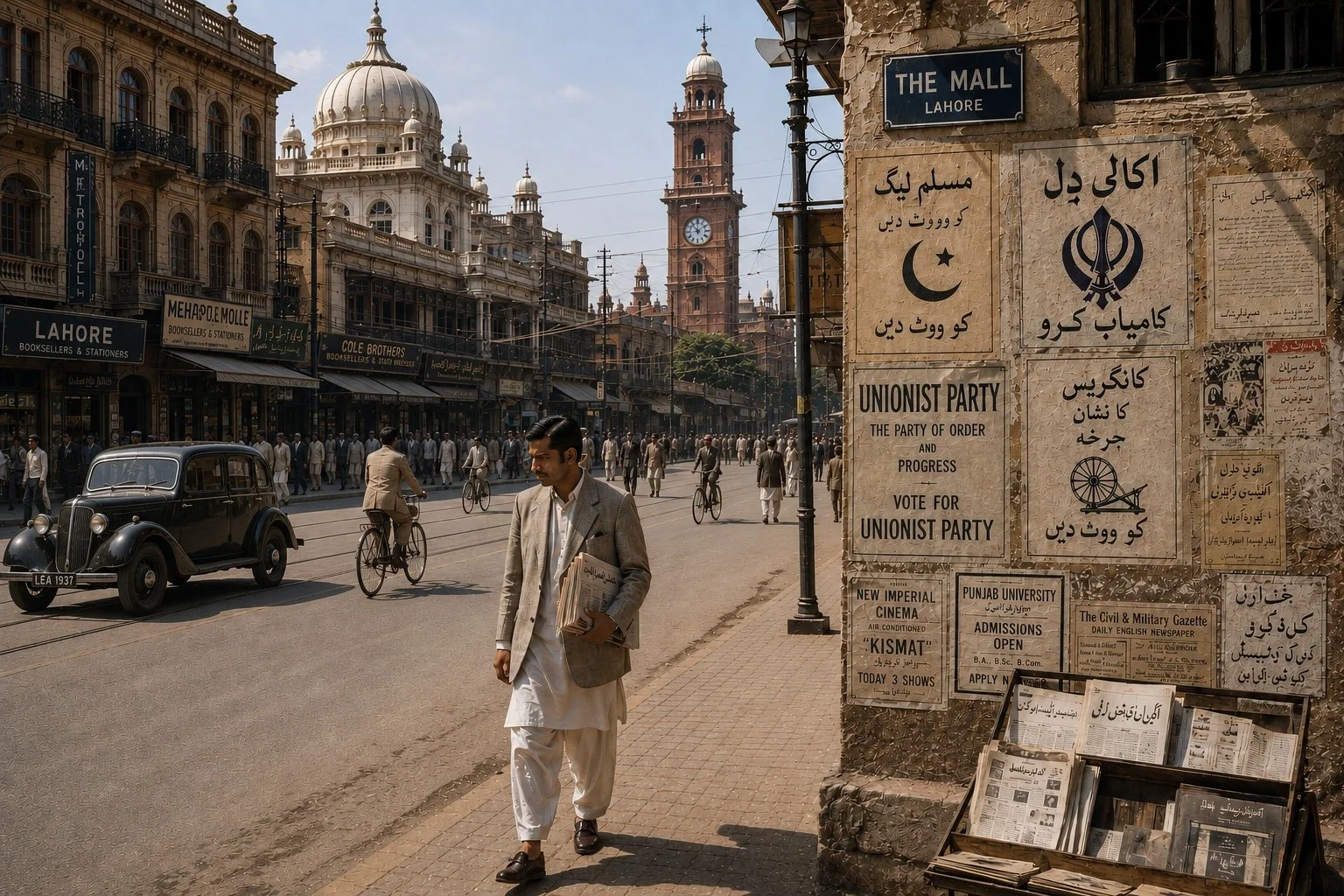
A depiction of election posters
To those who sought Punjab's future in different ways,
With Great Respect,
TrishSaab