
BAHADUR SHAH - II
WHO WAS BAHADUR SHAH ZAFAR?
Bahadur Shah Zafar, the final Mughal emperor, remains a figure of both tragedy and resistance in Indian history. Born in 1775, Zafar inherited an empire reduced to a shadow of its former glory. By the time he ascended the throne in 1837, the Mughal Empire was a name without power, confined largely to Delhi and heavily influenced by the British East India Company. Despite his limited authority, Zafar became a symbol of India’s struggle against colonial rule during the Revolt of 1857.
EARLY LIFE: A DYNASTY IN DECLINE
Bahadur Shah Zafar’s early life reflected the deteriorating state of the Mughal dynasty. The empire, once stretching across vast territories, was now fractured and weakened by internal conflicts, invasions, and the growing dominance of European powers. Zafar was more a poet and a philosopher than a ruler, renowned for his literary talents and interest in Sufism.
His ascension to the throne was not marked by ambition or military prowess but by inheritance. The real power in India had shifted to the British, and the emperor’s role was reduced to that of a ceremonial figurehead. Despite this, Zafar held court in Delhi and maintained the traditions of the Mughal court, albeit in a diminished capacity.
THE REVOLT OF 1857: BAHADUR SHAH ZAFAR AS A SYMBOL
The Revolt of 1857, also known as the First War of Independence, was a turning point in Zafar’s life and the history of the subcontinent. Discontent with British rule united various groups, including disaffected soldiers, peasants, and local rulers. Although the revolt had multiple causes, ranging from economic exploitation to cultural and religious grievances, Zafar became its unlikely leader.
The rebels declared Bahadur Shah Zafar their emperor, hoping to rally the population under the banner of the Mughal Empire. Zafar’s leadership during the uprising was largely symbolic; he lacked the resources or military experience to lead a successful campaign against the British. Yet his name and position lent legitimacy to the rebellion.
When the revolt was crushed, the British sought to make an example of Zafar. He was captured, tried for treason, and exiled to Rangoon (present-day Yangon, Myanmar) in 1858. His death in exile in 1862 marked the end of the Mughal dynasty and the formal beginning of British Crown rule in India.
THE MUGHAL EMPIRE AND PUNJAB UNDER ZAFAR
By the time Zafar came to power, the Mughal Empire’s influence in Punjab had long diminished. The rise of the Sikh Empire under Maharaja Ranjit Singh in the early 19th century had transformed Punjab into a formidable independent state. Ranjit Singh’s leadership, coupled with the military might of the Sikh Khalsa Army, kept the British and remnants of the Mughal administration at bay.
The Sikh Empire, however, began to decline after Ranjit Singh’s death in 1839, leading to instability in the region. This power vacuum allowed the British to annex Punjab by 1849, following the Anglo-Sikh Wars. During Zafar’s reign, Punjab was already under British control, and the Mughal emperor had no authority in the region.
The Punjabi Confederacy, a collection of independent Sikh misls (clans), had initially resisted Mughal domination before Ranjit Singh unified them. The Mughals’ inability to subdue the Sikhs during the late 18th century was a significant factor in their decline. The rise of the Sikh Empire and its eventual fall to the British reshaped Punjab, diminishing Mughal influence permanently.
THE COMPLEX LEGACY OF BAHADUR SHAH ZAFAR
Bahadur Shah Zafar’s legacy is one of a fallen empire and a cultural icon. As the last Mughal emperor, he symbolised the end of an era. His poetry and writings reflected his despair at the loss of sovereignty and the suffering of his people. Zafar is remembered for his poignant ghazals, which convey the grief of exile and the fragility of human ambition.
While Zafar himself did not have a direct impact on Punjab, the broader Mughal decline paved the way for the Sikh Confederacy and later the British Raj. His symbolic role during the Revolt of 1857 inspired future generations of Indians and Punjabis alike to resist foreign domination.
In conclusion, Bahadur Shah Zafar represents both the tragic end of the Mughal Empire and the enduring spirit of resistance against oppression. His reign, though marked by powerlessness, holds historical significance for its role in the Indian freedom struggle and its cultural contributions. From a Punjabi perspective, Zafar’s time reflected the region’s shift from Mughal to Sikh to British rule, a transition that forever changed its history and identity.
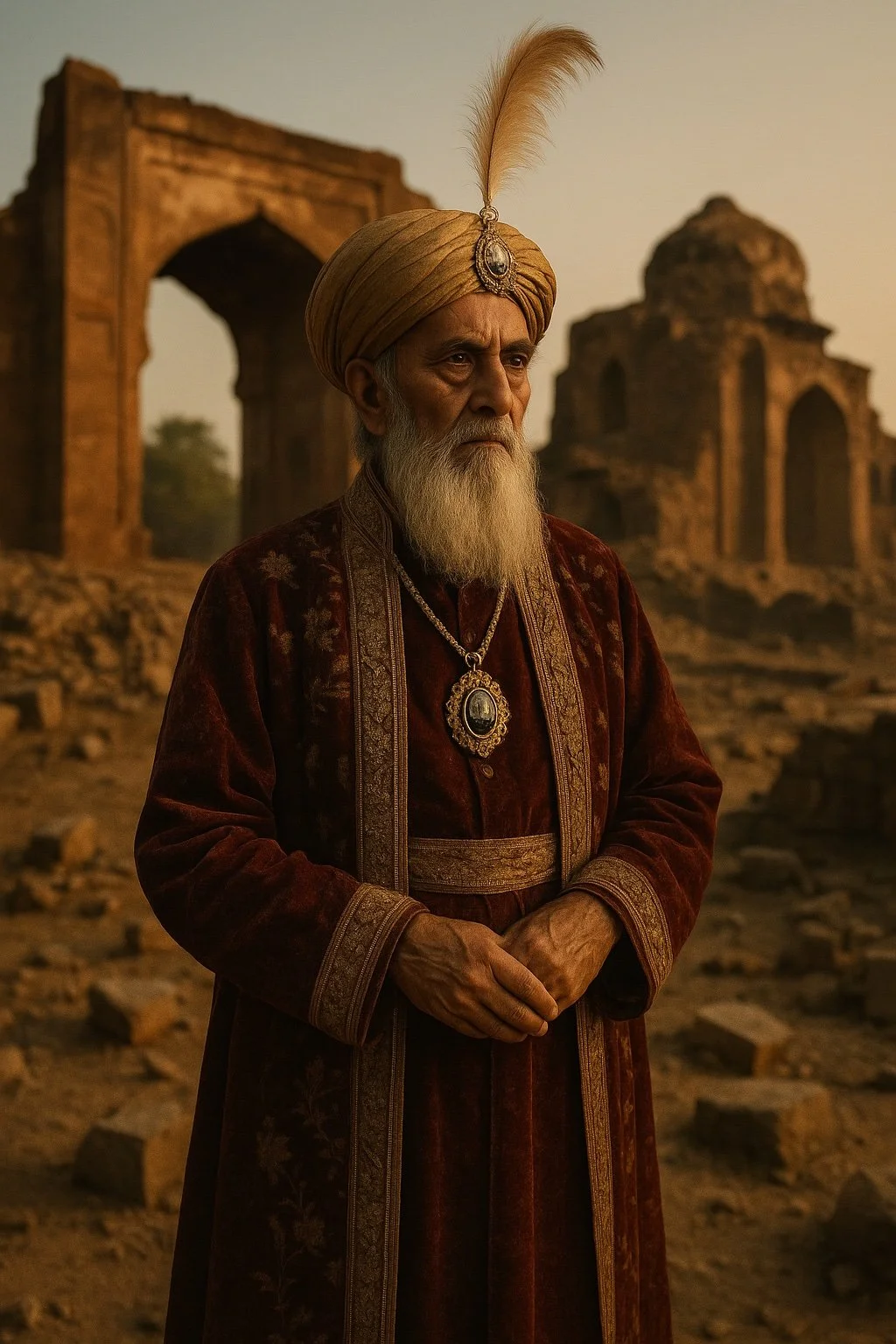
Bahadur Shah Zafar depicted as an elderly, frail man with a regal yet melancholic aura. His attire reflects the grandeur of the Mughal court. His eyes are hinting at the sorrow of a ruler witnessing the fall of his dynasty.
To Emperor Bahadur Shah Zafar, his predecessors, and the nobles of The Mughal Empire,
may history remember you with respect and honour your complex legacies.
To Punjab, who saw the rise and fall of the Mughal dynasty, may your resilience and sacrifices be remembered through time.
With great respect - TrishSaab