
WHO WAS SHAH ALAM II?
Jalal al-Din Muhammad Ali Gauhar, better known as Shah Alam II, began his first reign over the Mughal Empire in 1760, which lasted for 28 years. However, his reign faced immediate challenges, and he had to flee Delhi after his father, Alamgir II, was assassinated. While he was in exile, powerful nobles installed Shah Jahan III as a puppet emperor. Shah Alam II spent years away from Delhi, striving to reclaim his throne.
In 1772, the Marathas, under the leadership of Mahadji Scindia - a prominent Maratha statesman and military leader of the Scindia dynasty, which ruled the princely state of Gwalior restored Shah Alam II to the throne. This marked the beginning of his second reign, which lasted another 18 years. During this period, Shah Alam II was a figurehead. The Marathas, particularly Mahadji Scindia, controlled the empire’s administration, military, and significant decisions, using Shah Alam II’s title to legitimise their authority.
EARLY LIFE: A PRINCE IN EXILE
Born in 1728, Shah Alam II spent much of his early life witnessing the declining power of the Mughal dynasty. In 1759, Shah Alam II fled Delhi to avoid assassination by the influential court noble Imad-ul-Mulk. This period of exile saw him attempting to rally support in Bihar and Bengal, where he would clash with the British.
Despite his struggles, Shah Alam II ascended the throne in 1760 after the brief and ineffective reign of Shah Jahan III. However, his rule began under the control of the Marathas, who wielded significant influence in Delhi, symbolising the Mughal emperor’s diminishing authority.
SHAH ALAM II’S REIGN: A FRACTURED EMPIRE
Shah Alam II’s reign was marked by the fragmentation of the Mughal Empire. Once a mighty force, the empire had become a shadow of its former self by the mid-18th century. Regional powers like the Marathas, Rohillas, Sikhs, and British competed for dominance, reducing the Mughal emperor to a figurehead.
One of the most defining moments of his reign was the Battle of Buxar in 1764. Defeated by the British East India Company, Shah Alam II was forced to sign the Treaty of Allahabad in 1765, granting the British control over Bengal, Bihar, and Orissa. The treaty marked a significant step in the British colonial conquest of India and further diminished Mughal sovereignty.
Despite these losses, Shah Alam II remained a symbol of continuity, representing Mughal legitimacy even as his power waned. He returned to Delhi in 1772 with Maratha assistance, but the empire’s influence was limited to the city and its immediate surroundings.
the rise of the Sikh EMpire
During Shah Alam II’s reign, Punjab was under the control of the Punjabi Confederacy, a coalition of Sikh Misls that had risen to prominence in the region. The fall of Mughal authority in Punjab, combined with Nadir Shah’s invasion in 1739 and subsequent Afghan incursions, had left the region in turmoil. The Sikhs, seizing the opportunity, consolidated their power and established a strong presence.
By the mid-18th century, the Punjabi Confederacy had effectively ended Mughal dominance in the region. The Bhangi Misl captured Lahore in 1765 and made it their administrative and military centre - they remained in control of Lahore for multiple decades but their dominance was marked by internal struggles. This rise represented a major shift in the power dynamics of northern India, as the once-mighty Mughal Empire was no longer a significant player in Punjab.
In 1799, amidst this backdrop of declining Mughal influence and regional chaos, Maharaja Ranjit Singh, leader of the Sukerchakia Misl, captured Lahore. The Bhangi Misl’s hold had weakened due to internal discord. Recognising this opportunity, Ranjit Singh was invited by the residents of Lahore to take control and restore order. With a swift and strategic campaign, he entered the city with minimal resistance, consolidating his rule over Lahore.
This event marked the beginning of Ranjit Singh’s reign and the establishment of the Sikh Empire, with Lahore as its capital. Under his leadership, Lahore transformed into a thriving centre of culture, trade, and administration. For Shah Alam II, the loss of Punjab and its capital city was another devastating blow to the already crumbling Mughal Empire.
The strength and resilience of the Punjabi Confederacy, followed by the rise of Maharaja Ranjit Singh, underscored the collapse of Mughal authority, particularly in frontier regions like Punjab. It was a decisive moment in history, marking the emergence of the Sikhs as a dominant power in northern India.
A FRAGILE LEGACY
Shah Alam II’s reign highlights the Mughal Empire’s decline. Despite his efforts to preserve the empire, he was largely powerless in the face of external invasions and internal rebellion. His reliance on the Marathas and later the British showed the emperor’s dependence on regional powers.
While Shah Alam II retained symbolic authority, the empire during his time became increasingly irrelevant in Punjab and other regions. The Sikh misls continued to consolidate power, leading to the establishment of the Sikh Empire under Maharaja Ranjit Singh in the early 19th century.
Shah Alam II’s legacy is a poignant reminder of the challenges faced by the Mughal Empire in its final years. His reign, though marked by decline, reflects the resilience of an emperor striving to maintain the dignity of a fading dynasty. For Punjab, it was a time of transformation, as the region moved beyond Mughal rule to carve its path in history.
CONCLUSION
Shah Alam II’s story is one of survival in the face of adversity. His reign highlights the end of the Mughal Empire’s dominance and the rise of regional powers like the Punjabi Confederacy. While he could not restore the empire to its former glory, Shah Alam II’s persistence serves as a testament to the challenges of his time. For Punjab, his reign marked the transition from Mughal control to the emergence of a powerful Sikh Confederacy, setting the stage for the region’s rich and complex history.
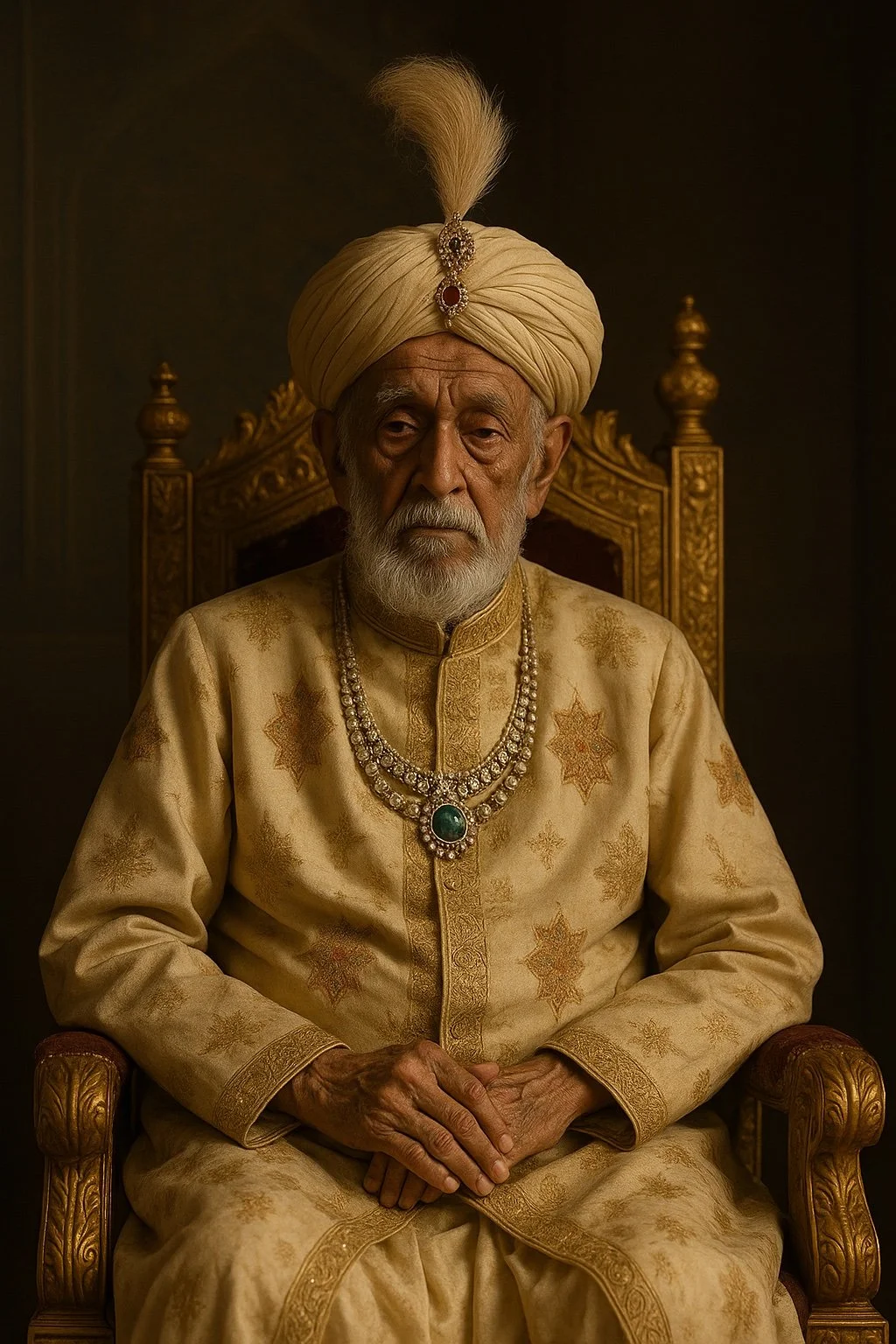
A depiction of the Emperor Shah-Alam II, his face holds a weary expression showing the stress and decline of the empire. The background also reflects this.
To Shah-Alam II, who sought to restore a fallen empire despite the harsh realities of time. To Punjab, whose resistance brought its liberation, despite the weight of history. With respect,
TrishSaab.