Maharani Jind Kaur
Following Duleep Singh’s ascension to the throne in 1843, the Sikh Empire was extremely unstable. The authority that had once been concentrated under Maharaja Ranjit Singh had fractured significantly, giving way to court rivalries, assassinations, and shifting alliances.
The Lahore Durbar no loner functioned as a unified centre of power, instead it had become a contested space where nobles, military leaders and administrative elites operated with independent interests.
Then Maharani Jind Kaur became regent.
A court without balance
Maharani Jind Kaur’s regency did not begin from a position of strength. The influence of the Dogra brothers in the Lahore Durbar - particularly Gulab Singh Dogra, was still high. Their role in earlier court dynamics had already changed succession outcomes, and their presence continued to affect the Durbar’s decisions.
At the same time, the Khalsa army had evolved beyond its earlier role. The army was no longer confined strictly to m ilitary functions, and sections of the army had begun to assert influence over state affairs - including the appointment and removal of state officials. The army’s size, organisation, and growing political awareness made them a force that could not be easily directed by the court.
Despite this, administrative continuity still existed - revenue officials, governors, and local intermediaries continued to function across the empire. But at the centre, coordination had weakened.
The Sikh Empire was not collapsing in structure, it was losing coherence.
Regency as Active Rule
Within this fractured system, Jind Kaur asserted her position as regent and actively governed. She engaged directly with court proceedings, influenced royal appointments, and oversaw the key factions within Lahore.
Her authority rested on multiple foundations:
her position has mother of Maharaja Duleep Singh
her proximity to the centre of power within the Lahore Fort
her ability to navigate competing interests within the court
Rather than allowing a single faction to dominate unchecked, she operated within the balance of these forces - working to keep the throne as the ultimate authority, even as its strength weakened.
The Army and the State
One of the defining challenges of her regency was the relationship between the royal court and the Khalsa army.
By the 1840s, the balance that existed in previous decades had shifted and the army, while still highly organised and well armed, was no longer tightly controlled by a single authority.
Its presence was no longer military, it was political. For the regency, this created a constant tension:
the army was essential to the defence of the empire,
but its autonomy limited the ability of the Lahore Durbar to act independently.
As regent, Jind Kaur’s position required navigating this reality; maintaining legitimacy in the eyes of the army, and attempting to preserve the authority of the state.
Observation and strategic interest of the British East India Company
While internal dynamics in Punjab continued to evolve, the British East India Company closely monitored the empire. As agreed in the Treaty of Amritsar (1809), the company had maintained a defined boundary with the empire - the Sutlej River. However, the instability of the 1840s altered the strategic position of both parties. A powerful but internally divided state presented both a risk and opportunity to the company.
The emergence of Jind Kaur as an active regent complicated this situation further. She did not function as a passive intermediary. Instead, her continued assertion of authority, combined with the presence of a strong and politically aware army, meant that Punjab remained unpredictable.
From the company’s perspective, the empire was no longer stable
but it was not yet weak enough to take over.
Approaching Conflict
By the mid 1840s, the Sikh Empire stood at a precarious position.
Its administrative systems continued to function across its territories, its armies remained one of the most formidable in the subcontinent, but at its centre authority was divided, negotiated, constantly contested.
Maharani Jind Kaur’s regency existed within this tension.
She did not restore the empire to its earlier unity,
but she did not allow its authority to dissolve without resistance.
In Lahore, the Durbar still asserted power.
At its borders, the empire was being closely watched.
The conditions for conflict had not yet erupted into war,
but they had taken shape.
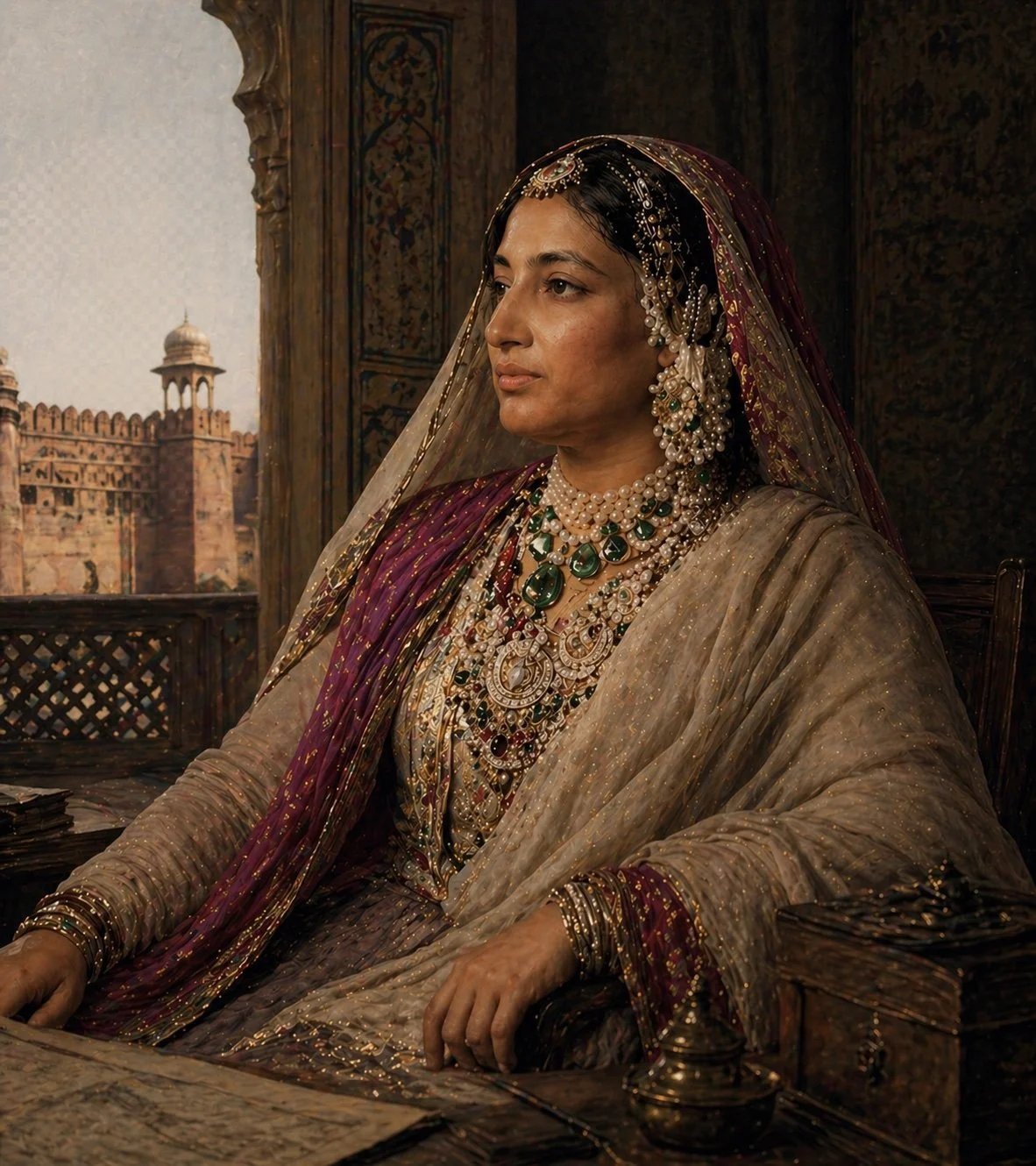
A depiction of Maharani Jind Kaur
To the regent who held authority in a court without balance, and stood at the centre of an empire beginning to crumble.
With great respect, Trish Saab.