
1857 - Resistance & Rebellion
A SUBCONTINENT IN CRISIS
In 1857 the British East India Company faced the greatest challenge so far. It had been less than a decade since Punjab’s annexation, however, dissent had been growing over Company controlled territories for much longer.
Indian rulers had lost kingdoms to annexation,
Traditional elites and nobles had seen their authority weaken,
Landholders feared economic change.
Religious leaders were anxious about change,
And within the Bengal Army itself, resentment had become increasingly dangerous.
In May 1857, sepoys stationed at Meerut rebelled against their officers. Soon afterwards, rebel soldiers marched into Delhi and proclaimed the final Mughal Emperor Bahadur Shah Zafar as a symbolic leader of their uprising,
The rebellion quickly spread across Company controlled territories, and for months, entire regions descended into warfare, sieges, executions, and political chaos.
For the British East India Company, the empire itself appeared at risk of collapse.
Why did the Rebellion Begin?
The uprising of 1857 did not emerge from a single cause. One trigger involved the introduction of the Pattern 1853 Enfield Rifle. Soldiers were required to bite open greased cartridges before loading the weapon, and rumours quickly spread that the grease was serviced from cow or pig fat - which did not align with Indian religious and moral ideals.
However, the cartridge controversy merely ignited tensions that already existed. Many Indian rulers already disagreed with Company annexation policies - particularly the Doctrine of Lapse; which was the method through which the Company absorbed states whose rulers died without a direct Heir.
Others feared growing Company interference in religious and social matters. Within the Bengal Army, sepoys increasingly complained about:
unequal treatment
overseas deployment
declining privileges
racial discrimination
lack of trust between troops
By the summer of 1857, mutiny had grown into political rebellion.
Punjab’s complex position:
Punjab’s role during the uprising was unlike any other region in India. The province had been annexed 8 years prior, and the society was still familiar with the fall of the Sikh Empire in 1849. Despite this, Punjab did not rise in unified rebellion against the British East India Company.
Instead, the province became one of the company’s most important strongholds during the crisis. This reflected the fragmented political reality of Punjab after 1849.
The Khalsa state didn’t exist anymore,
The Lahore Durbar collapsed,
Former nobles had lost their power,
Political loyalties and interests were divided between communities.
A reason for this was that the uprising centred around the Bengal Army and the Mughal Court in Delhi - not the restoration of Punjab’s sovereignty. The memory of conflict between the Sikh Empire and Mughal authority also shaped attitudes of Punjab’s population. At the same time, there were Punjabis who opposed Company rule, sympathised with the rebellion, or resisted colonial authority in different ways.
the Disarming of the Bengal Army
Company officials feared that Bengal Army regiments stationed in Punjab might join the rebellion spreading across northern India. If Punjab itself revolted, Company control over the north west could collapse entirely. In May 1857, Company authorities near Lahore moved quickly to disarm Indian regiments before the rebellion could spread further. Soldiers were ordered onto parade grounds and forced to surrender their weapons. Similar disarmaments were forced across Punjab - Amritsar, Ferozepur, Jhelum, Rawalpindi; some surrendered compliantly, others resisted violently.
At Jhelum, heavy fighting erupted between mutinous sepoys and British forces.
The British response throughout Punjab was quick and often brutal. Executions, surveillance, arrests, and public punishments became increasingly common as colonial authorities attempted to prevent rebellion from spreading across the province.
John Lawrence and the Defence of Punjab
One of the central figures during the uprising in Punjab was John Lawrence, the Chief Commissioner of Punjab. He argued that Punjab had to be held at all costs. As a result, under his administration, Punjab became the primary military base for British operations in northern India; troops, supplies, artillery, transport animals, and reinforcements were rapidly mobilised across the province.
Punjab also became the main source of new soldiers after large sections of the Bengal Army rebelled. The British East India Company increasingly recruited Punjabi soldiers, who would become critical to the Company’s war effort during 1857.
The Seige of Delhi
Punjab played a decisive role in the British recapture of Delhi. After rebel sepoys seized the city and declared Bahadur Shah Zafar the emperor, Delhi became the symbolic centre of the uprising. British forces moving from Punjab formed a major part of the army that besieged the city. Punjabi troops, frontier regiments, artillery units, and newly raised levies all participated in the campaign. The siege lasted for months, the fighting was brutal - with heavy casualties on both sides. Eventually in September 1857, British forced retook the city. This was a turning point in the rebellion, but the British victory came with consequences:
large sections of the city were destroyed
civilians were killed
mass reprisals followed
Mughal authority came to an official end and Emperor Bahadur Shah Zafar was later exiled.
Punjabi Cheifs and the Princely states
Several princely states and landed elites across Punjab supported the British East India Company during the uprising. The rulers of Patiala, Nabha, and Jind provided troops, supplies, transport, and political support to the Company.
For many local rulers, siding with the British East India Company was both a strategic and political decision, because supporting the rebellion carried enormous risks - particularly when the outcome of the conflict was uncertain.
The British East India Company later rewarded many loyal cheifs and landlords with titles, estates, political favour, and influence within colonial administration. These alliances also helped strengthen British control over Punjab in the decades that followed.
The consequences for Punjab
The rebellion of 1857 permanently changed Punjab’s role within British India. In 1858, the Crown formally abolished the British East India Company and transferred India directly under imperial rule. But the consequences in Punjab went further - the administration saw Punjabis as martial races, claiming that some communities were naturally suited for military recruitment. As a result,
military recruitment in Punjab expanded dramatically
cantonments and military infrastructure increased
canals and strategic transport networks were integrated
loyal elites and landlords gained social and administrative influence
Punjab became one of the most heavily militarised provinces in British India.
Over time, Punjab would contribute enormous numbers of soldiers to the British Indian Army, particularly during the First and Second World Wars.
THE dissolution OF THE British EAST INDIA COMPANY
The uprising of 1857 marked the end of the East India Company.
Founded in 1600 by royal charter, the Company had originally arrived in the Indian subcontinent as a commercial trading enterprise. Over the following centuries, it expanded its influence through trade, diplomacy, alliances, and warfare. By the mid-1800s, the Company controlled vast areas of the subcontinent. It maintained its own armies, collected taxes, administered territories, and governed millions of people. Following the Anglo-Sikh Wars, it annexed Punjab in 1849, bringing the former Sikh Empire under Company rule.
Yet beneath the surface, tensions had been growing for decades. Political annexations, military grievances, economic pressures, and fears of cultural and religious interference fuelled increasing resentment across parts of India. The uprising of 1857 exposed how fragile Company rule had become. Although the rebellion was ultimately suppressed, the crown blamed the East India Company for many of the failures that had contributed to the crisis.
In 1858, the British Parliament passed the Government of India Act, transferring all of its territories, powers, and responsibilities directly to the British Crown.
The East India Company ceased to govern India.
British rule, however, did not end.
Instead, authority passed from a commercial company to the British state itself. Queen Victoria became the sovereign of British India, while a new imperial administration governed the subcontinent on behalf of the Crown. The Governor-General was redesignated as the Viceroy of India, serving as the monarch's representative.
The Company that had conquered Punjab less than a decade earlier was gone.
In its place emerged the British Raj - a new era of direct imperial rule that would shape Punjab and the wider subcontinent for the next ninety years.
A turning Point
The 1857 uprising changed the political future of the entire subcontinent.
The British East India Company was dissolved
The Mughal Empire fell completely
Colonial rule became more centralised
But Punjab in 1857 was still adjusting to conquest, divided by competing interests, and a province whose future would become deeply tied to the British Empire after the rebellion had ended.
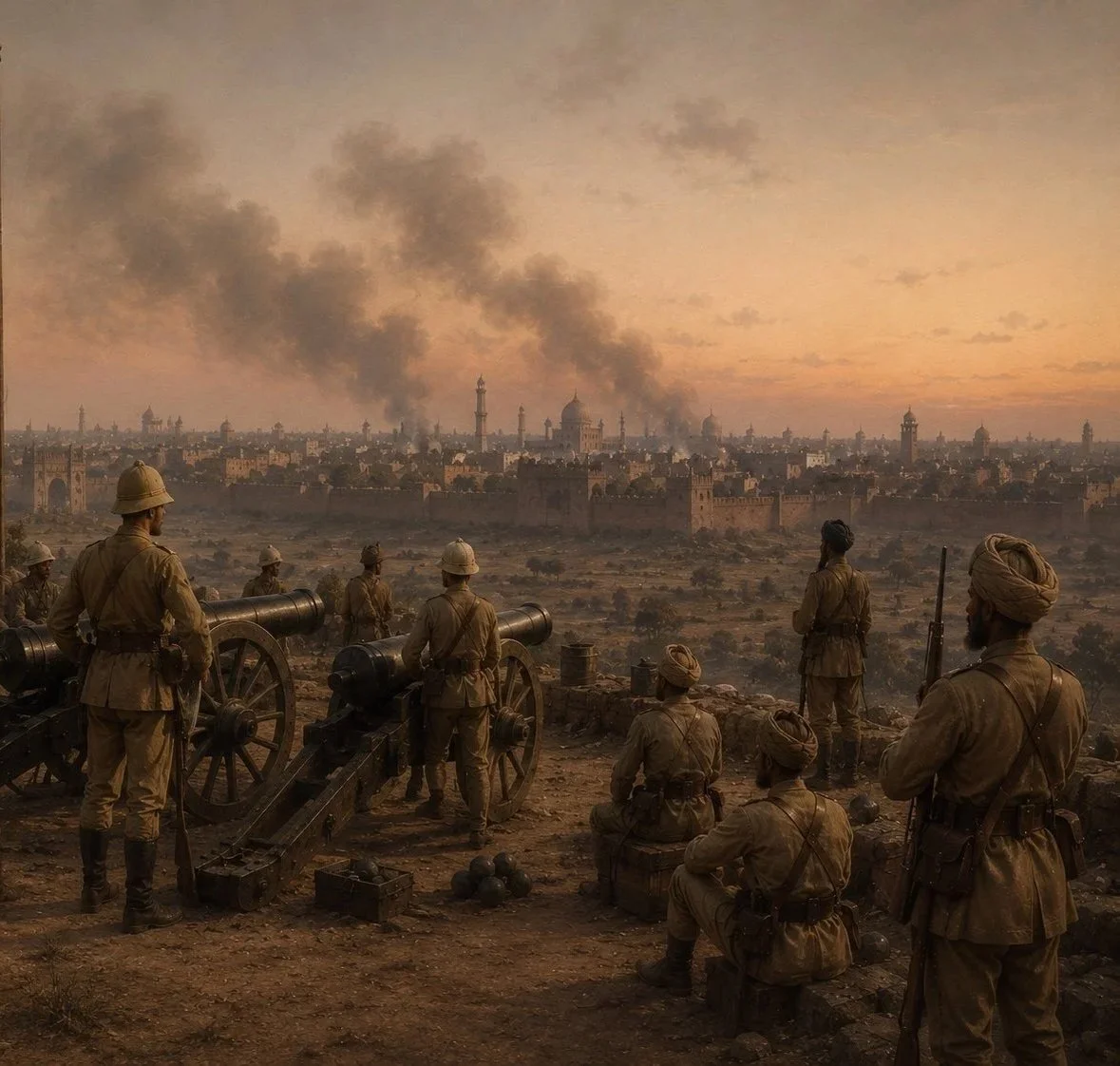
A depiction of the siege.
To those who chose resistance, and to those who lived through its consequence.
With strength - Trish Saab