
The Frontier & The Empire: Punjab’s Strategic Role
After the annexation of Punjab in 1849, the region became a frontier - a buffer between British India and Central Asia. For centuries invaders had entered the Indian subcontinent through Punjab. Now the Company intended to ensure that no empire would do so again.
The North West Frontier
Punjab occupied one of the most strategically important locations in Asia. The passes of Afghanistan and the rugged frontier regions beyond the Indus River lay to the west. The mountain corriders, particularly the Khyber Pass, had historically connected Punjab to Central Asia, Persia, and Afganistan.
It was through these routes that invaders had entered the subcontinent over centuries:
Mahmud of Ghazni
Timur
Babur
Ahmad Shah Durrani
Like the former Sikh Empire, the British East India Company understood this history clearly. Whoever controlled Punjab, controlled the gateway to northern India.
Punjab As a Buffer
Following annexation, Punjab became the Company’s defensive shield. The British East India Company feared that instability beyond the northwest frontier could threaten central India, particularly as Russian influence in Central Asia continued to expand during the 1800s.
As a result, Punjab was strategically transformed into a heavily militarised frontier province. Roads, forts, cantonments, telegraph lines, and supply routes were expanded, and strategic cities - Lahore, Rawalpindi, Peshawar, and Multan grew in their military importance.
Punjab was no longer an agricultural heartland, it had become the outer defensive line of the British Indian Empire.
The Great Game
The geopolitical tensions between Britain and Russia during the 1800s are known as The Great Game. The potential of Russian expansion through Central Asia deeply shaped British-Indian policies. Punjab, as a result, became critical to imperial defence planning:
Troops were mobilised rapidly toward the frontier
Supplies and reinforcements could move through Punjab’s rail and canal systems
Frontier intelligence networks grew
Military infrastructure was concentrated in the province
Connection to Afghanistan
Punjab’s relationship with Afghanistan remained central throughout the colonial period. Trade, migration, military campaigns, and tribal politics linked the frontier regions closely. The British East India Company held stakes in Afghan affairs - particularly regarding rival powers.
This eventually contributed to the Anglo Afghan Wars, which relied heavily on Punjab’s contributions. For the British Empire, Punjab held a significant role in frontier warfare.
The Indus and the Five Rivers
Punjab’s river system further increased its strategic importance. The Indus River, and the five rivers of Punjab created natural transport and supply corridors across the northwest. Control over these waterways improved military movement, trade, communication, and agricultural production.
Punjab’s geography offered both defence and logistics:
Fertile land capable of supporting large populations and armies
River routes connecting frontier regions
access between northern India and the western front
strategic depth against external threats
This combination made Punjab uniquely valuable within the empire.
Rawalpindi and Peshawar
Specific cities became strategically important under the British Raj.
Rawalpindi developed into one of the major military headquarters of northern India. Large cantonments, supply depots, and transport networks were developed there to support frontier operations.
Peshawar, positioned near the Khyber Pass held a similar position as it did for the Sikh Empire. However, it now stood at the edge of British-Indian influence, where imperial authority met tribal politics once again.
These cities became symbols of the militarised frontier system that emerged after 1849.
The Legacy of the Sikh Empire
After annexing Punjab, the new British-Indian administration was built upon that which already existing. The former Sikh Empire had already transformed Punjab into a major military power with the capacity of resisting invasions, and maintaining control over frontier territories.
Essentially, they were inheriting a number of strategic realities:
frontier fortifications,
military routes,
administrative centres
existing relationships with frontier regions
In many ways, the British frontier system in Punjab expanded upon foundations that were established during the Sikh Empire.
The Punjab Frontier Force
To secure the frontier, the British East India Company created specialised military formations designed for warfare in the northwest. One of the most important was the Punjab Frontier Force - established in the years following annexation, these units operated along frontier regions and were intended to respond rapidly to unrest, tribal conflicts, or external threats. This force included:
infantry
cavalry
artillery
other irregular frontier units
Its existence reflected how central Punjab was to imperial military strategy.
Railways and Rapid Mobilisation
The expansion of railways across Punjab was not solely economic. The rail lines allowed troops, weapons, and supplies to move rapidly between major cities and frontier regions. Military mobility became a defining priority for colonial infrastructure planning.
By the late 1800s, Punjab had one of the most strategically important railway systems in British India, and its infrastructure served both civilian and imperial purposes.
A military Province
Under colonial rule, Punjab developed a strong military identity. Following the Anglo-Sikh Wars, the British East India Company became deeply aware of Punjab’s military capabilities. Over time, many Punjabis were increasingly recruited into the colonial army.
By the late 1800s, Punjab had become one of the British-Indian army’s main recruiting grounds. This military relationship shaped Punjab for generations, and influenced:
economy
land ownership
social status
migration
political loyalty
colonial policy
In many ways, the Punjab region became central to the empire.
The Frontier Mindset
The Punjab province was often viewed through a military and strategic lens rather than purely an administrative one. Stability, discipline, infrastructure, and rapid mobilisation became major priorities for the colonial government. Viewing Punjab as a strategic frontier influenced:
policing
infrastructure projects
railway expansion
canal development
intelligence gathering
military settlement policies
Many of the policies introduced during the Raj were therefore tied not only to governance - but also to imperial security.
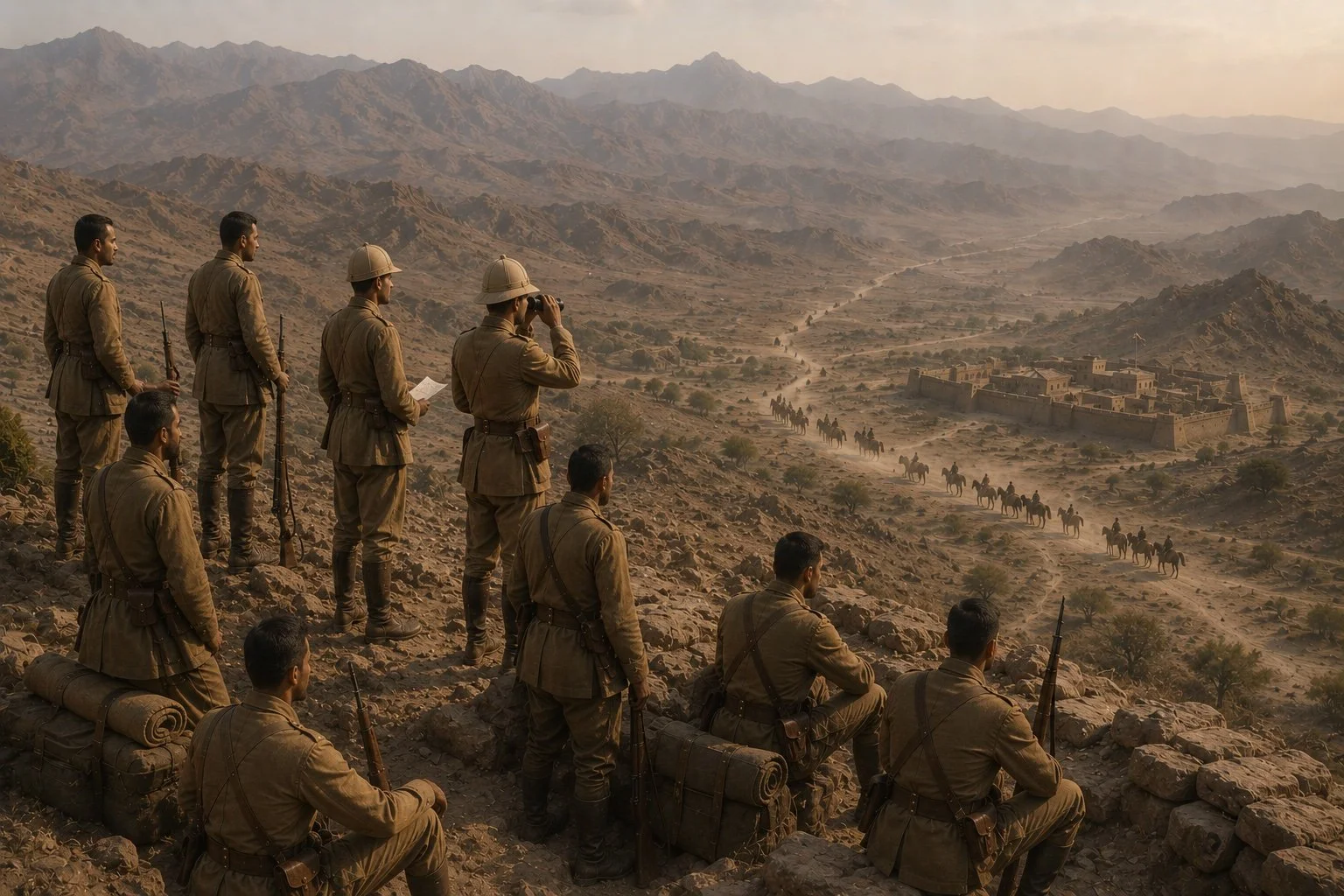
A depiction of British East India Company troops at the frontier.
To the frontier that stood between worlds, and the soldiers that guarded it.
With marvel - Trish Saab