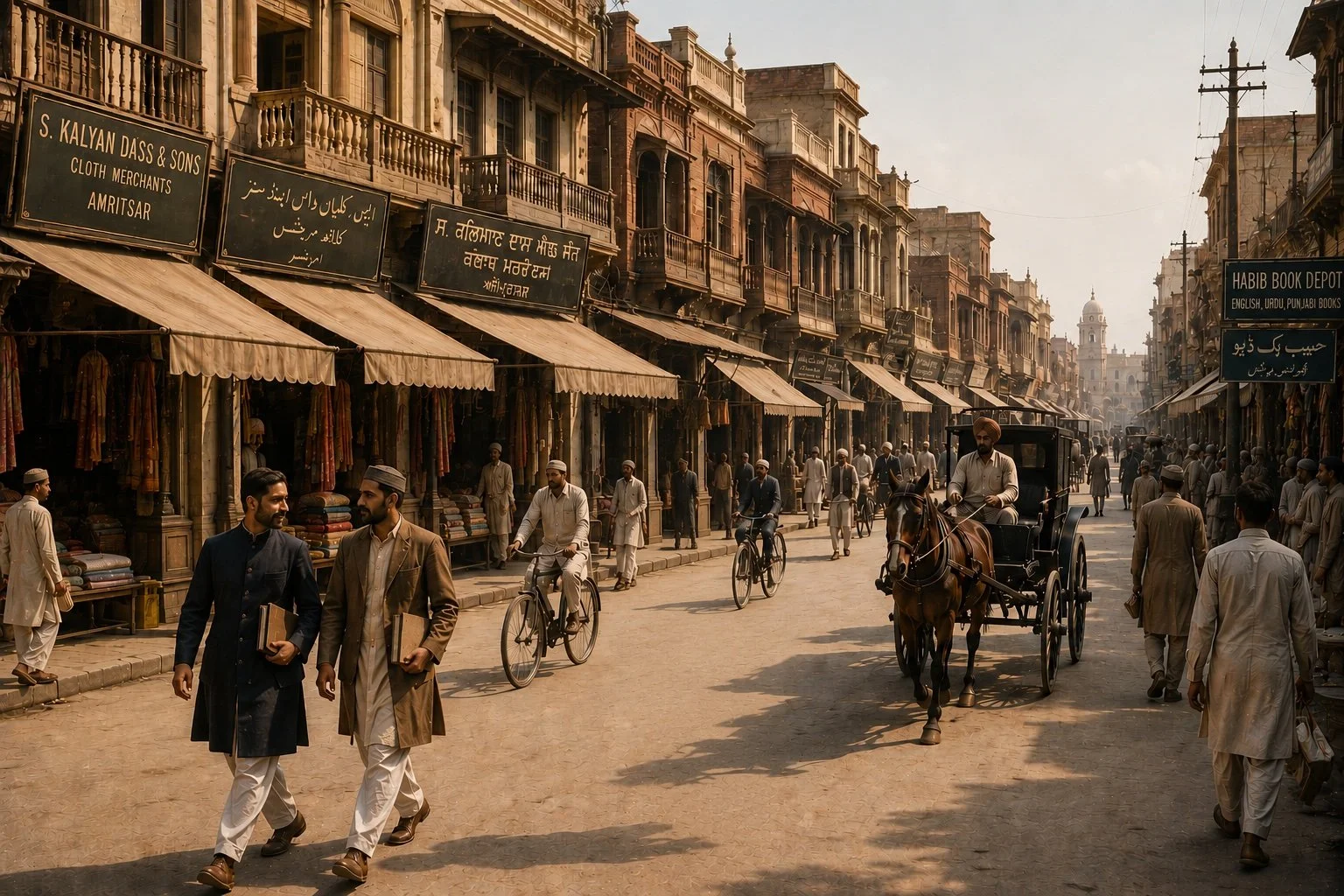
Part III - Society & Identity: The Urban Renaissance
Following annexation in 1849, the British East India Company inherited a province that had spent decades at the centre of conflict. Punjab had witnessed the rise and fall of empires, invasions, political conflict, and two Anglo-Sikh Wars in less than a decade.
The early years of colonial rule focused heavily on administration, security, agriculture, and infrastructure. Roads were built, railways expanded, canals transformed vast areas of farmland, and a new civil bureaucracy established across the province.
Throughout the late 1800s to early 1900s, urban centres expanded rapidly. New educational institutions, government offices, courts, markets, railways, and municipal services reshaped the province's major cities. While many of these cities had existed for centuries, they entered a new phase of development under the British Raj.
This period would transform Lahore into the intellectual capital of Punjab, strengthen Amritsar's role as a commercial and spiritual centre, and give rise to entirely new urban communities across the province.
THE GROWTH OF URBAN PUNJAB
Lahore had once served as a Mughal capital. Amritsar had long been one of the most important religious centres in the region. Multan had traded with distant lands for centuries, while Rawalpindi occupied a strategic position near the north-west frontier.
Colonial rule created the conditions for rapid urban growth.
Railways connected cities to agricultural districts. Expanding trade increased the movement of goods and people. Government offices attracted administrators and professionals, while schools and colleges drew students from across the province.
As agricultural production increased through irrigation projects and canal colonies, urban markets expanded alongside them. The wealth generated in Punjab's countryside increasingly flowed into its towns and cities.
By the beginning of the 1900s, Punjab was becoming more urban, more connected, and more economically integrated than ever before.
MUnicipal GOVERNMENT AND MODERN PLANNING
One of the less visible but most important changes introduced during colonial rule was municipal administration. Municipal committees were established across many towns and cities, taking responsibility for roads, sanitation, drainage, water supplies, street lighting, and other public services.
For the first time, many urban centres began receiving regular investment in civic infrastructure.
Roads were widened, public gardens were created, railway stations were constructed, and new government districts emerged alongside older sections of the city.
These developments were not always perfect, nor were they evenly distributed, but they helped lay the foundations of modern urban life in Punjab.
LAHORE: THE INTELLECTUAL CAPITAL OF PUNJAB
Already rich in history from the Mughal, Sikh, and earlier periods, Lahore became the administrative and intellectual heart of British Punjab. Government institutions, courts, educational establishments, and cultural organisations increasingly concentrated within the city. Students, scholars, writers, lawyers, journalists, and civil servants arrived from across the province.
A notable change related to this time was the growth of higher education.
Newly established educational colleges and universities helped create a new educated middle class that would play an increasingly important role in Punjab's social, cultural, and political life.
THE MALL ROAD
Developed during the colonial period, the Mall became the centre of British Lahore. Educational institutions, museums, government buildings, libraries, and public spaces lined the broad avenue. Among its most famous landmarks were the Lahore Museum, the Punjab Public Library, and numerous educational institutions that helped define the city's intellectual character.
Yet while the Mall represented the new Lahore, the historic Walled City remained very much alive.
Its bazaars, mosques, shrines, havelis, craftsmen, and traditional communities continued to thrive alongside the newer colonial districts. Rather than replacing the old city, colonial development created a second Lahore alongside it.
AMRITSAR: THE MERCANTILE AND SPIRITUAL HUB
While Lahore became Punjab's intellectual centre, Amritsar remained one of its most important commercial and spiritual cities. Its location, trading traditions, and growing railway connections helped transform the city into a major centre of commerce during the British Raj.
Merchants traded textiles, grain, shawls, handicrafts, and other goods throughout Punjab and beyond. Banking networks expanded, markets grew, and commercial activity increased significantly during the late nineteenth century.
By the early twentieth century, Amritsar had become one of the leading mercantile centres of northern India.
THE SPIRITUAL HEART OF SIKHISM
Amritsar also remained the spiritual centre for the Sikhs of Punjab.
The Harmandir Sahib - Golden Temple, continued to attract pilgrims from across Punjab and beyond. Religious institutions, charitable organisations, and educational networks centred around the city contributed significantly to Sikh religious life during the colonial period.
This unique combination of commerce and spirituality gave Amritsar a character unlike any other city in Punjab. It was simultaneously a marketplace, a pilgrimage destination, and a centre of community life.
THE RISE OF NEW CITIES
The urban renaissance was not limited to Lahore and Amritsar. Across the province other cities expanded alongside changing economic conditions.
Rawalpindi grew as an important military and administrative centre due to its strategic location near the frontier.
Multan strengthened its role as a commercial hub connecting Punjab to Sindh, Balochistan, and regions further west.
The most historically notable is the city of Lyallpur - Faisalabad. Founded during the canal colony era, Lyallpur represented one of the most ambitious urban planning projects undertaken in Punjab. Unlike ancient cities that had developed gradually over centuries, Lyallpur was carefully planned from the beginning. Its famous clock tower stood at the centre of eight major bazaars that radiated outward in a distinctive design. The city's growth was closely tied to the success of the surrounding canal colonies. As previously uncultivated land was transformed into productive farmland, Lyallpur emerged as a thriving commercial centre serving the region.
A NEW URBAN IDENTITY
By the early 1900s, Punjab's cities had become far more than administrative centres. They were places where students attended colleges, merchants expanded businesses, newspapers circulated new ideas, and communities interacted on a scale previously unimaginable.
Railways connected them. Municipal governments managed them. Educational institutions shaped them.
Ancient cities such as Lahore, Amritsar, and Multan adapted to a changing world, while newer centres such as Lyallpur emerged alongside them. The urban renaissance of the British Raj did not erase Punjab's older traditions.
Instead, it added new layers to them.
By the end of British rule, Punjab possessed a network of cities that would continue to influence the region's economy, culture, education, and identity long after the Raj itself had ended.