
Education & Modernity
Before the Raj
Before annexation, education in Punjab was largely organised through religious and local institutions like:
Maktabs attached to mosques and Madrasas for advanced Islamic learning
Sikh educational centres linked to gurdwaras
Pathshalas serving Hindu communities
Instruction varied between institutions, but often focused on religion, language, literature, general mathematics, law, and administration. Although most people received some form of education, access to it was shaped by various demographic factors that varied between communities and regions. The British administration in Punjab sought to create a more standardised system that could produce teachers, clerks, surveyors, and officials for the expanding colonial bureaucracy.
THE SPREAD OF ENGLISH EDUCATION
Following their administrative takeover, the colonial government gradually established a network of schools throughout Punjab.
Alongside the traditional subjects, students also studied:
English
Mathematics
Science
Geography
History
Administrative skills
As a result of this, English became the language of government employment and higher education. For many Punjabi families, education offered a path to stable employment and social advancement. Young men who would have otherwise taken traditional agrarian jobs began to enter careers within the colonial administration, legal professions, or jobs within the education sector.
By the late 1800s, English education had become one of the most significant pathways for social climb in Punjab.
Missionary Schools
Christian missionary organisations were significant in expanding educational opportunities across the Punjab province. Mission schools were established in major cities like Lahore, Amritsar, Ludhiana, Sialkot, and Rawalpindi. They introduced:
modern classrooms
printed textbooks
scientific subjects
English language
education for girls
Although these schools aimed to promote Christianity, many Punjabi families enrolled their children for the quality of education being offered. Resultantly, students from various religious backgrounds studied in the same institutions, and mission schools became some of the most influential educational centres in Punjab during the early years of the Raj.
LAHORE: THE EDUCATIONAL CAPITAL OF PUNJAB
Arguably, Lahore was the city that benefitted most from the education related developments. Being the capital of the former Sikh and Mughal empires, Lahore was seen as the intellectual and educational centre of Punjab. During the late 1800s, a number of prestigious institutions were established in the city, and students from across the province began travelling to study in Lahore.
The city had become a hub of learning, journalism, literature, scholarship, and politics.
THE UNIVERSITY OF THE PUNJAB
Founded immediately after 1882, the University of the Punjab became one of the earliest universities in South Asia, and the first university established in present day Pakistan. The university served students from across Punjab (and beyond), and it became on of the most important intellectual institutions in the region.
A new mIDDLE cLASS
Education created social changes that existed outside schools and universities, as literacy rates increased and professional opportunities expanded, a new urban middle class began to emerge. This groups included teachers, lawyers, doctors, journalists, civil servants, accountants, and business owners.
Unlike traditional elites, whose influence was built upon land ownership, the new middle class derived their status from education and professional achievement. They would become increasingly influential in shaping public opinion, reform movements, literature, and politics.
Women’s education
One of the most significant social changes of this period was the gradual expansion of educational opportunities for women. Traditionally formal education for girls was limited, however missionary schools, reform organisations, and educational societies increased female access to education. Progress was often slow, and faced resistance from conservative sections of society, but by the early 1900s, growing numbers of Punjabi women had access to formal schooling.
Educational opportunities remained unequal, however, the foundations had been laid for future generation of women to participate more fully in public, professional, and intellectual society.
The printing Presses and New ideas
As education expanded, so did the circulation of new ideas. Newspapers, journals, magazines, and publishing houses found a new audience in Punjab. For the first time large groups of people could engage with politics, scientific discoveries, religious debates, social reform, and world events.
The spread of print culture helped create a more informed and interconnected society, and the ideas that were once confined to educated elites now travelled through the province.
Education and Religious Reform
Modern education also influenced the religious reform movements of the late 1800s. Independent religious organisations established their own schools, collages, and publications. They often sought to strengthen religious identity while adapting to a rapidly changing world around them.
Education became one of the primary ways communities preserved traditions, promoted reforms, and prepared future generations for modern life.
A new Punjab
By the beginning of the 1900s, Punjab had been greatly transformed. Canals reshaped the countryside, railways connected cities, and standardised education had created a new social class.
The educational system established during the British Raj helped create a new generation that would influence major aspects of Punjabi society - the thinkers, reformers, and political leaders who would help shape Punjab’s future.
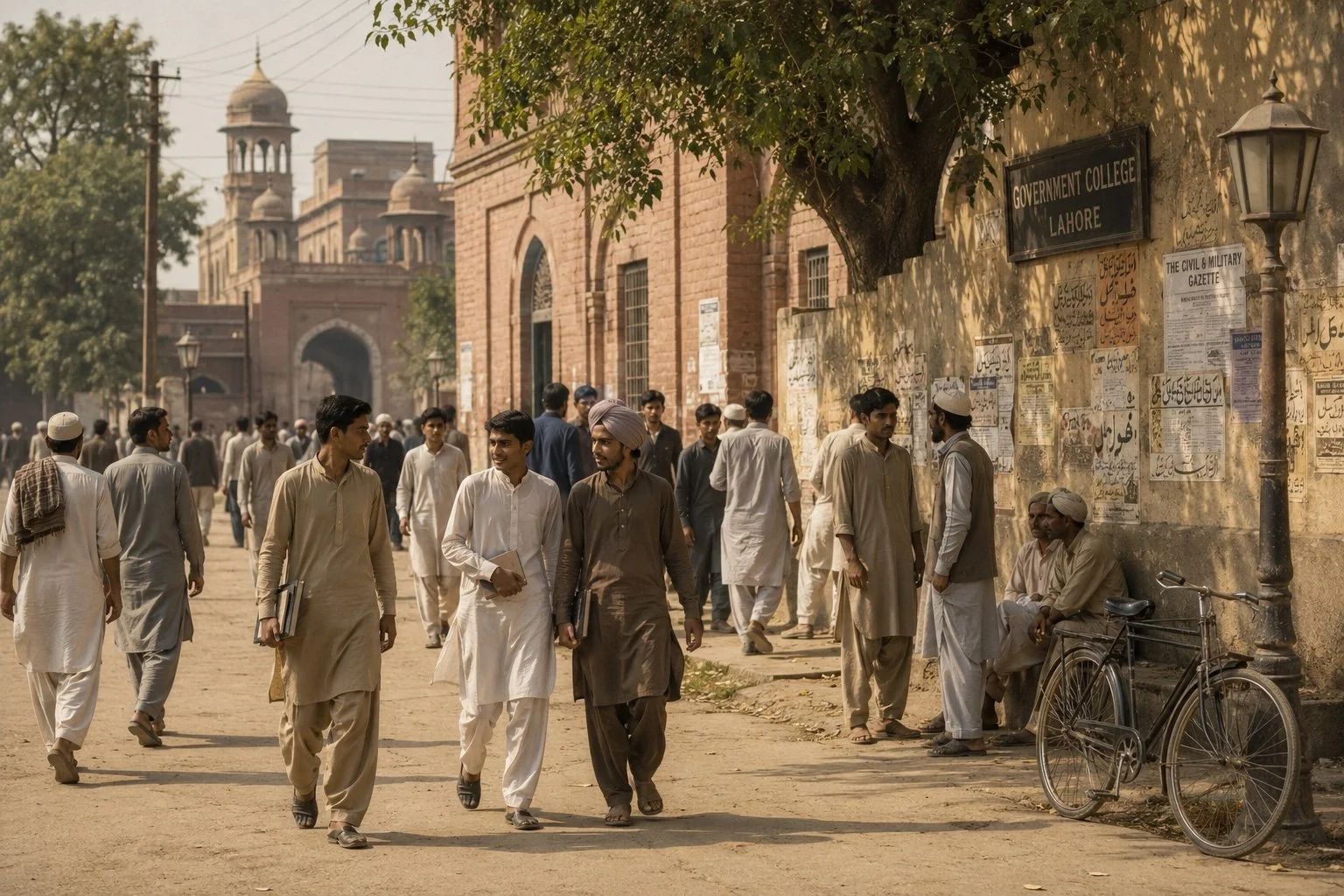
A depiction of students outside a government college
To those who believed knowledge could shape the future,
With admiration, TrishSaab