
The Canal Colonies
By the late 1800s, the British Raj began changing the administrative systems of Punjab through an immense irrigation project. Vast areas of dry scrubland called the bar, covered much of western Punjab. These regions supported scattered settlements and seasonal cultivation, but large areas were sparsely populated, especially compared to central Punjab.
The Punjab province was both strategically important and agriculturally valuable, its rivers offered enormous irrigation potential, particularly in the western region where rainfall was limited but large stretches of land were available for cultivation.
Over the following decades, the Raj constructed an expanding network of canals across Punjab. Water from the Indus River system was redirected into previously dry regions through canals, distributaries, and irrigation channels.
This transformation reshaped Punjab permanently.
New agricultural districts emerged, and populations migrated into newly irrigated lands. Planned villages appeared, and agricultural production expanded rapidly.
The canal colonies became one of the defining features of colonial Punjab.
Turning wasteland into wealth
To the colonial administration, the canal colonies represented the transformation of wasteland into productive territory. Colonial administrators believed irrigation could dramatically increase agricultural production, land revenue, and economic output throughout Punjab. Large scale canal construction therefore became central to colonial policy within the province.
The expansion of irrigation amplified the area of agricultural land capable of supporting wheat, cotton, sugarcane, and other major crops.
Railway expansion further strengthened the system by connecting canal colony districts to markets and export routes across British India.
By the early 1900s, Punjab had become one of the most heavily irrigated agricultural regions in the world.
The canal colonies represented the large-scale remaking of Punjab’s landscape under colonial rule.
Why the colonies were created
Canal colonies were not established entirely for development, they also had broader political and economic purposes within the British Raj. The colonies helped:
increase land revenue
expand food production
support agricultural exports
strengthen frontier stability
settle loyal rural populations
reward military service
reinforce colonial authority in Punjab
Punjab was increasingly viewed Punjab as a model province for the Raj in India. Irrigation projects became central to this vision.
Land grants were often distributed to communities categorised by the colonial state as agricultural tribes or martial races - groups believed to be suited for farming, military recruitment, and rural settlement.
The canal colonies were therefore agricultural projects, and also instruments of colonial organisation and control.
The Major Canal Colonies
SIDHNAI COLONY
The project expanded cultivation into previously dry regions and demonstrated the economic potential of perennial canal irrigation throughout Punjab.
Agricultural production increased significantly following settlement, particularly in wheat cultivation and cash crops.
Although smaller than later colonies, Sidhnai helped establish the foundations for the much larger irrigation projects that followed across western Punjab.
The Sidhnai Colony was among the earlier canal colony developments in Punjab.
Located within the Bari Doab - between the Ravi and Sutlej Rivers, the colony developed through irrigation systems connected to the Sidhnai Canal during the late 1800s.
The project expanded cultivation into previously dry regions and showed the economic potential of continuous canal irrigation throughout Punjab.
Agricultural production increased significantly - particularly in wheat cultivation and cash crops.
Despite being smaller than later developments, Sidhnai established the foundations for the much larger irrigation projects that followed across western Punjab.
Chenab Colony
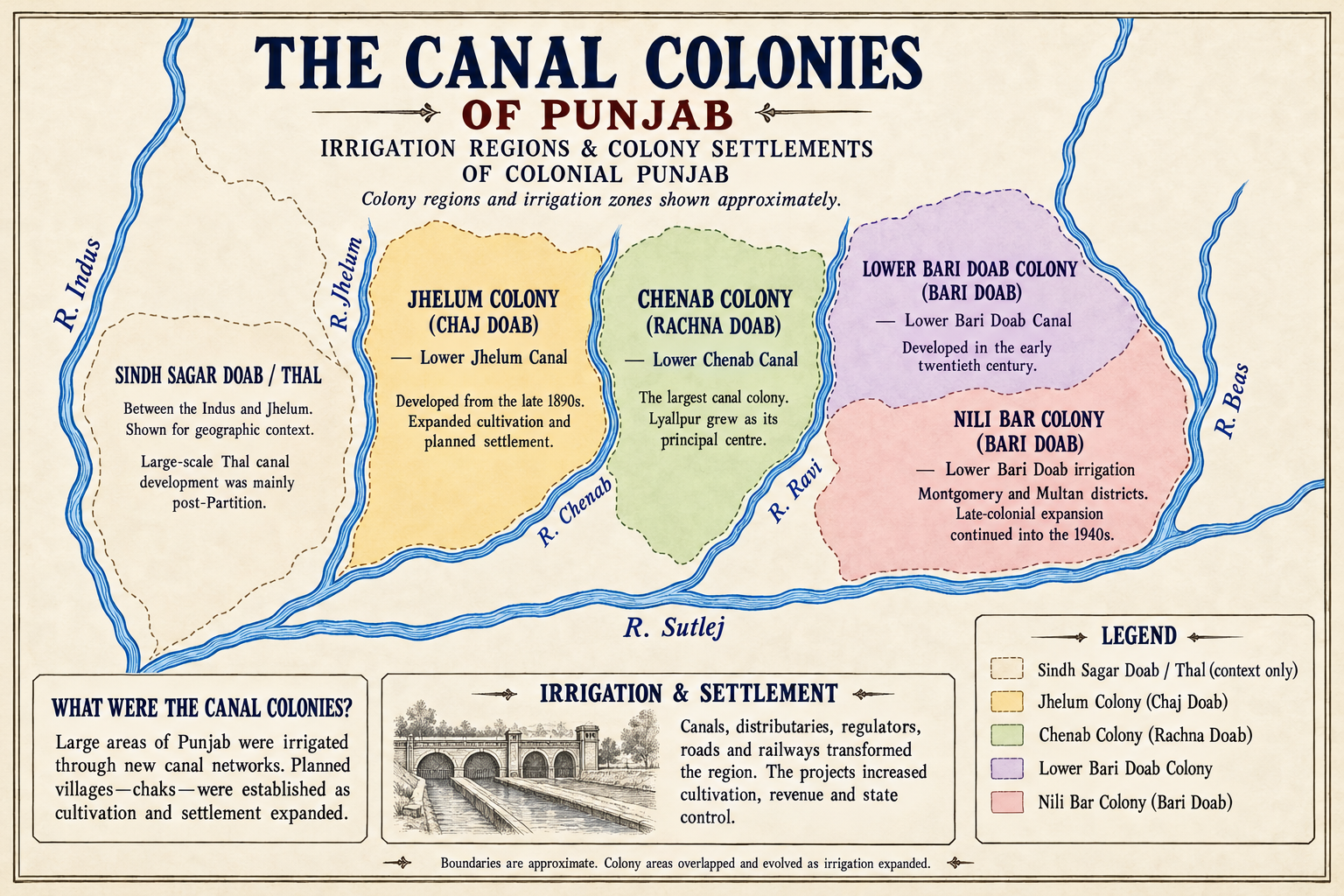
The Chenab Colony became the largest and most significant canal colony in colonial Punjab. Lit was located in the Rachna Doab between the Ravi and Chenab rivers, the colony emerged following the construction of the Lower Chenab Canal during the late 1800s.
Large numbers of settlers migrated into the region from central and eastern Punjab through colonial settlement schemes. Entire villages were established through carefully planned agricultural layouts. These villages were commonly known as chaks, and became one of the defining features of the canal colonies. Roads, irrigation channels, and settlement patterns were systematically organised by colonial authorities rather than developing gradually over centuries.
The colony rapidly developed into one of the most productive agricultural regions in Punjab, particularly in wheat and cotton production.
The colonial administration viewed the Rachna Doab as strategically important. Stable agricultural settlements populated by communities considered loyal to the colonial state were believed to strengthen political control across western Punjab. The development of the Chenab Colony contributed directly to the establishment of Lyallpur - Faisalabad city, which became one of the highest contributing agricultural cities in Punjab.
JHELUM COLONY
The Jhelum Colony developed within the Chaj Doab between the Jhelum and Chenab rivers.
Irrigation projects connected to the Lower Jhelum Canal expanded cultivation into areas previously associated with grazing land and sparse settlement. Many settlers were recruited from agricultural communities in central Punjab, including groups strongly connected to military recruitment within the British Indian Army.
Wheat cultivation expanded rapidly throughout the colony, helping strengthen Punjab’s role as a major agricultural supplier within British India. The colony also reinforced British influence across strategically important regions of northern Punjab.
LOWER BARI DOAB COLONY
The Lower Bari Doab Colony developed between the Ravi and Sutlej rivers through irrigation systems linked to the Lower Bari Doab Canal.
The project increased cultivation across central Punjab and supported expanding agricultural production near major urban centres including Lahore. Settlement schemes brought new agricultural communities into irrigated regions, while canal networks strengthened connections between rural production and railway transport systems.
The colony contributed significantly to the commercialisation of agriculture under colonial rule.
LOWER CHENAB DEVELOPMENTS
The expansion of irrigation within the Chenab region continued beyond the original colony settlements.
Additional canal branches and distributaries increased cultivation across western Punjab and encouraged further migration into newly irrigated areas. The wider Lower Chenab developments became closely associated with large-scale wheat cultivation, cotton production, and the continued growth of planned agricultural settlements. The region emerged as one of the economic centres of colonial Punjab and remained closely tied to railway expansion, agricultural exports, and imperial revenue systems.
The nearby Montgomery - Sahiwal region also experienced significant agricultural transformation during this period, particularly as previously forested and grazing areas were gradually incorporated into irrigated cultivation networks.
NILI BAR COLONY
The Nili Bar Colony represented a later phase of canal colonisation in western Punjab.
Located across the Ravi–Sutlej region, particularly around parts of present-day Sahiwal, Pakpattan, Okara and Vehari, the Nili Bar had historically consisted of grazing land, scrub, scattered woodland and semi-arid plains.
Irrigation projects gradually transformed these lands into settled agricultural districts connected to expanding canal and railway networks.
The development of the Nili Bar reflected the continuing reach of colonial irrigation engineering across Punjab, as older pastoral landscapes were divided into farmland and permanent settlements.
ENGINEERING THE COLONIES
The canal colonies relied upon one of the largest irrigation engineering systems in the world.
British engineers constructed an interconnected network of canals, distributaries, bridges, and regulators across Punjab’s river system. Water from the Jhelum, Chenab, Ravi, Sutlej, and Indus rivers was redirected across enormous distances into previously dry regions.
One of the most significant engineering achievements was the Triple Canal Project, which linked sections of the Jhelum, Chenab, and Ravi river systems together. The project allowed water to be transferred across different regions of Punjab and greatly expanded the reach of canal irrigation throughout the province.
Roads, railways, and planned villages increasingly developed around canal infrastructure, reshaping western Punjab into a carefully organised agricultural landscape.
MIGRATION INTO THE COLONIES
The canal colonies triggered major population movements across Punjab.
Large numbers of Punjabis from central and eastern districts migrated westward into newly irrigated lands through colonial settlement schemes. Entire villages and communities were relocated into planned agricultural settlements. Many of these villages were systematically organised and numbered by colonial authorities.
The migration reshaped the demographic geography of Punjab.
New agricultural frontiers emerged across western districts, while patterns of land ownership, settlement, and rural identity expanded into regions that had previously remained sparsely populated.
LAND, LOYALTY AND POWER
The canal colonies became closely tied to colonial ideas about loyalty, land ownership, and military service.
Land grants were frequently distributed to communities considered loyal to the Colonial administration, particularly groups associated with agricultural productivity and recruitment into the British Indian Army. The British believed that stable landholding communities would strengthen rural order and reinforce loyalty to colonial rule.
At the same time, control over irrigation allowed the state to exercise significant authority over agricultural life. Water distribution, taxation, and land access became increasingly tied to government administration.
The canal colonies therefore reflected both agricultural expansion and the growing reach of colonial power across Punjab.
THE DARKER SIDE
Despite their economic success, the canal colonies also produced tensions and inequalities.
Access to land was uneven, and many settlement schemes favoured specific communities and social groups over others. Policies often reinforced existing hierarchies within rural Punjab.
Control over irrigation also created dependency upon the colonial state. Water access, land regulations, and agricultural production became increasingly shaped by administrative authority.
The environmental transformation of western Punjab altered older grazing patterns and traditional land use. Tensions surrounding land and irrigation policies contributed to growing unrest during the early 1900s, particularly during the Punjab disturbances of 1907.
The agitation emerged partly in response to proposed canal colony legislation and broader fears regarding state control over agricultural land.
The protests revealed that the canal colonies were not simply development projects, but deeply political spaces within colonial Punjab.
LATER WESTERN EXPANSION
By the early 1900s, canal projects continued expanding further into western Punjab.
Irrigation development gradually reached additional semi-arid regions, including parts of the Thal and wider Sindh Sagar Doab areas. Although some of these projects accelerated during the later colonial and post-partition periods, they reflected the continuing expansion of irrigation-based settlement first established under the British Raj.
The reach of the canal system continued transforming regions that had historically remained sparsely populated, pastoral, or dependent upon seasonal cultivation. This expansion reinforced Punjab’s growing importance as an agricultural centre within the wider economy of British India.
THE LEGACY OF THE CANAL COLONIES
The canal colonies permanently reshaped Punjab.
Regions that had once been sparsely populated became some of the most productive agricultural districts in South Asia. New towns and cities emerged across western Punjab, while irrigation networks transformed patterns of cultivation and settlement throughout the province.
The legacy of the colonies remains in:
the agricultural heartlands of Pakistani Punjab
the planned settlement patterns of canal districts
irrigation-dependent farming systems
the growth of cities such as Faisalabad
the continuing importance of Punjab’s river networks
More than engineering projects, the canal colonies represented the large-scale remaking of Punjab’s landscape under colonial rule.
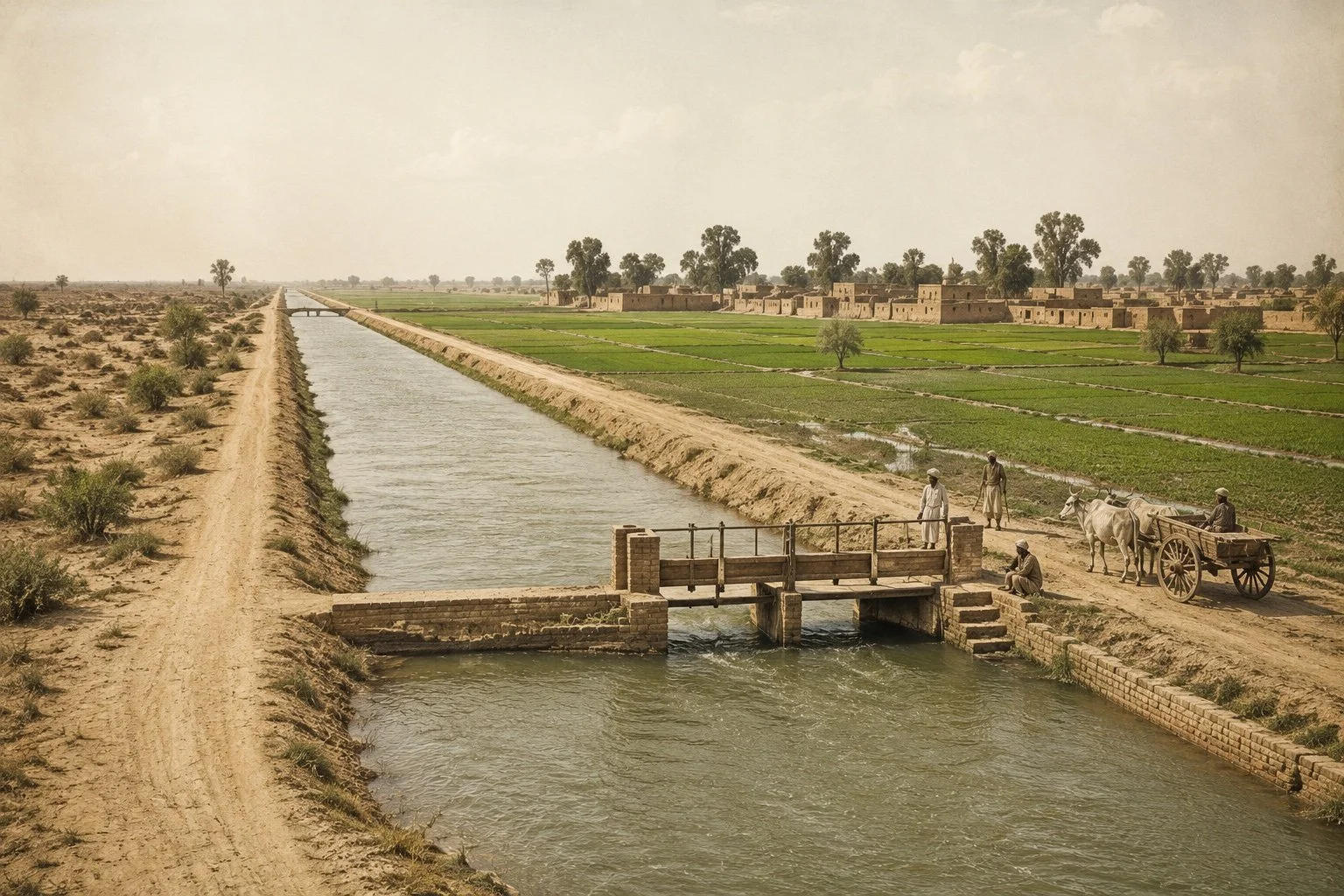
A depiction of a newly established chak - village.
To the waters that shaped, and reshaped Punjab.
With great respect - TrishSaab. 