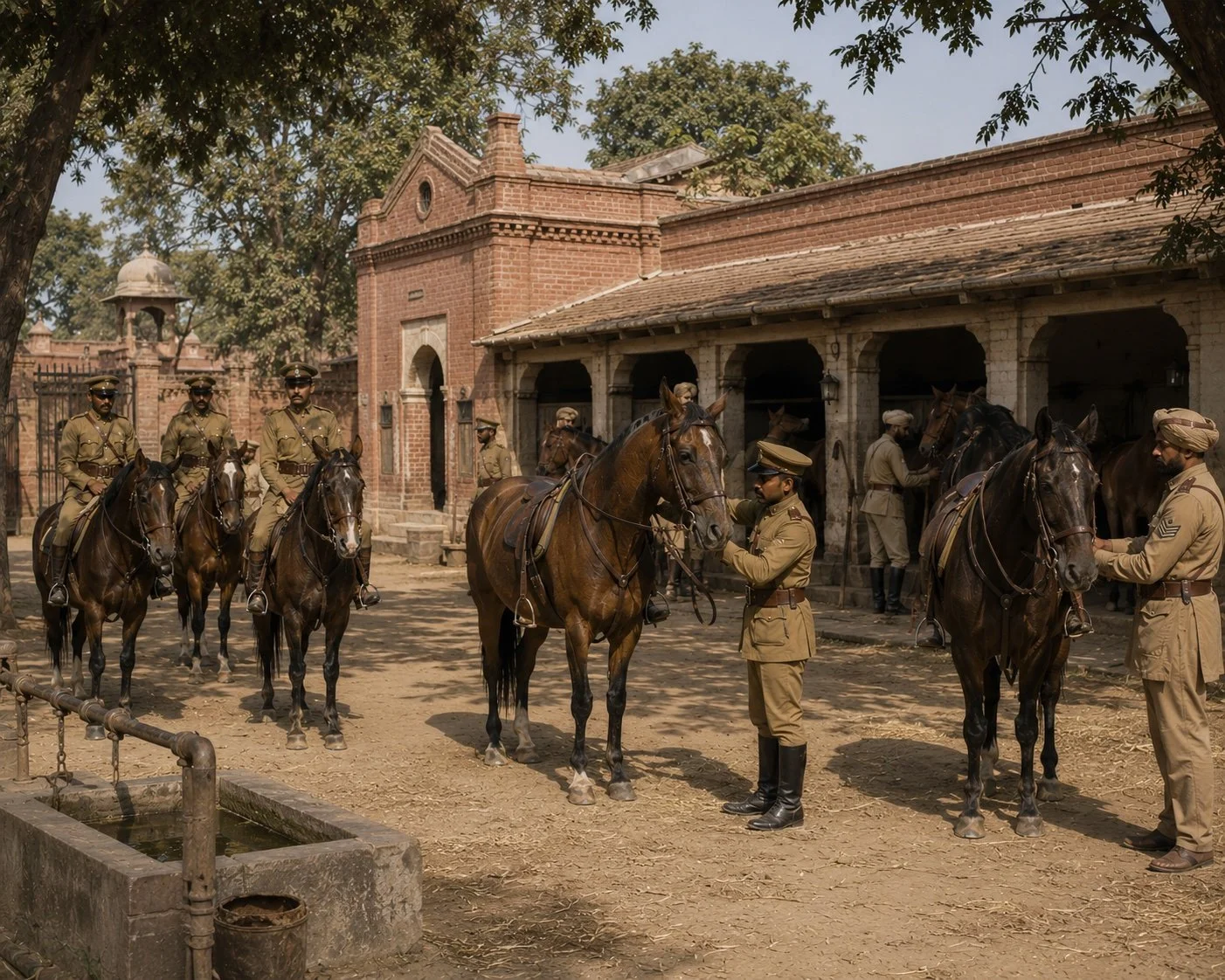
Law & Order - Policing The Province
When Punjab was annexed by the British East India Company in 1849, the new administration inherited a vast and diverse province stretching from the central doabs to the frontier regions bordering Afghanistan.
For the colonial government, maintaining order was not just a matter of preventing crime. Punjab occupied a strategically important position within the British Empire, serving as a military recruiting ground, an agricultural powerhouse, and a buffer against perceived threats from the northwest.
As a result, the colonial government invested heavily in creating one of the most extensive systems of policing, administration, and surveillance in British India. Through police forces, intelligence networks, census records, and legal classifications, the colonial state sought to monitor and manage many aspects of life within the province.
Building a Colonial Police Force
The annexation of Punjab marked the beginning of a new approach to law enforcement. Traditional systems of local authority were gradually supplemented by a centralised police structure designed to operate under colonial administration.
Following the Police Act of 1861, introduced in the aftermath of the 1857 Rebellion, policing became increasingly standardised across British India. Police stations were established throughout Punjab, creating a permanent government presence in both urban and rural areas. Districts were overseen by British officers, while much of the day-to-day policing was carried out by locally recruited Punjabis.
The police held multiple responsibilities. They enforced government regulations, monitored political activity, gathered intelligence, tracked population movements, and reported on local conditions to district authorities. By the late 1800s, Punjab possessed one of the most organised policing networks in the subcontinent.
Governing Through Villages
Despite the growth of formal police institutions, the colonial administration still relied heavily upon local intermediaries to govern rural Punjab.
Village headmen - lambardars and regional officials - zaildars became important links between local communities and the colonial state. They assisted with tax collection, reported disturbances, identified suspects, and supplied information to district authorities.
This system allowed the government to extend its influence deep into rural communities without maintaining a large police presence in every village. Through a combination of local cooperation and colonial oversight, the state could monitor vast rural populations with relatively limited resources.
The Rise of the Information State
One of the most significant changes under British rule was the expansion of record-keeping and surveillance. The colonial administration believed that effective government depended upon information - census operations, land settlements, property registers, police reports, and intelligence files produced an unprecedented volume of data about Punjab's population.
The Punjabi society had previously interacted primarily with local authorities, but was now documented by a more distant administration. Names, occupations, landholdings, religions, castes, and places of residence were recorded and classified in official records. Punjab gradually became one of the most closely documented provinces in British India. The state's ability to collect information expanded alongside its ability to govern.
The Criminal Tribes Act
A highly controversial aspect of colonial policing was the Criminal Tribes Act 1871. The legislation was based on the belief that criminal behaviour could be inherited through birth.
Under the Act, certain communities could be officially designated as criminal tribes and subjected to extensive government surveillance regardless of whether individual members had committed any offence.
The flagged tribes were often required to register with authorities, report regularly to police, and obtain permission to travel. Entire communities became subject to suspicion simply because of their classification within colonial records.
The policy reflected broader colonial assumptions about race, caste, occupation, and social identity. Although the Act was eventually repealed after independence, many communities continued to experience the social consequences of these classifications for decades.
Intelligence and Political Surveillance
As political awareness and anti-colonial movements expanded particularly during the early 1900s, the role of policing evolved further. Officials increasingly monitored newspapers, student organisations, religious gatherings, political meetings, and emerging nationalist movements. Intelligence reports became a routine part of administration.
The creation of the Criminal Investigation Department (CID) consolidated the state's ability to gather information on individuals and organisations considered politically significant. Surveillance was no longer focused solely on crime; it was also directed toward preserving the state’s authority. Punjab received particular attention because of its military importance and its history of political activism. Revolutionary organisations, nationalist groups, and later movements attracted significant scrutiny from the administration.
The Frontier and Security
Punjab's position on the northwestern edge of British India gave policing an additional strategic dimension.
The frontier regions were viewed as areas requiring special attention due to their proximity to Afghanistan and Central Asia. Concerns about tribal conflict, cross-border movement, and imperial security led to the development of specialised frontier policing arrangements and intelligence networks.
For the colonial government, maintaining order in Punjab was closely linked to protecting the rest of the British Empire.
Legacy
The policing systems established during the British Raj left a lasting mark on Punjab. Modern police organisations, district administration, and many bureaucratic practices have their origins in institutions developed during the colonial period.
At the same time, the history of colonial policing reveals how law enforcement was often intertwined with surveillance, classification, and political control. The administration presented these systems as tools of order and stability, yet they also expanded the state's ability to monitor and regulate everyday life.
By the early twentieth century, Punjab had become one of the most closely observed provinces in British India - a place where governance increasingly depended not only on authority, but on information.