
Language & Literature Under the Raj
The British annexation of Punjab in 1849 also reshaped the way Punjabis communicated, recorded ideas, and understood their own identities.
New schools produced a growing educated population. Printing presses became increasingly common. Newspapers circulated information between cities and towns. Books, poetry, religious writings, and political commentary reached new audiences.
By the early 1900s, Punjab had become one of the most active literary and intellectual regions of British India. Urdu, Punjabi, English, and to a lesser extent Persian all continued to influence the province's cultural landscape, creating new forms of public discussion and literary expression.
THE AGE OF PRINT
Before the widespread introduction of printing presses, much of Punjab's literature circulated through handwritten manuscripts, religious institutions, oral traditions, and storytellers.
Under colonial administration, printing technology expanded rapidly throughout the province and presses appeared in urban centres. Newspapers, journals, pamphlets, textbooks, and religious literature could now be produced on a much larger scale than ever before.
For the first time, ideas could be distributed quickly across Punjab, helping create a shared intellectual culture that connected people across great distances. Print culture became one of the most important vehicles through which Punjabis debated religion, education, language, politics, and social reform.
THE LANGUAGE OF THE PEOPLE AND THE LANGUAGE OF GOVERNMENT
One of the most significant linguistic developments of the colonial period was the growing separation between the language spoken by most Punjabis and the language used by the state.
Punjabi remained the everyday language of the overwhelming majority of the province's population. It was spoken in villages, towns, marketplaces, and homes across Punjab regardless of religion. Government administration, however, increasingly operated in Urdu. This distinction would become one of the defining characteristics of language and literature in colonial Punjab.
URDU, HINDI, AND HINDUSTANI
In the past, the distinction between Urdu and Hindi was less apparent than it is today. Both languages developed from a common linguistic foundation known as Hindustani, a language that emerged across northern India through centuries of interaction between local dialects and Persian-speaking elites.
In everyday conversation, speakers of Urdu and Hindi could generally understand one another with little difficulty. The primary differences lay in script, literary traditions, and vocabulary.
Urdu was typically written in the Perso-Arabic script and incorporated greater Persian and Arabic influence, while Hindi was written in the Devanagari script and increasingly drew upon Sanskrit vocabulary.
During the British period, Urdu became the principal administrative language of Punjab, whereas Hindi was more prominent in parts of northern and central India. The modern distinction between Urdu and Hindi became increasingly defined during the late 1800s as language became more closely connected to questions of identity, and politics.
WHY URDU BECAME THE OFFICIAL LANGUAGE
Upon annexation in 1849, Persian had long served as the language of administration under successive governments, including the Mughal Empire and the Sikh Empire.
The colonial administration gradually removed Persian from official use throughout much of northern India. Rather than replacing it with Punjabi, they adopted Urdu as the principal language of administration, education, and the courts.
Several factors influenced this decision.
Urdu already possessed a well-developed literary tradition, a growing print industry, and an established network of teachers, clerks, and officials throughout North India. It was essentially a ready-made administrative language that could be integrated into the expanding colonial bureaucracy.
Punjabi, despite being the language spoken by most people, existed primarily as a spoken language. Literary traditions certainly flourished through figures such as Waris Shah, Bulleh Shah, Shah Hussain, Sultan Bahu, and Baba Farid, but there was no single standard written form used across the province. Punjabi was written in multiple scripts depending on community and region. Muslims generally used Shahmukhi, Sikhs used Gurmukhi, and some Hindu communities used Devanagari. For administrators seeking uniformity, Urdu appeared to provide a simpler solution.
As a result, Urdu became the dominant language of government offices, courts, schools, and much of the press, while Punjabi remained the language of daily life.
THE DECLINE OF PERSIAN
For centuries, Persian had been the language of government, diplomacy, scholarship, and elite culture throughout much of the subcontinent. Historically, knowledge of Persian provided access to administration, education, and social prestige. Many members of Punjab's educated classes studied Persian literature, poetry, and history.
The British, however, increasingly viewed Persian as impractical for a modern colonial bureaucracy. During the nineteenth century it was progressively removed from official administration and replaced by Urdu and, increasingly, English.
Despite losing its official status, the Persian influence did not disappear and large portions of Urdu vocabulary continued to derive from it. Classical Persian poetry remained widely studied, and many literary traditions throughout Punjab continued to draw inspiration from Persian works long after the language had vanished from government offices.
THE RISE OF URDU PRINT CULTURE
The adoption of Urdu by the colonial administration helped transform it into one of Punjab's most important literary and publishing languages.
Lahore emerged as a major centre of Urdu journalism, literature, and intellectual life. Newspapers, literary journals, educational publications, and publishing houses flourished throughout the late nineteenth and early twentieth centuries. Urdu became the language through which many Punjabis engaged with public debate, political discussion, and modern education.
By the early twentieth century, Lahore had established itself as one of the leading centres of Urdu publishing in South Asia.
ENGLISH EDUCATION AND A NEW INTELLECTUAL CLASS
The spread of English education created another major literary transformation.
Institutions across Punjab produced graduates who engaged with both local and global intellectual traditions. English provided access to European science, law, economics, history, and political thought. A new Punjabi middle class emerged consisting of teachers, lawyers, civil servants, journalists, academics, and reformers. Many became influential writers and public intellectuals.
Rather than replacing local languages, English often existed alongside them. Many educated Punjabis moved comfortably between English, Urdu, Punjabi, and Persian traditions. This multilingual environment became one of the defining characteristics of intellectual life in colonial Punjab.
THE EVOLUTION OF PUNJABI LITERATURE
Although Urdu dominated administration and much of formal publishing, Punjabi continued to evolve as a literary language. The colonial period witnessed growing efforts to preserve, publish, and expand Punjabi literary traditions.
Publishers increasingly printed Punjabi poetry, folklore, religious works, historical writings, and educational texts. Earlier literary figures remained widely read and continued to influence new generations of writers. At the same time, modern Punjabi prose began to emerge through newspapers, journals, essays, and historical works that addressed contemporary issues.
Arguably for the first time, Punjabi increasingly became a language not only of oral tradition and poetry, but also of organised modern publication.
NEWSPAPERS AND PUBLIC DEBATE
The growth of newspapers transformed Punjab's intellectual landscape, because publications in Urdu, Punjabi, and English connected readers to developments occurring throughout Punjab, British India, and the wider world. Newspapers reported political events, discussed educational reforms, promoted social movements, and provided platforms for public debate. They also helped spread new ideas regarding community, identity, language, and political representation. For many Punjabis, newspapers became their first regular connection to a rapidly changing modern world.
RELIGIOUS AND INTELLECTUAL MOVEMENTS
The literary growth of Punjab was closely connected to the religious and social reform movements of the nineteenth and early twentieth centuries. Organisations associated with Sikh, Muslim, Hindu, and Christian communities increasingly relied upon printed literature to spread their ideas.
Pamphlets, newspapers, books, translations, and educational materials became powerful tools for reaching wider audiences. This encouraged higher literacy, greater public discussion, and a vibrant intellectual culture that extended far beyond traditional centres of learning.
LEGACY
The literary transformations of the British Raj left a lasting impact on Punjab. Modern journalism, publishing, universities, literary societies, and public debate all expanded significantly during this period. Urdu became the principal language of administration and much of the press. English connected Punjabis to global intellectual currents. Punjabi itself evolved from primarily oral and poetic traditions into a modern literary language with an expanding body of published work.
By the time British rule ended in 1947, Punjab had a vibrant and multilingual literary culture that would continue to influence both East and West Punjab long after Partition.
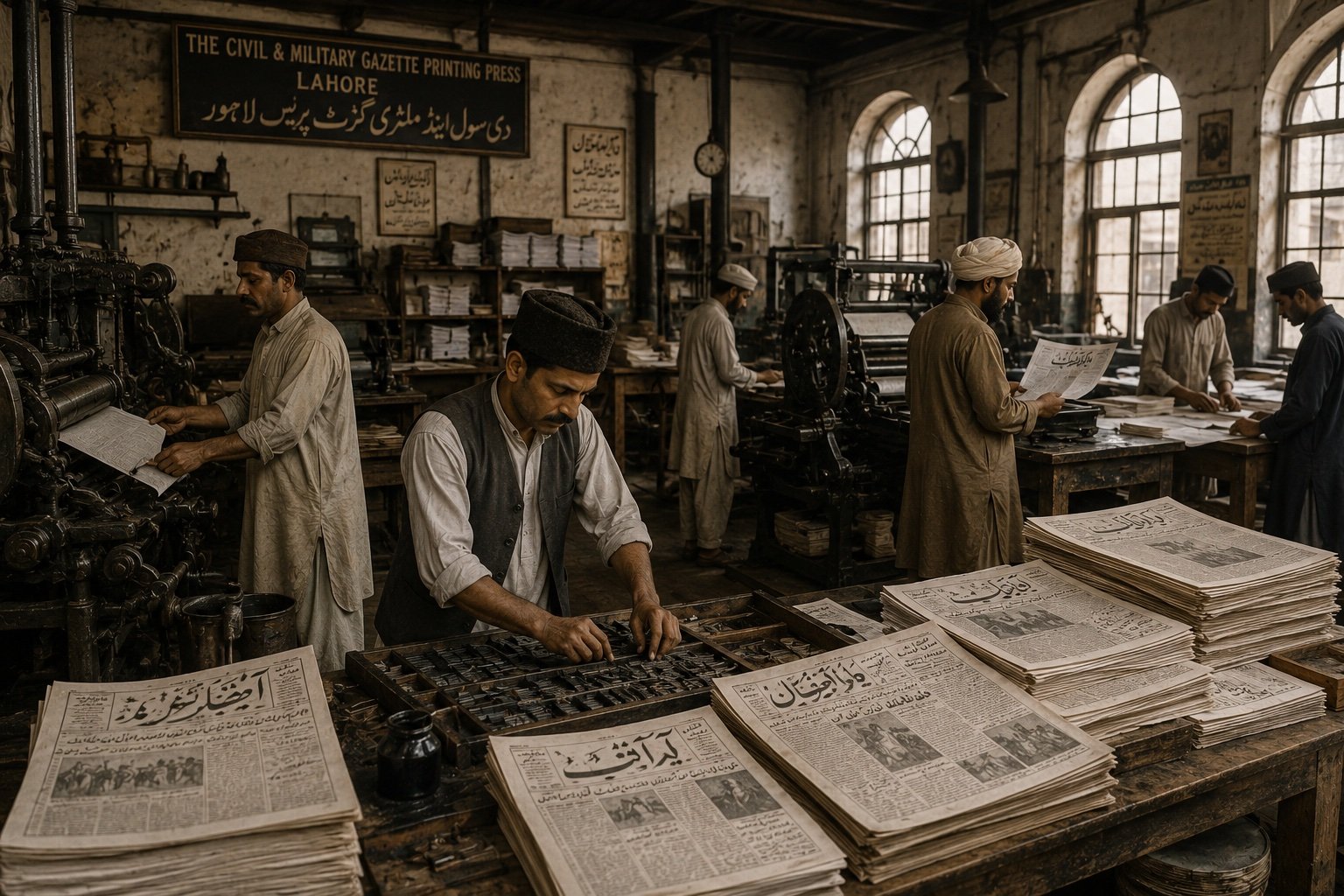
A depiction of a printing press
To the words that carried Punjab across generations,
With Great Respect, TrishSaab