The British Takeover - Administration of the Punjab Province
The British Takeover:
The annexation of Punjab in 1849 marked the beginning of new political order in the region. For the British East India Company, Punjab was strategically vital - positioned along the northwestern frontier, bordering Afghanistan, Central Asia, and the routes that had historically carried invasions into the subcontinent. The province was fertile, militarily significant, and deeply shaped by the recent Sikh Empire.
The British East India Company understood that Punjab had to be reorganised, stabilised, and integrated into the wider structure of Company rule. Over the following decades, Punjab would become one of the most heavily administered provinces of the British Raj.
The Board of Administration:
Follow annexation, the British East India Company established the Board of Administration in 849 to govern the Punjab province. Instead of a single governor, a group pf senior officials were tasked with rebuilding administration across the region. The board was led by Sir Henry Lawrence, alongside his brother John Lawrence, and Charles Mansel.
Henry Lawrence generally believed Punjab should be governed through cooperation and alliance with Punjabi aristocracy, and assumed that elements of the old order could exist within newer administration. John Lawrence, however, adopted a more disciplined and centralised bureaucracy directly controlled by Company officials.
The Governor General, James Andrew Broun-Ramsau, the Marquess of Dalhousie (commonly known as Lord Dalhousie), strongly supported the expansion of Company rule across India.
Rebuilding Administration:
Under British East India Company rule, Punjab was reorganised into districts controlled by commissioners and deputy commissioners. This created a new administrative hierarchy that connected Lahore to smaller towns, villages, police stations, and revenue offices. The new administrative system expanded record keeping, taxation systems, policing, and judicial administration at a scale Punjab had not seen under a single centralised bureaucracy.
At the same time, the Company did not completely erase older systems inherited from the Sikh Empire and Mughal administration. Many positions such as patwari, qanungo, chaudhry, and village headmen remained important in rural administration because the Company acknowledged that governing Punjab without relying on existing structures and local knowledge would be met with resistance.
This created a system that was both new and familiar, the British East India Company held ultimate control, but was built upon older Punjabi administrative foundations.
The Civil Bureaucracy:
One of the defining features of colonial rule in Punjab was the growth of civil bureaucracy. Company officials often viewed administration as a means of maintaining control within the province. As a result, governance became centred upon reports, surveys, census records, land settlements, and legal codes.
Deputy commissioners became some of the most powerful figures in colonial punjab, where one official could oversee taxation, policing, judicial matters, canal administration, and local governance within an entire district.
Compared to earlier administrative systems, the new administration was more documented, procedural, and centralised. This allowed the colonial state to expand its authority deeply into everyday life across Punjab.
Creating a Model Province:
By the mid 1800s, Punjab had become a model province for colonial rule in India - it was used as a testing ground for colonial administration. Infrastructure expanded rapidly; through roads, canals, postal networks, and military infrastructure. To colonial officials, Punjab represented efficiency, order, discipline, and stability after years of warefare and political instability after Maharaja Ranjit Singh’s death.
Despite this, the notion of a model province also reflected the British East India Company’s priorities. The administration was designed to secure revenue, improve military recruitment, maintain order, protect trade routes, and integrate Punjab into British India.
For the Punjabi population, this period marked the beginning of rapid and profound transformation.
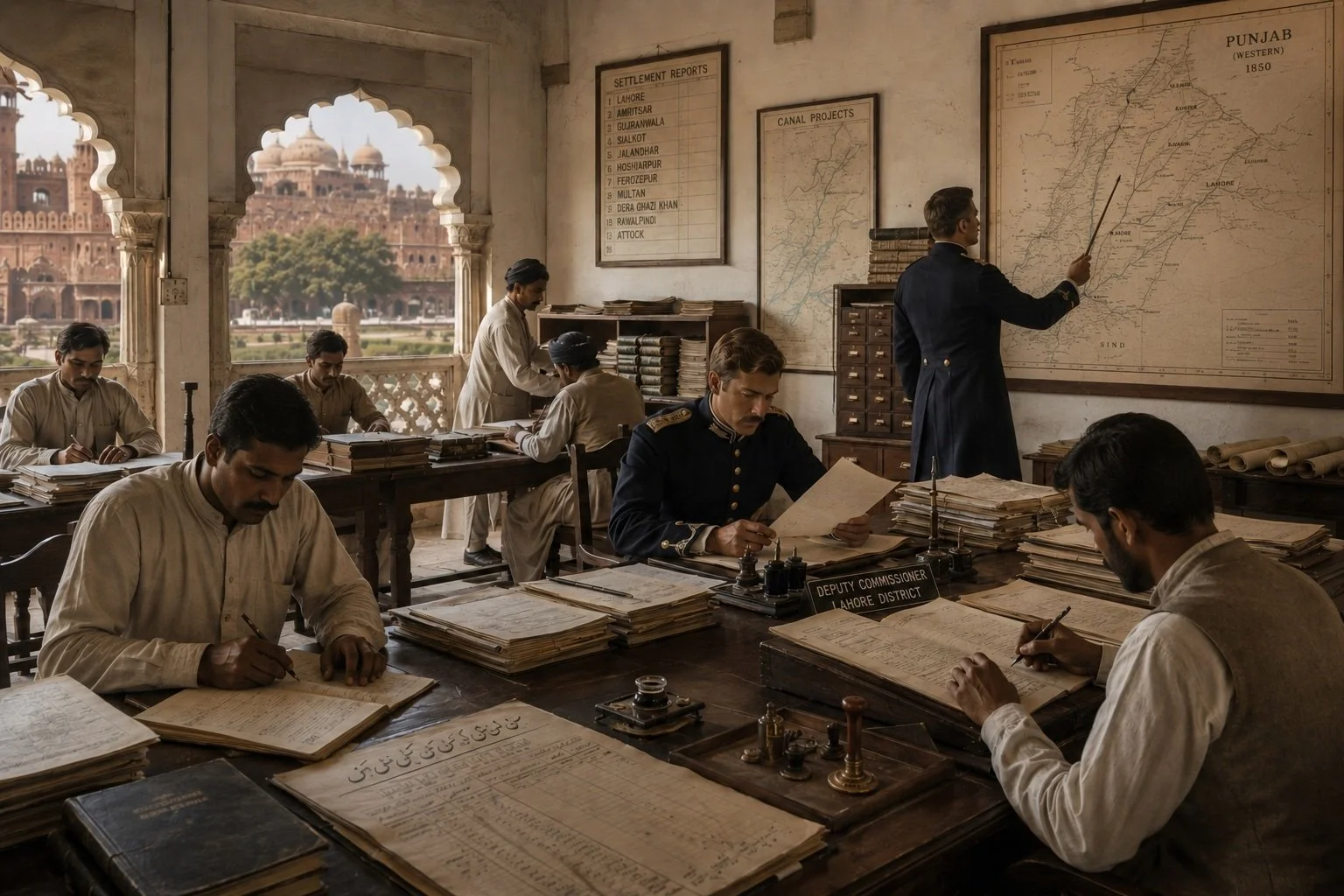
A depiction of the new administration system being implemented in Lahore.