An Arcitectural & Cultural Legacy
When empires fall, they seldom do so without leaving something behind - a golden dome, a forgotten coin, a whisper of a land once free.
What remains after power fades?
The Sikh Empire did not disappear all at once. It crumbled unevenly - treaties, annexations, political factions. Its army was disbanded, borders redrawn under foreign rule, and governance replaced by colonial laws.
But the physical and cultural architecture of the empire stood as its administration fell.
The architectural and cultural legacy of the Sikh Empire remains today in preservation - of sacred spaces, urban centres, and the culture of a region that is built on its history.
A ruler Focused on Restoration
Maharaja Ranjit Singh came to power in a Punjab that had been subject to decades of conflict and disruption. The downfall of the Mughal Empire, repeated Afghan invasions, and internal conflict had left the Punjabi cities damaged, and religious sites neglected. Many places of worship were ruined by conflict, or abandoned.
Unlike other leaders, Maharaja Ranjit Singh prioritised the repair and continuity of religious monuments within Punjab, His architectural policy was centred on restoring what was already significant.
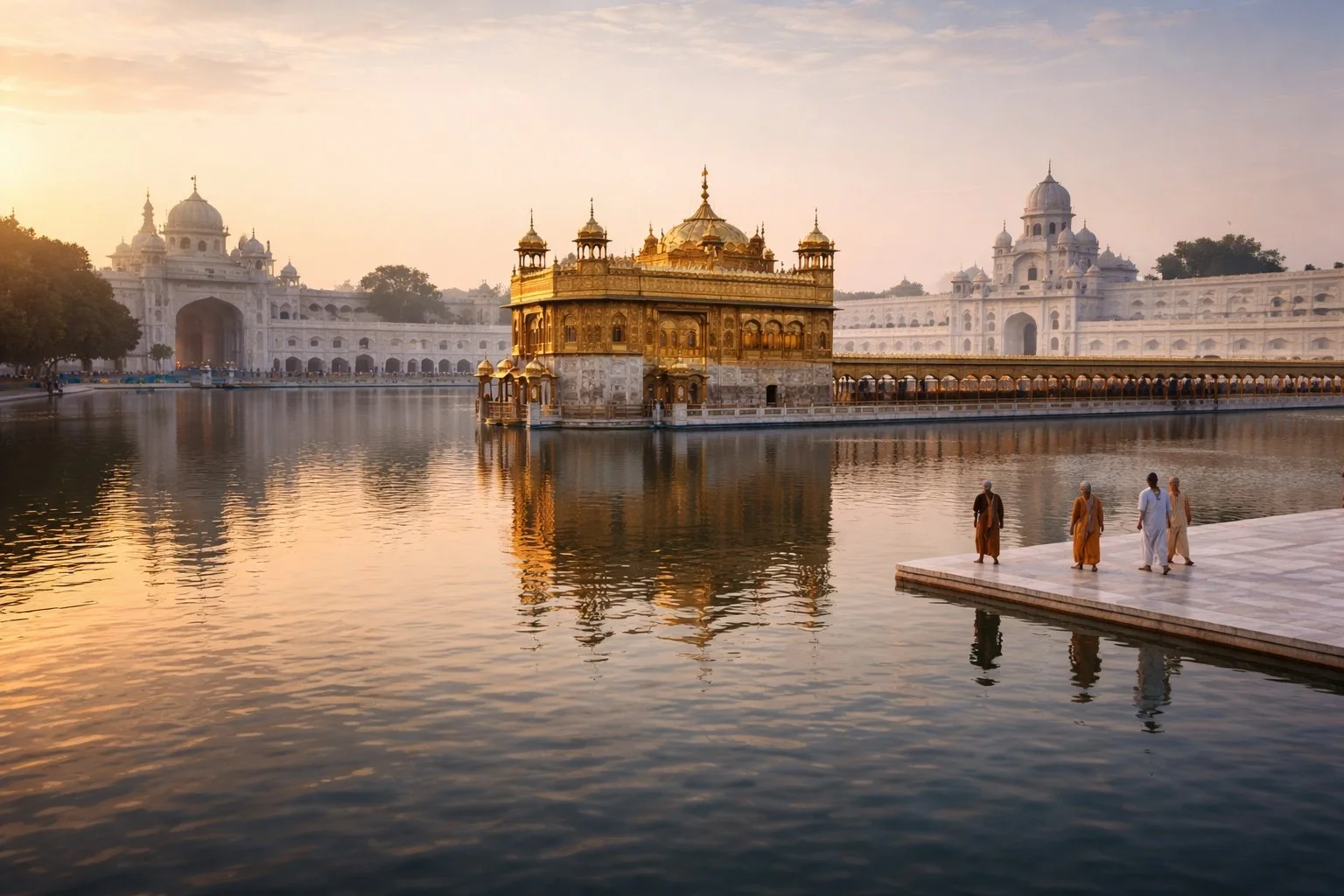
The Harmandir Sahib - Golden Temple was repaired, reinforced, and gilded during his reign.
Note: it is widely believed that previous Mughal emperors (namely Emperor Aurangzeb) removed gold from the Harmandir Sahib to embellish Mughal structures. However, this is not historically supported as during (and after) Aurangzeb’s reign, the Harmandir Sahib was not covered in gold and was a marble structure.
This belief compresses Emperor Aurangzeb’s order to destroy, and the Sikh efforts to rebuild and embellish the Harmandir Sahib into one event. Additionally, there is no historical record of any Mughal Emperor removing the gold off the Harmandir Sahib. However, an accurate idea is that Maharaja Ranjit Singh used the gold off Mughal structures to embellish Sikh structures. This was not looting or disrespect as it followed the norms at the time:
Reusing materials from previous imperial structures after regime changes.
Mughal structures were political, not religious.
Gurdwaras - Sikh temples across Punjab were restored, and protected. At the same time, mosques, shrines, and Hindu temples received state protection and in special cases, financial support.
Architecture as continuity
Lahore Fort & Sheesh Mahal
Once a Mughal administrative centre, the Lahore Fort was retained as the seat of power for the Sikh Empire. Its structures were maintained and not altered significantly, signalling a transfer of authority in Punjab, without discrediting the past of the region.
Maharaja Ranjit Singh’s Samadhi, Lahore
Built by Kharak Singh, Maharaja Ranjit Singh’s Samadhi houses his cremated remains today. Its placement and design reflect the coexistence of Punjab’s diverse population (by incorporating Sikh, Islamic, and Hindu architectural elements).
Ram Bagh Gardens, Amritsar
Inspired by the Mughal garden design the Ram Bagh Gardens function as both a residence and public space. Unlike other royal enclosures reserved for exclusive elites, the gardens remained accessible, reinforcing Maharaja Ranjit Singh’s idea of rulership by proximity rather than separation.
The Courts Culture
The Courts of the Sikh empire functioned as more than administrative centres, they were cites of cultural continuity. Scholars worked in Gurmukhi, Persian, and Sanskrit, reflecting the linguistic diversity of Punjab. Sikh historical texts and manuscripts were copied and preserved.
Additionally, music and performance were sustained. Various types of music was performed in the courts - raagis, dhrupad, qawwals, shayar - not as an imitation of Mughal rule, but as an inherited culture of the region.
This combination of Sikh, Punjabi, and Indo-Persian tradition gave the empire a distinct cultural character.
Symbols of the Empire’s Authority
The Sikh Empire’s state identity was reinforced through subtle, consistent motifs rather than overt propaganda. The coins were issues in the names of Guru Nanak and Guru Gobind Singh, rather than the ruler, signalling spiritual authority above personal rule. Persian remained the language of administration, but Gurmukhi and shahmukhi were used in religious and communal contexts - a choice that reflected the empire’s dual administrative and cultural foundations.
Sikh symbols, like the Khanda, appeared in artwork, arms, and textiles - not in excess, but as markers of identity.
What Endures today
Despite colonial rule, partition, and modern political changes, much of what the Sikh Empire preserved remains today. The empire itself ended. Its structures, culture, institutional choices did not.
What the Sikh Empire left behind was a framework of continuity - one that allowed memory, faith, and culture to survive political collapse.