
Trade and Economy
While the empire’s borders were guarded by soldiers, prosperity was built in its fields, markets, and the traders that passed through it.
The Sikh Empire is frequently remembered for its military conquests and successes, but behind every strong state is a strong economy. Under Maharaja Ranjit Singh, Punjab became an economic centre. The state’s economy was no longer built on what could be extracted from it, it was now rooted in the land, sustained by trade, and trusted by citizens.
The land as the Lifeline:
Punjab'‘s economic strength first came from its soil.
Agriculture was the backbone of the empire’s revenue. The plains of punjab produce various crops during different harvesting cycles of each year. These crops powered both domestic markets, and fed the army of the empire.
Maharaja Ranjit Singh’s government used kardars - local land officials to assess and collect taxes, which were generally set at a share of the expected produce for each harvest. This system of taxation was practical:
Taxes were moderate, allowing farmers to sustain their families.
Assessments were reviewed and ammended, sometimes by the Maharaja himself.
Revenue officers were replaced if they abused their power - a stark distinction from the fractures of the system employed by the mughal governance.
Additionally, in times of scarcity, the state opened granaries to prevent famine and unrest, an action that won the loyalty of the agrarian, peasant population.
Trade that moved through borders:
The Sikh Empire sat at a crossroads of different worlds:
To the west of Punjab was Afghanistan and Central Asia. To south and east of Punjab were Delhi and the Gangetic plains. North of Punjab was Kashmir (which was under the administration of the empire, but led to Tibet).
Within Punjab, the main cities of Lahore, Amritsar, Multan, and Rawalpindi also became trade and commercial centres.
The trade routes within Punjab were under the protection of the Khalsa Army. This protected caravans and traders from being harassed or looted by rogue bandits or robbers, and ensured they paid taxes at checkpoints. This encouraged more traders to take routes through, and return to Punjab.
Imports & Exports:
Lahore became a key transit city for goods travelling between British India and Central Asia; resulting in both strategic importance and economic wealth.
Exports: wheat, ghee, cotton, indigo, horses, arms and artillery parts, Kashmiri pashmina.
Imports: silk, European weapons, glassware, books, paper, gunpowder.
Coinage
The Sikh Empire minted its own coins - bearing inscriptions of sikh gurus, symbolising both faith and statehood.
As a result, the coins minted in Lahore and Amritsar were:
Trusted across Punjab (and in some neighbouring regions).
Widely accepted in trade, lending, and wages.
Stable in weight and metal - avoiding currency fluctuations.
By anchoring the currency in a shared identity, Maharaja Ranjit Singh created economic unity across a diverse empire.
Where did the revenue go?
The Sikh Empire, at the time of Maharaja Ranjit Singh invested heavily in the functioning and improvement of the state.
Salaries for soldiers, officers, and administrators.
Maintenance of roads, bridges, and trade checkpoints.
Restoration of temples, mosques, and gurdwaras.
Public health, and emergency granaries.
Military expoansion, particularly arms protection and modernising the army.
This internal investment created a state that strengthened it’s economy, and an economy that sustained the state.
Why did this work?
In a time when other kingdoms struggle due to economic pressure, Punjab stood steady - its economy didnt rely on empire, it relied on balance.
The Maharaja and noblemen were never allowed to overtax the land, keeping populations loyal and productive.
Revenue officers were held accountable, preventing them from acquiring vast expanses of land.
Maharaja Ranjit Singh priorities security along trade routes, making Punjab one of the safest regions for merchants and travellers in the subcontinent.
Lasting Prosperity
By the time of Maharaja Ranjit Singh’s death, the Sikh Empire was stable and economically self-sustaining. His successors inherited an empire wherein cities were active, soldiers were paid, crops thrived, and merchants willingly traded. The crack that would shake its foundations were not economic, they were political.
But for now, Punjab knew something rare - sovereign prosperity.
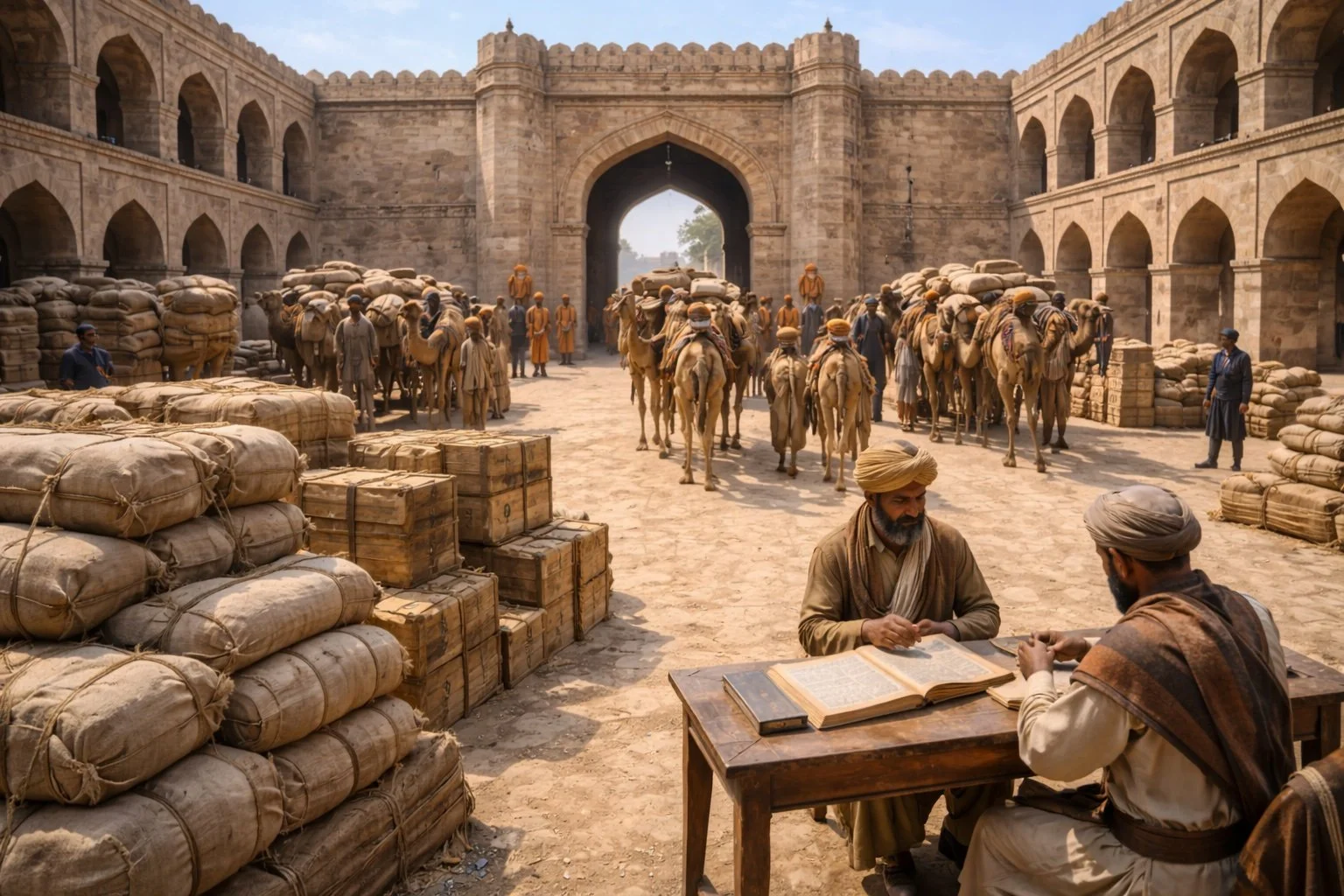
A depiction of a checkpoint on a trade route through Punjab.
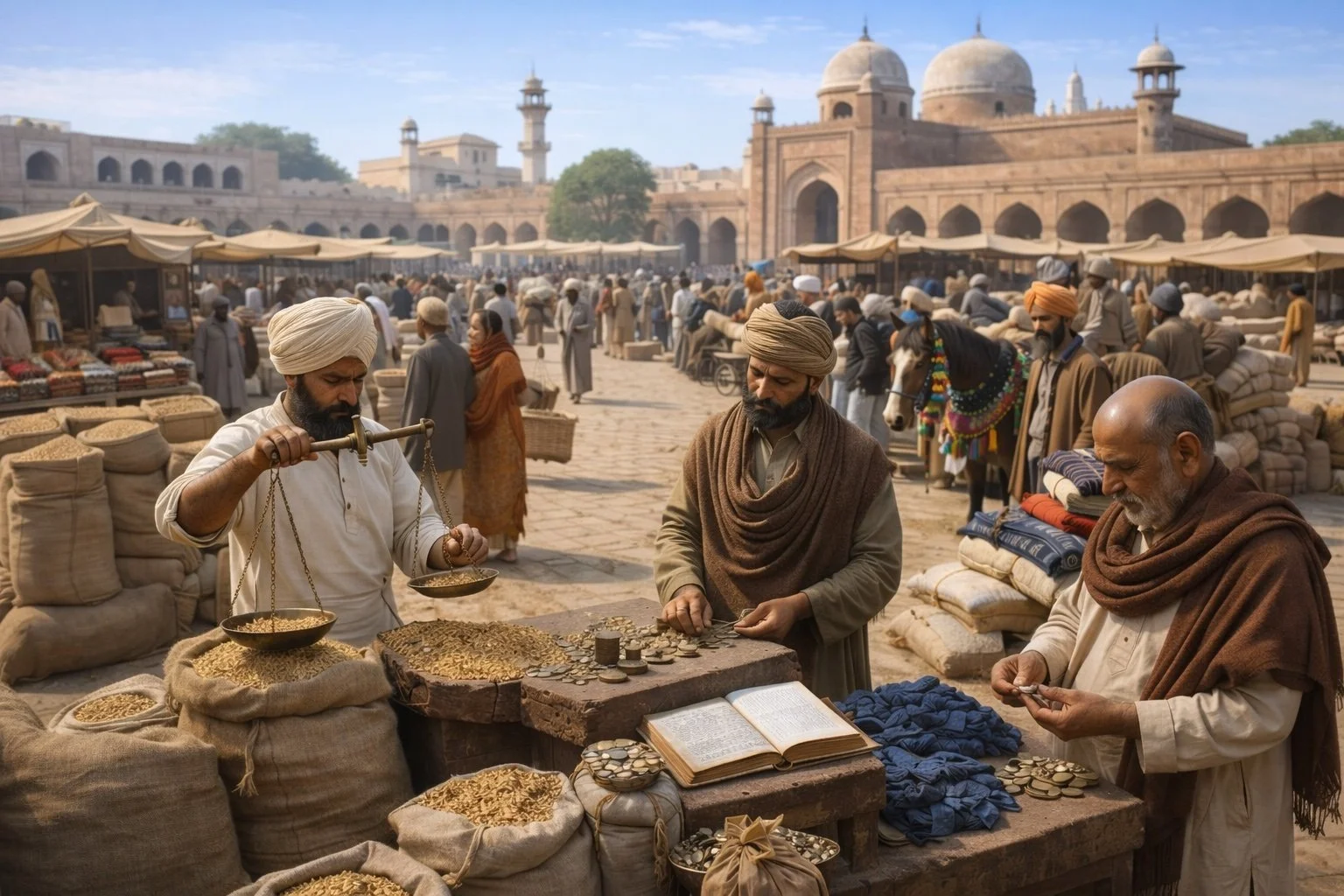
A depiction of a market in Lahore.
To the farmers, merchants, and noblemen who held the empire together - quietly, diligently, faithfully.
With gratitude, TrishSaab. 