
Currency of the Sikh Empire
Coinage under the Sikh Empire was a political declaration of Punjabi sovereignty and a religious statement. The Sikh coins were different from most currencies as they did not centre the reigning king, instead they often invoked the Sikh Gurus - specifically Guru Nanak and Guru Gobind, which reinforced the notion of Punjabi rule existing under spiritual authority.
Note: Coinage circulated in the Punjab region under various imperial powers, however this post focuses specifically on coinage minted under a sovereign, indigenous Punjabi Empire.
Banda sINGH bAHADUR AND THE FIRST sIKH cOINS
The first Sikh coins were struck by Banda Singh Bahadur after his victories in 1710, when Punjabi-Sikh authority overcame Mughal state power in Punjab. The first mint was established at Mukhlisgarh, a hill fort that Banda Singh’s forces renamed Lohgarh.
Banda Singh Bahadur’s coins are paramount because they were not struck in his name, instead they invoked both Guru Nanak and Guru Gobind, reflecting that sovereignty belonged to the Khalsa under the Sikh Gurus, not to Banda Singh as a revolutionary or leader.
The inscription on Banda Singh’s coins:
Struck in the two worlds (spiritual and physical), by the grace of Guru Nanak’s sword and Guru Gobind Singh’s victory
Note: the exact translation/ transliteration varies across coins and translators, but the foundational notion of spiritual and temporal sovereignty, and the Guru’s victories are constant.
Lohgarh - the first mint
Lohgarh was the first capital like centre of early Sikh sovereignty in Punjab, under Banda Singh Bahadur. Minting the first Punjabi coins there was significant - in premodern politics, the right to mint was a symbol of statehood and sovereignty; something that the Mughal empire had denied in Punjab. Banda Singh renaming the Mukhlisgarh mint to Lohgarh made the Punjabi rebellion tangible.
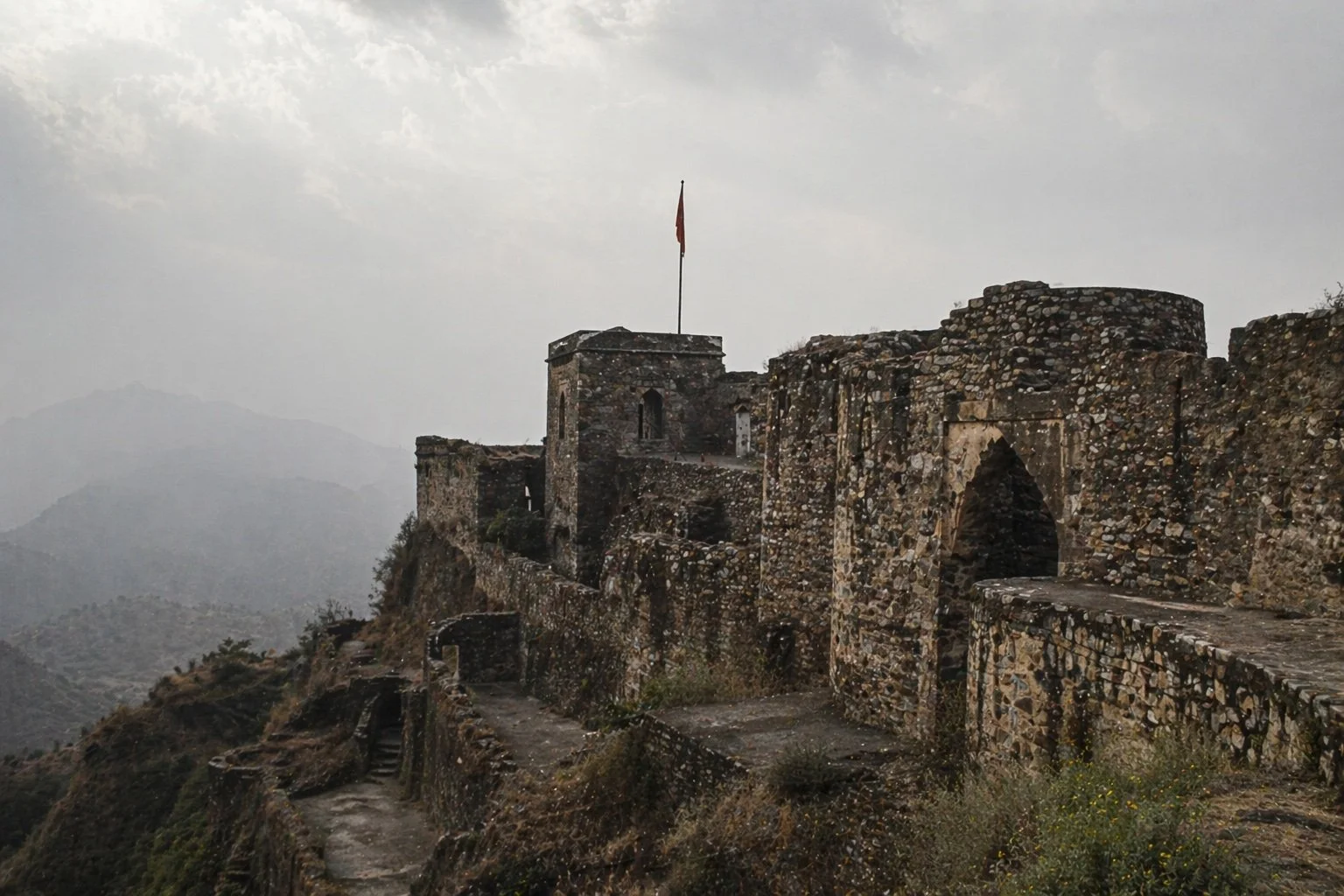
A depiction of Lohgarh
Banda Singh to the Punjabi confederacy
After Banda Singh and his forces capture at the Gurdas Nangal fort, Sikh power in Punjab fragmented but was not eradicated the way Mughal forces had intended with his gruesome execution. As a result, the idea of Punjabi coinage revived alongside the confederacy in the 1700s. This resulted in a transitional Gobindshahi coin. These coins were struck in the Sikh controlled territories after major victories, but still carried the same basic principles as the previous coins.
One exeption to this are coins associated with Jassa Singh Ahluwalia, who minted coins carrying his own names after the Bhangi Misl’s 1761 capture of Lahore. Some traditions say it was recalled because it contradicted the long standing tradition of invoking Gurus, not rulers, but this is not historically proven.
Deg tEGH fateh
A widely recognised phrase is:
Deg, Tegh, Fateh
Cauldron (a symbol of charity), Sword, Victory
On the Punjabi coins, this represented the state philosophy - offer charity, defend people and sovereignty, prevail in righteousness. This phrase was used by Banda Singh, the Misls of the confederacy, and allied Sikh states.
Gobindshahi & Nanakshahi
Sikh coinage can be organised into two categories:
Gobindshahi: generally used for earlier coins, particularly those minted before 1777, linked to Banda Singh and the Confederacy period - these coins are symbolically dedicated to Guru Gobind Singh.
Nanakshahi: generally used for post 1777 coins, particularly those of the Sikh Empire period - although these coins invoke both Guru Nanak and Guru Gobind, they are referred to as Nanakshahi.
Under the Maharaja - Empire Scale Coinage
When Maharaja Ranjit Singh captured Lahore, he expanded independent Punjabi coinage massively. The empire began issuing coins from Lahore in 1801, from Amritsar in 1805-1806, and Multan/ Kashmir/ Srinagar in 1818-1819.
The coins varied by type, mint, and period, but generally Sikh Empire coins used Persian inscriptions, continuing the use of Persian as the official administrative language from the Mughal era.
This is notable, because it highlights how the Sikh Empire worked:
politically, it followed the Persainate state system
ideologically, it replaced the centuries old notion of one central ruler with a spiritual message of equality.
Materials and denominations:
The empire’s coinage was struck in gold, silver, and copper - the main categories of coins included:
Gold: mohar, butki
Silver: rupee
Copper: paisa, taka, dhelaa
Silver rupees are the best known today. Many standard silver rupees of the Sikh Empire weigh from 11 to 11.15 grams, varying by mint and type.
Major Mints
The Empire’s currency circulated across its territories, but circulation was not uniform in the modern sense. Major mint centres included Lahore, Amritsar, Multan, Kashmir, Peshawar, Jhang, and Pind Dadan Khan - this meant that the coinage physically moved through a commercial zone across central Punjab, frontier regions, and urban areas.
For the later princely states, coins were used within their own territories though urban areas near borders would have accepted neighbouring coinages too. The states of Nabha, Patiala and Jind had independent currencies, however, the state of Karputhala used Nanakshahi and British currencies instead of its own.
The Leaf Motif and other symbols
A leaf motif began to appear on Sikh coinage in the late 1700s. Some historians connect this motif to the Chalisa Famine of 1783-84, where the leaf became a symbol of renewal, fertility, and prosperity; however, this is an interpretation. There were other symbols and icons on the coins as well:
Leaf - in varying sizes and patterns
fish
trident
flag
lotus
dagger/ sword
peacock feathers
Shahmukhi and Gurmukhi script
Most coins used Persian legends, as Persian remained the formal administrative language of the Empire, but was written in the Shahmukhi script. Some coins included explicitly Sikh (Gurmukhi) elements as well. This hybrid was a result of the Sikh Empire’s religious-political identity.
Political significance
In premodern South Asia, minting independent coins was a sign of kingship and empire, as the right to issue coins was related to revenue, legitimacy, and recognition of power. the Punjabi- Sikh coinage held both economic and symbolic value:
Banda Singh Bahadurs coins stated that the Khalsa ruled Punjab.
Misl/ Confederacy coins stated that the Sikhs held power in Punjab.
Sikh Empire coinage reflected an imperial Sikh state that was spiritually answerable to the divine.
After the Empire’s Fall & Modern Day value
After the British annexed Punjab in 1849, Sikh state coinage was shut down and replaced by British administered currency. Sikh coins were withdrawn, and had become an outdated currency. Some pieces were melted for their metal value, and others remained in personal collections, hoards, shrines, and museums.
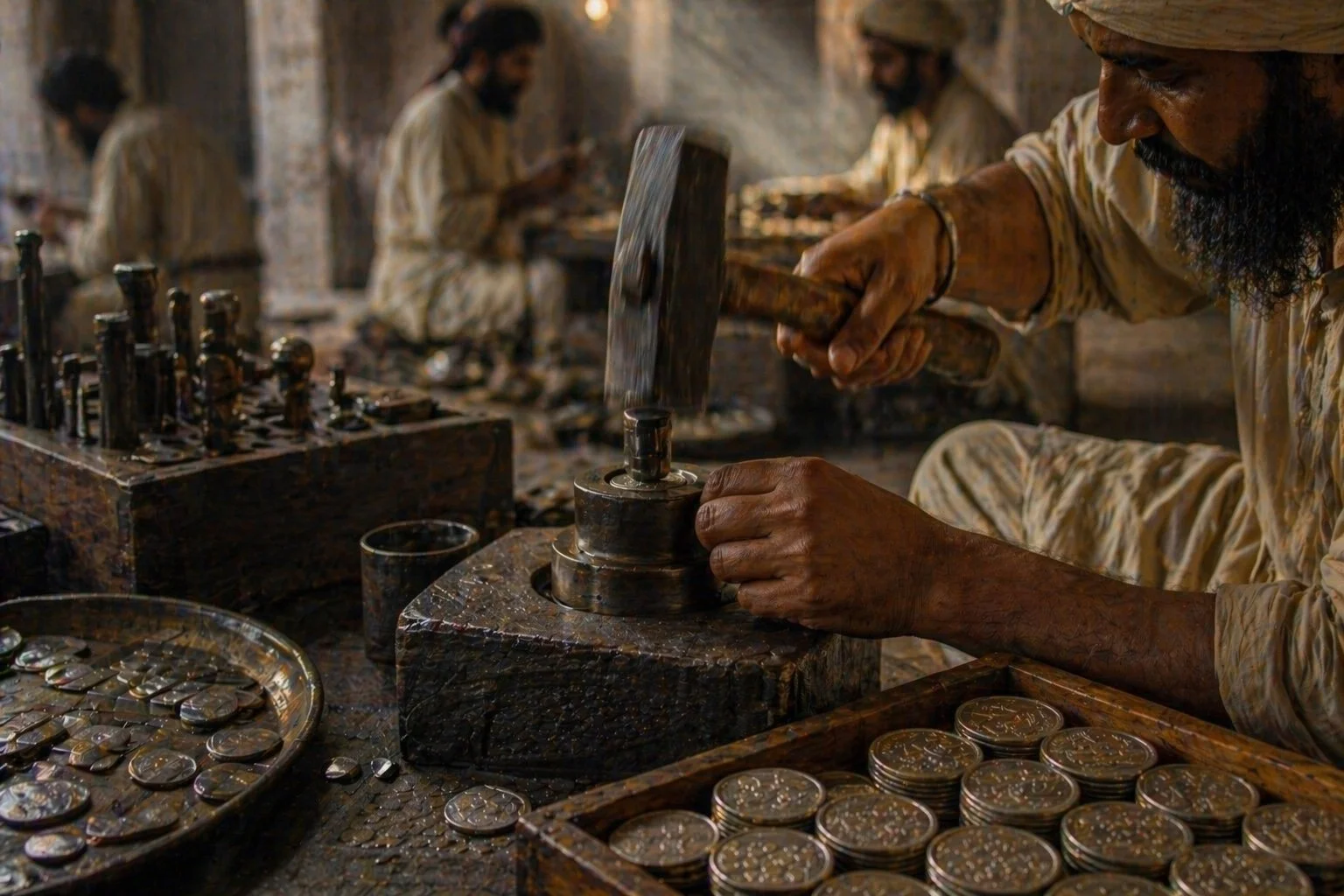
A depiction of the process of hand minting silver rupees during Maharaja Ranjit Singh’s reign.
To the metal that carried both value and Punjabi sovereignty.
In remembrance, Trish Saab. 