
From Misls to a Unified Empire
The Blueprint of the Empire:
These were semi-autonomous warrior groups that emerged in the 18th century following the decline of Mughal authority and continued invasions by Afghan rulers. The misls functioned as regional powers, each led by its own chief or sardar, and were responsible for defending their territories, maintaining law and order, and upholding the Sikh way of life.
Before the Sikh Empire held power over Punjab, control of the region was divided amongst the leaders of the Punjabi Confederacy while the Mughal Empire held official power of the region. The Misls of the Punjabi Confederacy functioned as regional powers, each led by a chief/s.
There were twelve prominent misls in total, including the Sukerchakia, Ahluwalia, Ramgarhia, Bhangi, and Kanhiya misls. While united by faith and common enemies, the misls often competed for land and influence, resulting in frequent skirmishes. Despite their rivalry, they formed a loose confederacy known as the Dal Khalsa, which would occasionally coordinate military action or gather for major religious events.
THE RISE OF MAHARAJA RANJIT SINGH
The turning point in the history of the misls came with the rise of Ranjit Singh. Born in Gujranwala in 1780, Ranjit Singh was the son of Maha Singh, the leader of the Sukerchakia misl. After the death of his father, Ranjit Singh assumed leadership at the age of twelve. Despite suffering from smallpox in childhood, which left him with partial blindness and facial scars, he quickly gained a reputation for military skill and leadership.
In 1797 and 1798, he successfully defended Punjab against invasions by Zaman Shah Durrani, the grandson of Ahmad Shah Durrani. These victories increased his standing among the misldars and the people of Punjab.
Sada Kaur and the Kanhaiya Alliance
After the death of her husband Gurbaksh Singh Kanhaiya, Sada Kaur became the leader of the Kanhaiya Misl - one of the 12 misls in the confederacy. By arranging the marriage between her daughter Mehtab Kaur and Ranjit Singh she forged an alliance of the Sukerchakia and Kanhaiya Misls and became both an ally and political mentor to Ranjit Singh.
Together, the combined forces of the Sukerchakia and Kanhaiya Misls became one of the strongest military alliances in Punjab. Sada Kaur’s support was paramount in Ranjit Singh’s 1799 capture of Lahore.
The Capture of Lahore (1799)
By the late 1700s, the Mughal authority in Punjab had weakened significantly, and the Bhangi misl held control over Lahore. In 1799 Ranjit Singh and Sada Kaur led a joint campaign to take over the capital. The Bhangi chiefs showed little resistance, and the city was captured with limited conflict. The residents of Lahore (and the greater population of Punjab) welcomed Ranjit Singh’s power, hoping that a stronger ruler would restore stability to the region.
Note: Although the Bhangi Misl held control over lahore from 1765 to 1799, the city remained an official Mughal Capital until Maharaja Ranjit Singh capured it. Following Ranjit Singh’s capture of the city, it was made the Capital of the Sikh Empire, and no longer under external control.
With the capture of Lahore, Ranjit Singh gained control of Punjab’s historic capital - something no other misl leader possessed. This was the beginning of Punjab’s transformation from confederacy to empire.
Consolodating the Misls
In the time following his capture of Lahore, Ranjit Singh gradually consolidated control over the territories of other misls. This was not through a single military campaign, but through a combination of alliances, diplomatic agreements, and selective military action. Some misls acknowledged Ranjit Singh’s authority and aligned voluntarily while others resisted.
For example:
Territories of the Bhangi Misl were gradually absorbed after the loss of Lahore weakened their power.
Elements of the Ramgarhia Misl were incorporated into the expanding state, though some chiefs maintained limited autonomy.
The Nakai Misl became closely aligned with Ranjit Singh through marriage alliances.
The Ahluwalia Misl maintained cooperative relations with the emerging state.
Instead of eliminating old leadership structures, Ranjit Singh often integrated former misl chiefs into the administration of the expanding Sikh Empire.
The mAHARAJA’S CORONATION
In 1801, Ranjit Singh formally assumed the title of Maharaja of Punjab. His coronation was conducted by Baba Sahib Singh Bedi - a respected descendent of Guru Nanak, the first Sikh Guru, in Lahore.
A key distinction between previous rulers and the Maharaja of Punjab, was that the authority of the state was symbollically tied to the Khalsa and the Sikh Gurus rather than to the person of the Maharaja.
Recognition of a new state
By the early 1800s, the emerging state in Punjab was recognised by neighbouring powers as a major political force. The Empire controlled the central plains of Punjab, and governed from Lahore which remained the political and administrative capital of the region.
The Treaty of Amritsar (1809) was the first formal recognition of the state.
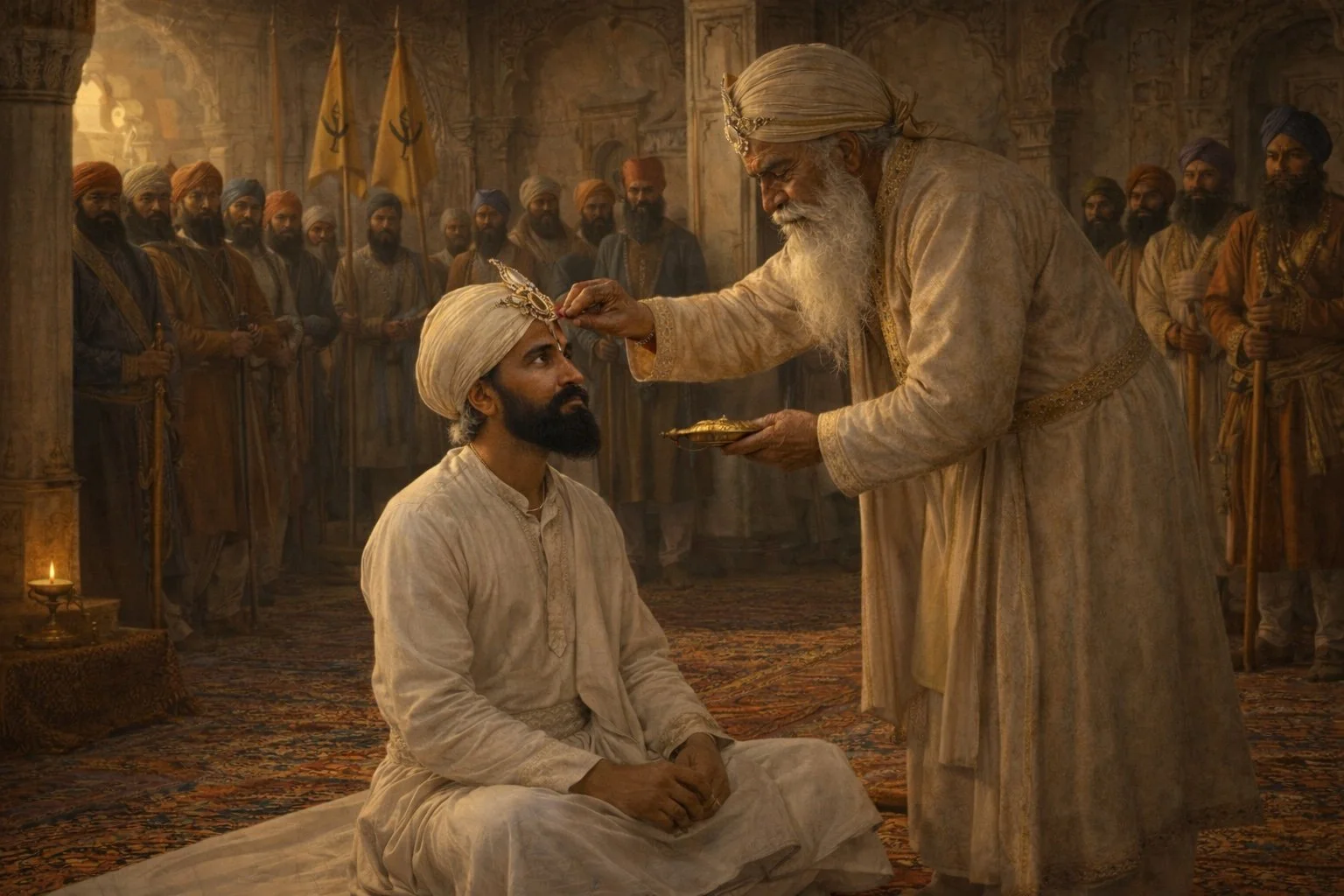
A depiction of Maharaja Ranjit Singh’s coronation
To the warriors who stood alone and the leader who brought them together. With reverence, TrishSaab.