
The Punjabi Army Before Modernisation
In the early 18th Century Punjab was not ruled by the Emperor, but torn between many powers: the declining power of the Mughals, repeated Afghan invasions, and the emerging Sikh community - who were driven by the losses of Guru Gobind Singh, and Banda Singh Bahadur.
The Sikhs had been marginalised by the Mughal Empire, and were forced to build a military tradition that was local, mobile, even spiritual in nature. This army was the pre-modern Punjabi force. What it lacked in structure, it had in spirit - as it was born out of resistance, not glory.
BANDA SINGH BAHADUR:
The first military formation in Punjabi-Sikh history was led by Banda Singh Bahadur (1670-1716), a disciple of Guru Gobind Singh - the tenth Sikh Guru. After the Guru’s death, Banda Singh led the first Punjabi campaign against Mughal officials, especially the Governor Wazir Khan of Sirhind.
Banda Singh’s main contributions:
Mobilised the Punjabi people (particularly Sikhs) in a revolutionary army.
Captured Mughal stronghold cities in Punjab, particularly Samana and Sirhind.
Minted the first Punjabi coins in the names of Guru Nanak - the first Sikh Guru and founder of Sikhism, and Guru Gobind Singh.
Established the first modern model of land ownership in Punjab, particularly for peasants and farmers who previously worked on land owned by nobles and landlords.
This army challenged the Mughal authority directly. After years of guerrilla fighting, Banda Singh and his army were captured in a siege at Gurdas Nangal and executed publicly in Delhi in 1716. However, the army had proved that armed resistance was possible, and that a militarised Punjabi identity existed.
THE MISLS AND THE PUNJABI CONFEDERACY:
After Banda Singh’s execution, the Sikhs in Punjab were persecuted out of cities and large towns. The Mughal governors, notably Governor Zakariya Khan of Lahore, launched targeted attacks on the population. In response, the Sikhs were forced to live in hiding and began to form small groups of armed soldiers. By the 1750s, these small groups had organised and grown into 12 distinct units - the 12 misls of the Punjabi Confederacy.
Each of the Misls:
Had informal control over a specific region within Punjab. This control was not recognised by the Mughal authorities, as the Punjab region was an official Mughal province.
Was led by a chief called the misldar.
Had an independent army, whose soldiers were composed of local peasants, farmers, traders, and displaced Sikhs.
Was responsible for the defence, taxation, justice, and administration of the region which it controlled within Punjab.
The misls are commonly misrepresented as pillars of the same army, and although that is true, they also had rivalries amongst themselves as they often competed for control and regional growth within Punjab. They would unite under the Dal Khalsa to protect Punjab, but also competed with each other to dominate within Punjab.
TACTICS, STRUCTURE, AND WEAPONS:
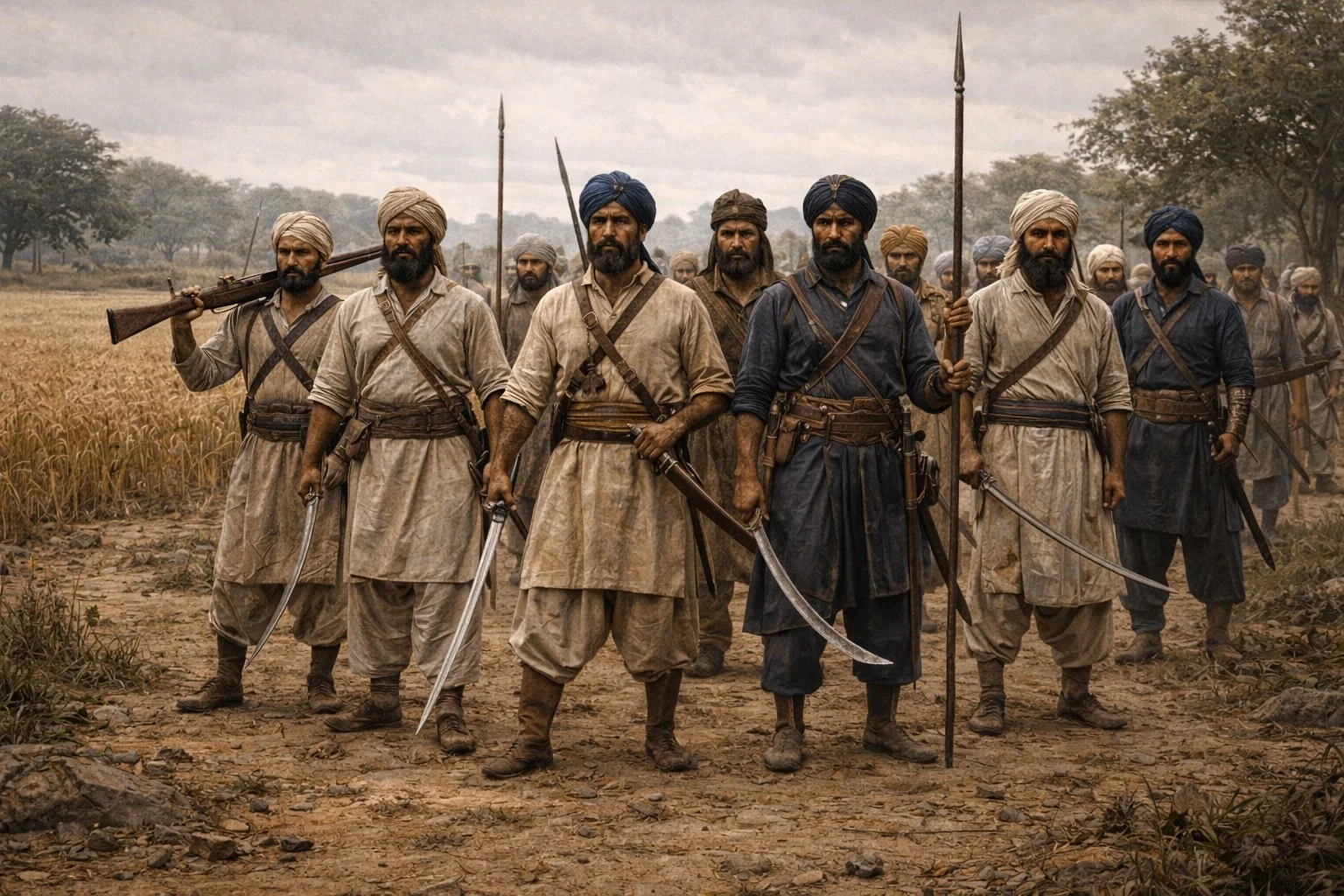
The Punjabi army before modernisation was an informal, flexible group of locally armed soldiers who were often farmers, peasants, or tradesmen who joined to protect Punjab from Afghan and Mughal invasions/ attacks.
Organisation:
There was no standing army, fighters would join when launching guerrilla attack/ counterattack and return to farming or trade otherwise.
Similar to the Mughal army, which employed Emperor Akbar’s Mansabdari ranking system, the Punjabi army did not have a formal hierarchy as a soldier’s authority was based on their martial success.
The arms and horses were supplied by the misldar or local landlords, and there was no centralised supply system.
Weaponry:
Bladed weapons - swords, spears, and axes. These were supplied by the Lohar - blacksmiths within each misl.
Match/ flintlocks - firearms.
Very few misls (namely the Bhangi Misl) used artillery, as the nature of the attack/ counterattacks during this time was quick, and the army often retreated afterwards. Therefore, most misls used cavalry.
Key Tactics:
Guerrilla warfare - the armies would launch raids on target convoys, outposts, and forts before retreating into forests.
Cavalry - the nature of the guerrilla attacks meant that soldiers on horseback would be most effective, and efficient. The armies seldom employed infantry.
The armies would use their knowledge of scrub forests, ravines, and jungles to make their guerrilla attacks more effective.
SPIRITUAL DIMENSIONS OF WARFARE:
The early Punjabi army was composed of multiple faiths, however, it was established and led under the umbrella of Sikhism. As a result, there is a clear link between the early Punjabi solider’s and the Sikh faith - specifically the Khalsa and Guru Gobind Singh.
The Nihang misl, and Akaali warriors were distinct warriors who were specifically dedicated to protecting the Sikh faith.
Sikh warriors carried copies of the Guru Granth Sahib - a compilation of teachings collated by Guru Arjan Dev (the fifth Guru) considered to be the eternal Guru in the Sikh faith.
The army operated under the phrase:
Deg, Tegh, Fateh
Cauldron (a symbol of charity), Sword, Victory
LIMITATIONS:
Despite the resilience of the early Punjabi army, there were still limitations that existed and flaws within their structure. The soldiers did not have any formal training, as they were often farmers and tradesmen joining to fight for Punjab.
Additionally, the Misdars did not have a centralised command for their individual armies, which caused conflict between leaders especially when they had clashing strategies. As a result of this, the leaders were limited in their ability to maintain hold of a city after their conquests, and often lost power or control to other Misldars or leaders.
LEGACY AND TRANSITION
As Maharaja Ranjit Singh began centralising power in the late 1700s, and the first flickers of a native Sikh Empire shone light over Punjab, he didn’t begin from scratch. He adopted the fighters from the misls, the heritage of the Nihang warriors, and he took on the lessons from Banda Singh’s rebellion and the Confederacy’s resistance to the Afghan and Mughal attacks.
He acknowledged that for an empire to stand, its army must be trained, paid, and modernised. The courage of the past became the foundation of the Sikh Empire’s army.
To the soldiers who built an army without a blueprint - With reverence - TrishSaab. 