Kharak Singh, Nau Nihal Singh & Chand Kaur
Some empires fall to invaders. Others fall from within - in silence and betrayal.
Three NAMES; One Collapse
Kharak Singh - The crown prince who never ruled.
Nau Nihal Singh - The heir who never wore the crown.
Maharani Chand Kaur - The queen whos efforts faded in history.
Their stories aren’t of conquest or glory.
They are stories of power without power, thrones without safety, and an empire without an anchor.
Kharak Singh:
Kharak Singh (r.1839 - 1840) was the eldest son of Maharaja Ranjit Singh. He was the second ruler of the Sikh empire, and despite his reign lasting only a year, its consequences shaped the future of the empire greatly.
Upon Maharaja Ranjit Singh’s death, Kharak Singh inherited:
A vast, militarised empire.
A hyper-competitive, complex, dynamic court.
A succession system that Maharaja Ranjit Singh never formalised.
The most stark difference between Kharak Singh and his father was their ruling tactics. Where Ranjit Singh employed his charisma, dominance, and ability to balance various factions, Kharak Singh was tested by nobles, generals, courtiers, and factions of the Sikh empire to validate whether he would live up to his father’s legacy. He was Maharaja by title, but tested by his subjects.
As a result of this, Kharak Singh was unfairly underestimated and labelled as incompetent, despite upholding similar Sikh values to Ranjit Singh, being conservative in his temperament, and personally pious. He was a prince unsuited to the deep complexities of the Sikh empire, not an unworthy ruler.
In 1839, a coup placed Kharak Singh on house arrest and power shifted to Nau Nihal Singh, his son. In November 1840, Kharak Singh died under uncertain circumstances, although it was never proven, he is widely regarded to have been poisoned.
In many historical accounts, Kharak Singh’s name bears the brunt of empire’s downfall because he was the first Maharaja to fall, and his reign marks the beginning of major chaos in the empire. The true fractures, however, were the following:
There was no clear succession law,
factions within the court gained significant power following Maharaja Ranjit Singh’s death,
the empire’s army had become politically autonomous
ministers began to rule through the throne, not under it.
Nau Nihal Singh:
Born in 1821, Nau Nihal Singh was the Sikh empire’s last beacon of hope. Despite being the son of Kharak Singh, and grandson of Maharaja Ranjit Singh, he was never formally crowned and only acted as the de facto ruler of the Sikh empire for a brief period in 1840.
The truth of his succession is that during his father’s rule, in 1839-40, the real power was shifting towards him and various matters - state matters, court pertitions, and military related issues, began to bypass Kharak Singh and were dealt by Nau Nihal Singh.
During the final months of Kharak Singh’s reign, Nau Nihal Singh became increasingly influential in Lahore. Despite never being formally crowned, he was acting as the Maharaja. However, in November 1840, following his father’s funeral, Nau Nihal Singh passed beneath the Hazuri Bagh gateway, where a section of masonry collapsed onto him. It is said that he initially survived with some injuries, but later that day his condition worsened and he died.
His sudden death removed the most capable and immediate successor, and the Sikh Empire was left questioning succession again.
Maharani Chand Kaur:
After the deaths of Kharak and Nau Nihal Singh, Maharani Chand Kaur - widow of Kharak Singh, declared herself regent and ruled Lahore. She was backed by loyal nobles and sections of the army. For a moment, Punjab had a queen, and she held her ground. But her rule was contested by Sher Singh - commander of the Khalsa Army. The Dogra brothers, namely the vizier Dhian Singh turned against her and backed Sher Singh instead.
Chand Kaur was forces to abdicate, and promised safety under house arrest. Two years later, she was murdered in her palace. Despite this, her resistance was one of the quietest, most dignified stands in the royal house of the Sikh Empire.
Aftermath:
The tradedy of the Sikh Empire was political, in three years:
The first successor died mysteriously
The second, violently
The third was erased
Without strong leadership, the empire began to inwards. The Dogras rose to unchecked influence, factions battled in the court, the Khalsa Army became politically motivated, and external rivals saw an empire beginning to crumble.
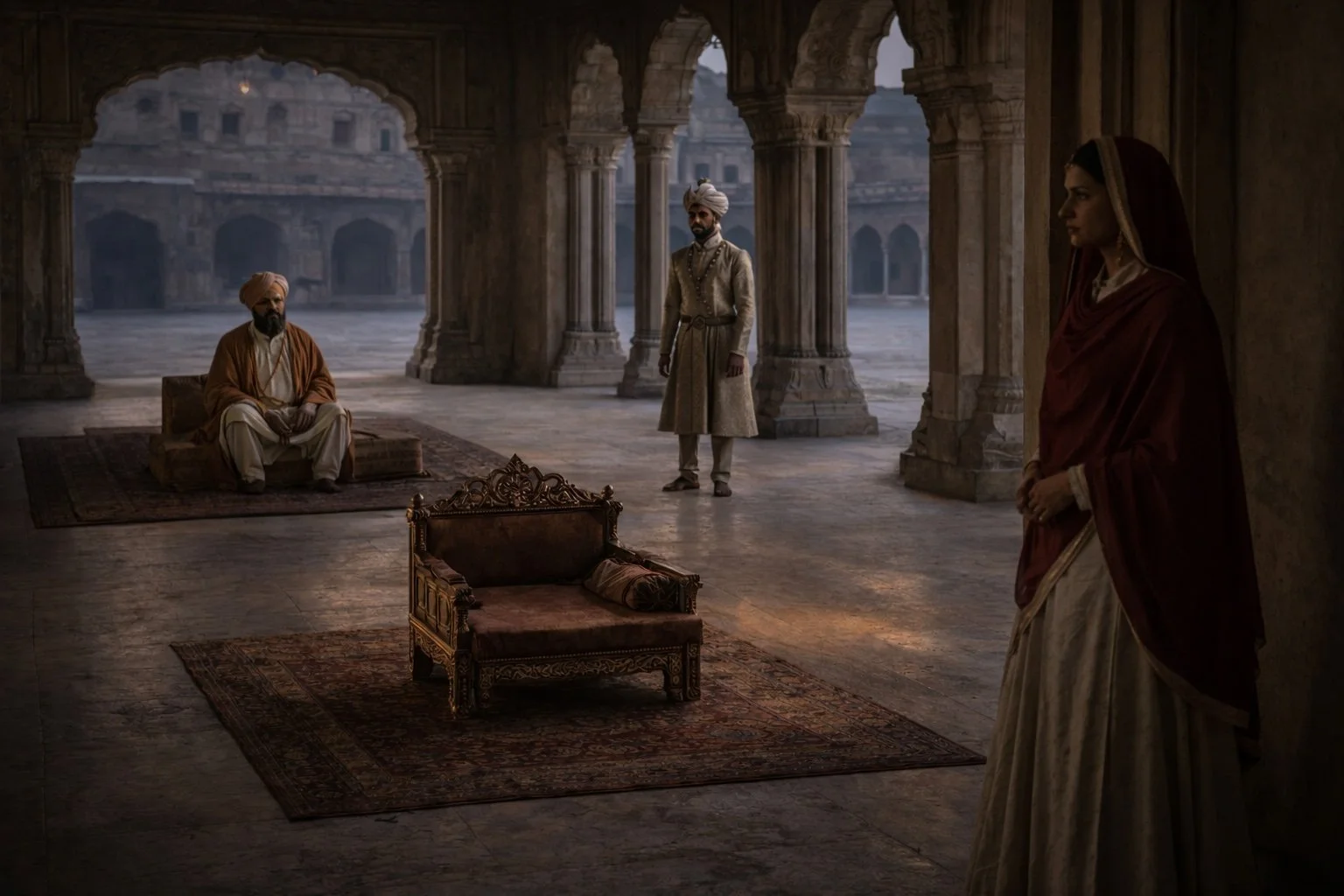
To the empire whose downfall began at its core. To the rulers who weren’t given a chance to rule.
May history account for your efforts, not your limits.