
Sher Singh’s Rule
He was not born to be heir. But in the empire’s final breath of calm, he wore the crown. And for a moment, the storm paused.
Who was Sher Singh?
Following the deaths of Kharak Singh, Nau Nihal Singh, and Maharani Chand Kaur, the court of Lahore was descending into chaos. Punjab had one last attempt at stabilising the falling empire - Sher Singh.
He was the elder son of Maharaja Ranjit Singh by Maharani Mehtab Kaur of the Kanhaiya Misl, his younger twin brother was Shahzada Kunwar Tara Singh (or Tara Singh).
His claim to the throne was not uncontested, but it was forceful. He was backed by the prime minister Dhian Singh Dogra, and had the support of key factions within the Khalsa Army. As a result, Sher Singh was crowned Maharaja of Punjab in January 1841.
Note: Sher Singh was supported greatly by the Khalsa Army as he was a commander. Additionally, he also held civil and military honours as the son of Maharaja Ranjit Singh - Governor of Kashmir (1831-1834).
It is important to distinguish Maharaja Sher Singh, from Khalsa Army leader Sher Singh Attariwala who was prominent during the second Anglo-Sikh war.
A fractured Empire. A measured Ruler.
As Maharaja, Sher Singh did not employ revolutionary tactics, and his main objective was to restore stability in Punjab. Therefore, during his reign, the empire did not expand or grow substantially.
He was supported heavily by the Khalsa Army and employed similar tactics as his father, Maharaja Ranjit Singh, by balancing court factions rather than crushing them; notably, he repaired tensions within the court by promising protection to those who had fallen out of favour. He also resumed patronage of the arts, and ordered repairs to Lahore’s fortifications.
Maharaja Sher Singh may have dominated the Sikh Empire in another time, but in 1841, he was ruling a kingdom on the brink of inevitable downfall.
An Empire Too Heavy To Hold
The empire Maharaja Sher Singh inherited was not similar to the one that existed decades ago, it was now dominated by fractures in the court:
The Khalsa Army was greatly powerful, and held political opinions.
The Dogra brothers - particularly Dhian Singh Dogra, were seen as Kingmakers and therefore disliked by Sikh cheifs and military leaders. Despite contextual differences, they held a similar position to the Sayyid Brothers of the Mughal Empire.
British officers we not actively involved in the empire (as the Treaty of Amritsar still held), but had growing stakes in Punjabi trade, diplomacy, and court politics.
Old rivalries that Maharaja Ranjit Singh had managed, began to return to the surface.
The MahAraja’s Assassination
September 15, 1843. Ajit Singh Sandhawalia - a nobleman previously forgiven for treason, approached Maharaja Sher Singh as he inspected a new cannon, and shot him with a concealed firearm. In the chaos that followed, Sher Singh was struck with a sword and assassinated.
Simultaneously, Dhian Singh Dogra was also killed and Punjab lost its king and kingmaker.
Note: Ajit Singh was from the Sandhawalia family of the Kanhaiya Misl, and a blood relative to the Sikh Empire’s royal family. He was Maharani Mehtab Kaur’s brother, and therefore maternal uncle to Maharaja Sher Singh. He was previously arrested as a suspect of treason during the political struggles that followed the deaths of earlier Sikh rulers, but he was pardoned by Maharaja Sher Singh in an attempt to reconcile rival factions within the Lahore court.
The throne was empty. The army stood leaderless.
The Sikh empire trembled, but did not yet fall.
Legacy & Aftermath
As Maharaja, Sher Singh kept the Sikh empire from falling prematurely, calmed internal factions and external enemies, and inspired enough loyalty that the empire held out against all odds. But he ruled at a time where the empire was in need of unity, vision, and time - none of which Sher Singh was allowed.
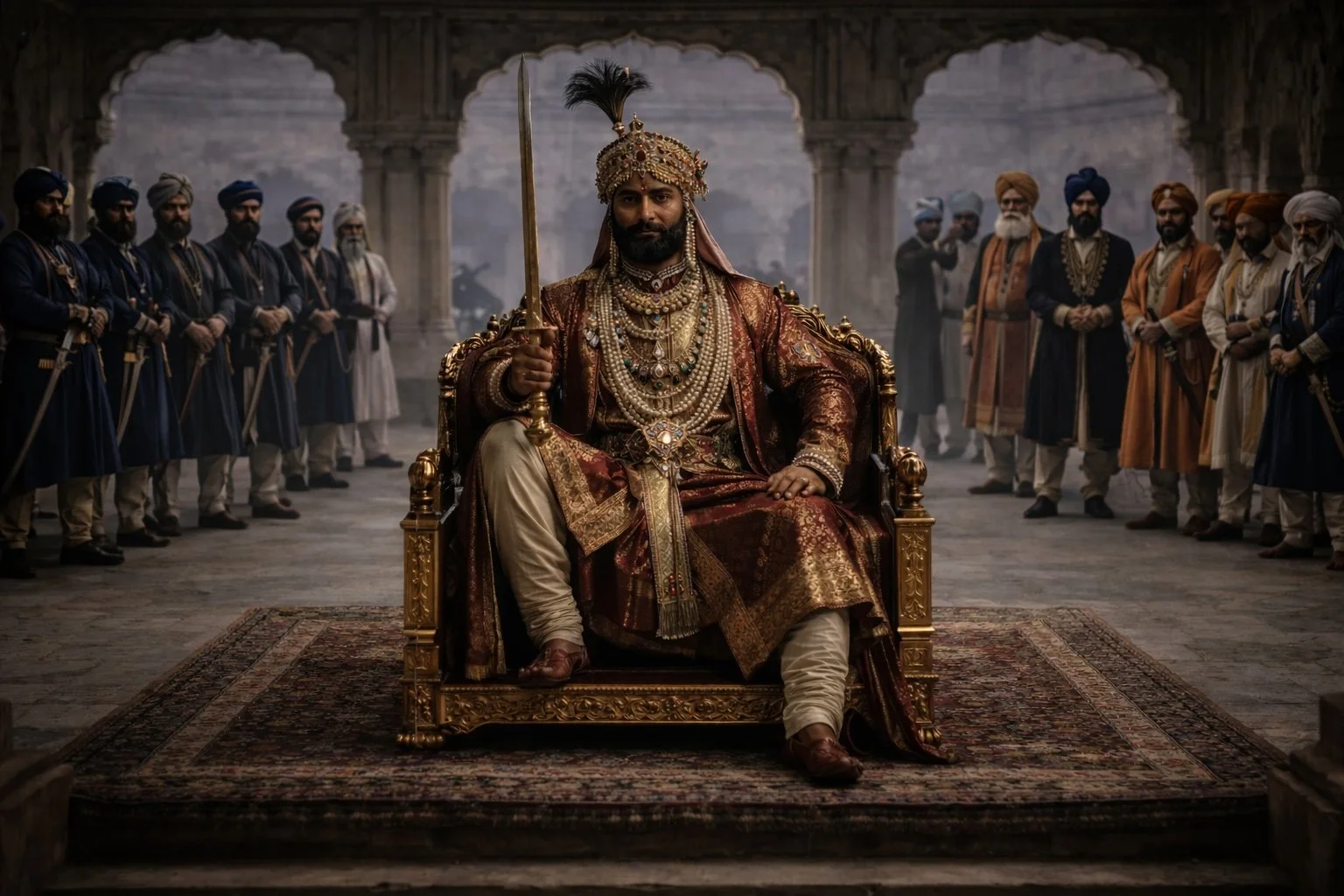
To the Maharaja who gave Punjab a final breath of calm before a decades long storm,
with great reverence - TrishSaab