
The Lahore Durbar & it’s Administration
The Lahore Durbar - Maharaja Ranjit Singh’s court combined the early administrative traditions of the Mughal emperors, Sikh leadership, and regional Punjabi customs to govern the Sikh Empire.
A Court Oriented around Function
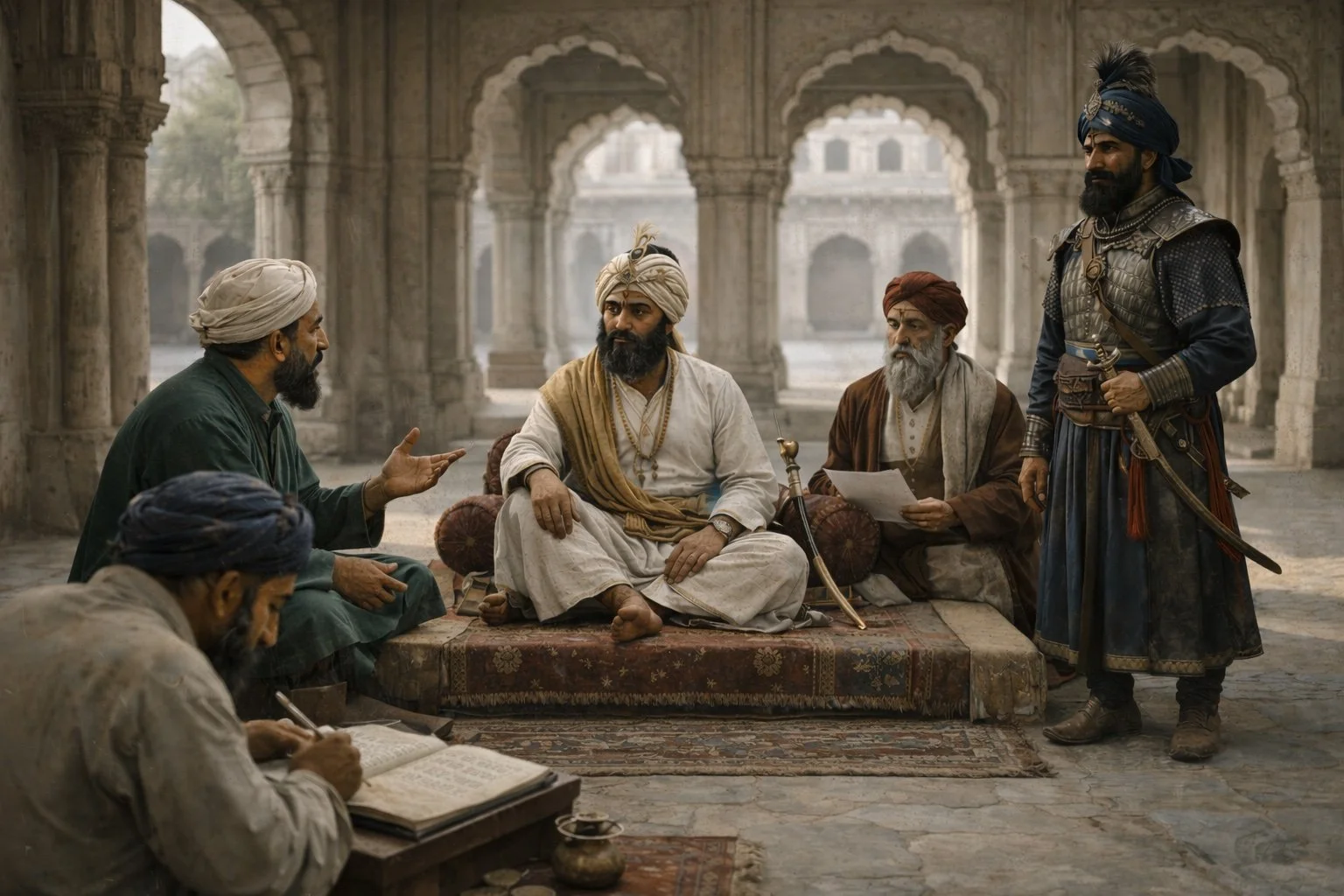
Compared to the Mughal and British courts, Ranjit Singh’s court was relatively informal. The Maharaja often sat on a low seat, sometimes on the ground, and his interactions with nobles, officials, and visitors were unmediated.
This informality reflected the Maharaja’s preferences for accessibility and oversight. The Lahore fort housed the Darbar-i-Aam - daily public meetings, whereby the Maharaja dealt with petitions, administrative disputes, revenue questions, and military reports. The meetings held during the latter part of the day were smaller and allowed for detailed discussions with senior advisors.
Multi-faith & Merit-Based
The Maharaja’s court deliberately centred diversity, drawing administrators for Punjabi and non-Punjabi, Sikh and non-Sikh backgrounds. This reflected Punjab’s demographic reality, and the empire’s focus on capability over lineage.
Key Figures of Maharaja Ranjit Singh’s court include:
Fakir Azizuddin - Muslim; overlooked the foreign affairs and diplomatic correspondence, specifically with the Afghan and British.
Dewan Bhawani Das - Hindu; coordinated revenue administration, particularly during the early consolidation of Lahore into the empire.
Misr Beli Ram - Hindu; coordinated later revenue matters, also superintendent of economic departments.
Sikh Sardars - Hari Singh Nalwa and Fateh Singh Ahluwalia; Senior military leadership and provincial management.
European Officers - Ventura, Allard, Court, Avitabile; training, reorganisation, and command roles within the Fauj-i-Khas.
Administrative Structure:
As Maharaja, Ranjit Singh did not dramatically alter or impose a new administrative code across the empire. Instead he expanded the existing systems and adjusted them to fit the region.
Revenue Adminstration
Revenue collected from the land was the empire’s primary source of income.
The empire continued the Mughal practice of assessing land by agricultural productivity and village capacity.
Local officials called kardars were responsible for revenue collection, judicial matters, and the general maintenance of public order.
Provincial governors called subedars and nazims were tasked with the supervision of the kardars, and reported to Lahore.
Maharaja Ranjit Singh frequently reviewed assessments and modified tax demands to prevent unrest, particularly in newly annexed territories.
Ranjit Singh’s interventions kept revenue relatively stable, even in frontier regions where Mughal control had collapsed decades earlier.
Jagirs and Land Grants
Alongside direct revenue collection, Maharaja Ranjit Singh also used the Jagirdari system to reward service and ensure administrative loyalty. A Jagir refers to a grant allowing a government official to collect revenue from a designated area under the control of the empire.
These grants were generally awarded to military commanders, nobles, or religious institutions; those who were recognised for their service to the empire. Unlike the Mughal system where Jagirs turned into hereditary estates over time, the Maharaja maintained strict oversight of these grants. As a result, they could be reassigned, reduced, or revoked if the holder did not fulfil their duties ethically.
This ensured that the jagirdars - grant holders benefitted from revenue, but the ultimate authority over both land and taxation remained with the Lahore Durbar.
Delegated provincial authority
Distant regions - Multan, Kahsmir, Peshawar were administered by appointed governors who had a significant degree of autonomy. They generally had the following responsibilities:
Maintaining law and order
collecting and documenting revenue
managing local defences
regularly reporting to Lahore
The Maharaja monitored these governors closely, both conducting tours to inspect frontier conditions and replacing them when necessary.
fRONTIER Governance
The administration of the empire’s frontier regions required a different approach to the core territories of Punjab. The areas of Peshawar, Hazara, and Derajat were close to Afghan tribal regions and often less politically stable. Therefore, Maharaja Ranjit Singh appointed military governors to these frontier provinces.
These governors were responsible for collecting revenue, maintaining order, and securing the empire’s volatile western borders by managing relations with tribal communities. Through this system, the Sikh Empire maintained control over historically challenging territories.
Diplomatic Court Culture
Lahore’s court became an important site of diplomatic interaction. Contemporary records by British observers describe Ranjit Singh’s darbar to be:
Less ceremonial than other Indian courts
Highly centralised to the Maharaja’s presence
Capable of rapid policy changes and decisions
Skilled in negotiation and political signalling.
Why the Court Worked
The court’s strength came from the following factors:
Direct access to the Maharaja, which enabled rapid decision making.
Merit-based appointments, which improved administrative competence.
Religious inclusivity, which reduced internal conflict.
Localised governance, which adapted to regional nuances and conditions.
Strong military-administration links, which ensured that authority was enforceable.
This system kept the empire stable until the death of the Maharaja, after which factionalism and competing power centres weakened central authority in a similar way to the Mughal Empire but on a smaller scale.
To the Maharaja who didn’t just govern from his court - but built an empire through it.
With reverence, TrishSaab