
The Golden Era of the Empire
The golden age of the empire was not a destination. It was a cumulation of decisions, battles, and laws. From 1809 - 1839 Punjab’s Sikh empire sat at the zenith of its power.
From TURmoil To Triumph
Centuries before the golden age of the Sikh Empire, the region frequently trembled under foreign raids, and the first rebellions that would fuel the rise of the misls. What had begun as irregular rebellions organised by scattered warrior clans had grown into the Sikh Empire, one of South Asia’s most formidable states.
The golden age of the Sikh Empire was an era of order after anarchy, and splendour after struggle.
Lahore
When Maharaja Ranjit Singh took Lahore from the leaders of the Bhangi Misl in 1799, the city was near ruined. However, under Ranjit Singh’s reign Lahore transformed and was restored.
Upon his succession, the Lahore Fort was partly abandoned and damaged by the past decades of conflict between the Bhangi Misl and Afghan Raiders. The markets within the city were partly deserted, and much of the old Mughal infrastructure had lost its past brilliance.
As Maharaja, Ranjit Singh immediately began restoring the city’s political and physical core. He changed Lahore Fort to his Royal Residence, and began commissioning new buildings - Naulakha Pavilion, Sheesh Mahal, Hazuri Bagh Baradari.
As Maharaja, he re-established civil order by appointing a kotwal - chief magistrate, rebuilding and reopening major bazaars - marketplaces, funded the reconstruction of the city walls and gates (which were destroyed during the invasions of the previous century). Ranjit Singh’s administration repaired canals and gardens, specifically the Shalimar Gardens, and bought in merchants from surrounding cities to repopulate the city’s commercial districts.
By the 1820s, Lahore had regained its position as the political capital and cultural centre of Northern India. European officers and travellers noted the cleanliness, activity, and order maintained by the Maharaja’s local police. It was never a new city, always restored through time - a Mughal capital re-organised under Sikh Rule.
A Kingdom Among Kingdoms
The Sikh Empire achieved formal diplomatic recognition during Ranjit Singh’s reign. The Treaty of Amritsar (1809) had established a clear boundary - the Sikh Empire existed north of the Sutlej River, and British India/ The Cis-Sutlej States south of the river.
Ranjit Singh actively maintained relations with neighbouring states and foreign powers. His empire exchanged envoys with Persia, Afghanistan, and Nepal; and his court frequently received missions from the British East India Company.
The Maharaja’s government established a delegated foreign affairs office in Lahore to manage correspondence, interpreters, and visitors.
European officers were employed to train the army, survey territory, and modernise fortifications. Their presence enhanced military capacity, and linked Lahore with the wider diplomatic networks of Europe.
By the 1830s, Punjab’s political independence and administrative efficiency were well known and recorded. The Sikh empire was not a tributary state, but a regional power that dominated from the Khyber to the Sutlej.
The Extent of POwer
At its zenith, the Sikh empire covered almost 600,000 square kilometres - 200,000 square miles, stretching between the Khyber and the Sutlej, and Kashmir to Sindh - all bound by one administration, one Khalsa Army, and one sovereign.
The frontiers of the empire were guarded by forts, making way for the interior to grow in prosperity.
The Might of the Khalsa Army
The strength of the army was forged by Ranjit Singh, by the 1830s, the Khalsa army stood as one of the most disciplined fighting forces in Asia. The soldiers were trained by European officers, equipped with French artillery, combining modern firepower with traditional Punjabi valour.
Divided into the Fauj-i-ain, and Fauj-i-khas, the army included infantry, cavalry, artillery, and irregular units.
Note: The Fauj-i-Khas was a smaller selection of soldiers from the Fauj-i-Ain, who were trained according to a higher level of the French model. The Fauj-i-Khas was essentially the best trained, and highest performing soldiers of the army.
Fauj-i-ain:
Was the regular standing army of the Sikh Empire, holding around 60,000 troops in the 1830s. It was composed of cavalry, infantry, and artillery, trained on both British and French models.
Fauj-i-khas:
Was the elite subdivision of the Fauj-i-ain, holding around 5000 troops in the 1830s. It was composed of the elite units of the army, specifically four infantry, two cavalry, and one artillery battalion, all who were trained according to the elite French model. They had an independent uniform and armour, and held a seperate emblem/ flag to the Fauj-i-Ain.
Maharaja Ranjit Singh, like the Mughal Emperor Akbar with his mansabdari system, personally supervised training, income, and discipline, ensuring regular salaries and equipment for all ranks. By maintaining a permanent standing army, Ranjit Singh secured both the frontiers and internal stability of the empire.
Order, Weath, Co-existence
Within the borders of the empire, peace was a policy.
A policy the revived trade routes, canals, and roads that previous conflict had negatively impacted. Taxation was both stable and fair.
The mint at Lahore produced the Nanakshahi Rupee - a coin bearing the Guru’s name, not the Maharaja’s, symbolising unity over ego.
Temples, Gurdwaras, and Mosques existed synergistically - so did the mulireligous population of Punjab. The governors administered their provinces through written legislature, rather than independent strategy, and revenue from both Multan and Kashmir supported the empire’s treasury.
As a result, Punjab prospered in a way unseen for centuries.
The rise before the fall
By the late 1830s, the Sikh Empire stood unchallenged. However, every rising sun must also set, and the Maharaja was beginning to age and fall ill. The strength of an empire built by one man’s vision would soon be tested.
For now, the Golden Age blazed and Punjab was whole, free, and admired.
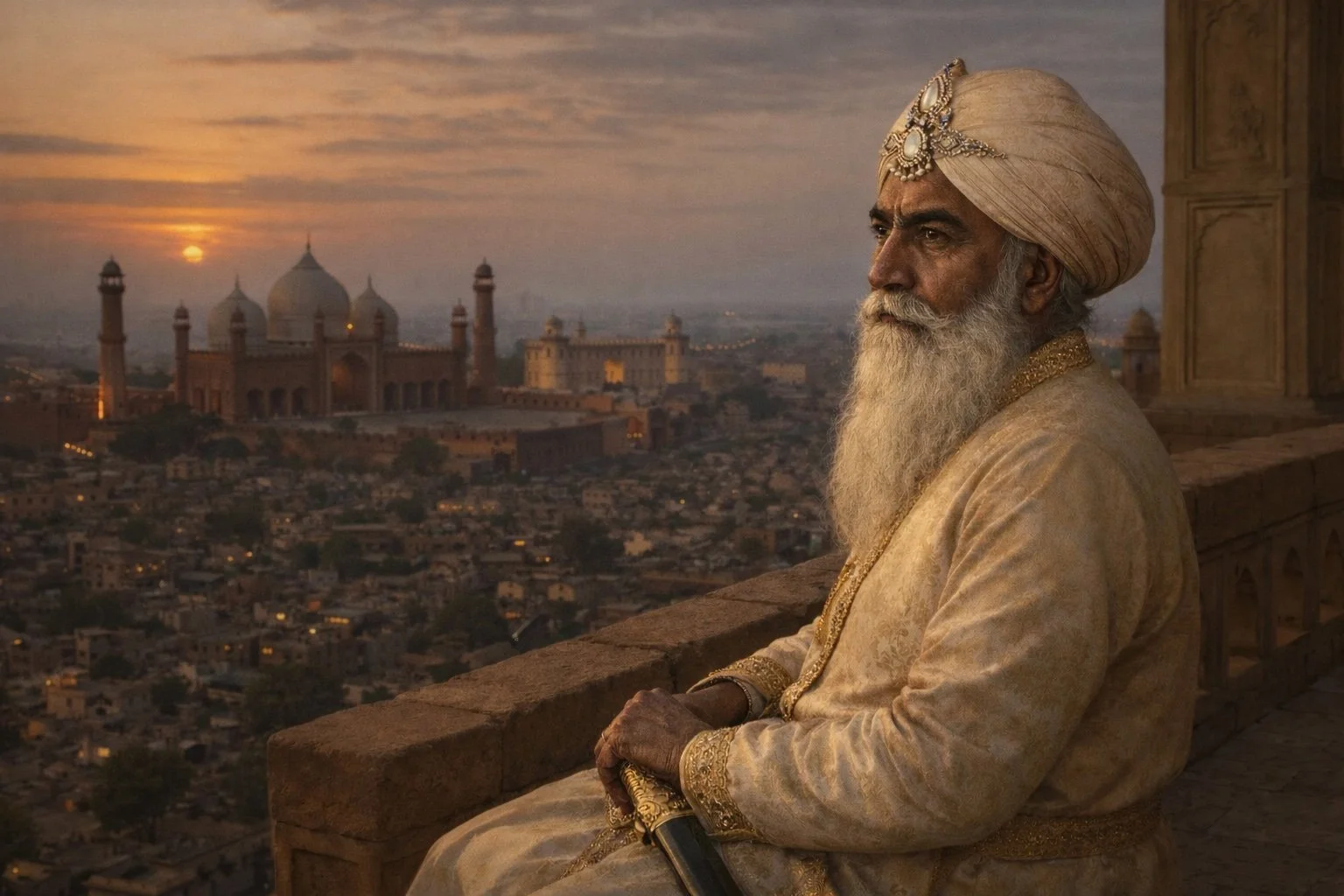
To the Maharaja who carved a Golden Age from the rubble of fallen empires.
To Punjab who saw the greatest heights.
With strength, TrishSaab