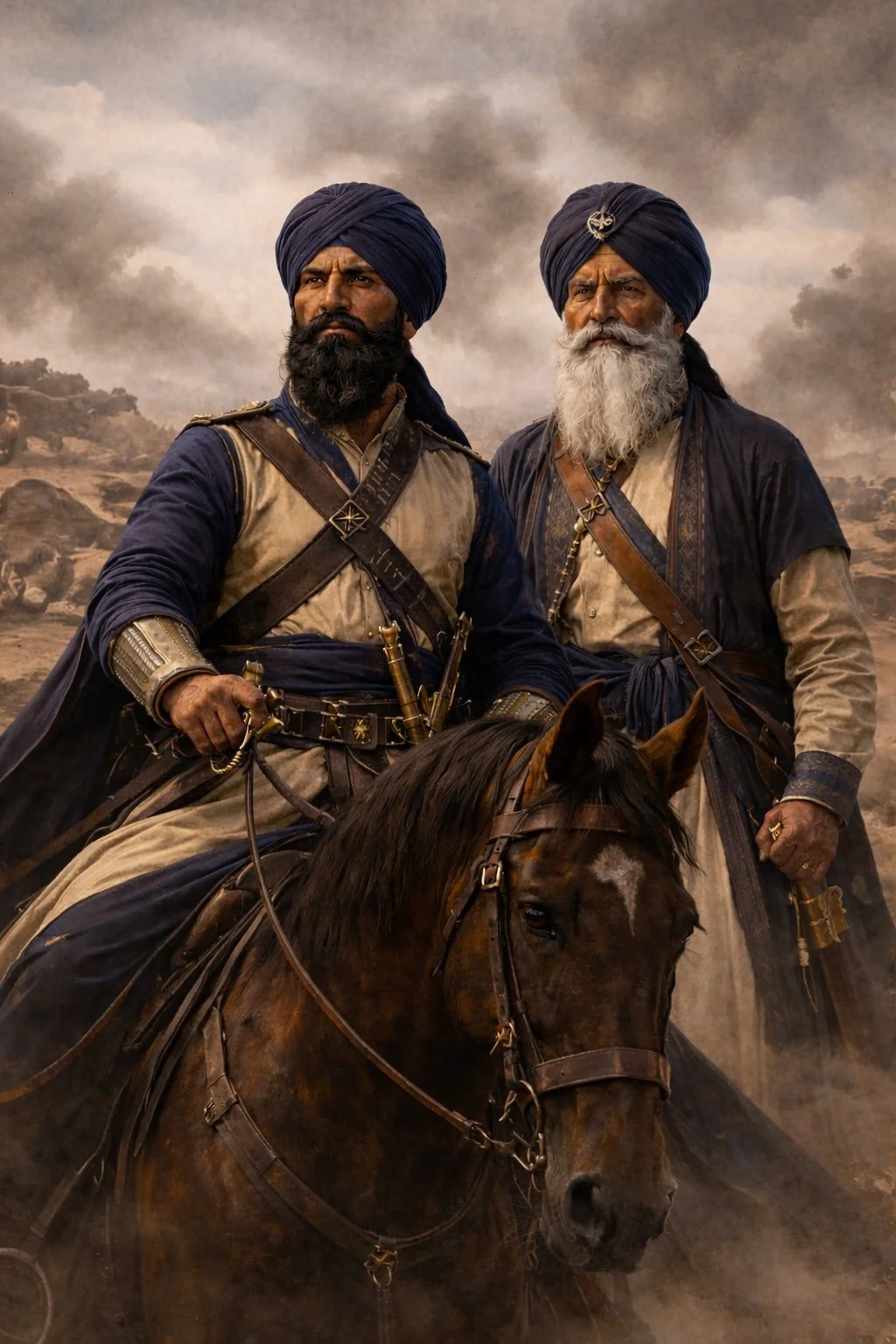
Chattar & Sher Singh - The Last Generals
They did not stand before the rising empire, nor did they shape its golden age - they stood at its end.
The Attariwala family rose to prominence during the later period of the Sikh Empire. Unlike the military leaders of the early 1700s, the Attariwalas belonged to a period where the empire had reached great territorial limits and was beginning to destabilise internally.
Sardar Chattar Singh Attariwala became one of the senior figures within this system, and his son Sardar Sher Singh Attariwala would later emerge as a key military commander during the final phase of the Sikh Empire.
To understand their role in history, it is necceseray to understand the conditions of the empire in which they operated.
The Sikh Empire in the 1840s:
After the Maharajas death in 1839, the internal balance weakened rapidly and the Lahore Durbar was divided into a number of factions.
Timeline: Leaders of the Sikh empire:
1801-1839: Maharaja Ranjit Singh
1839-1840: Maharaja Kharak Singh
1840: Maharaja Nau Nihal Singh, Maharani Chand Kaur
1841-1843: Maharaja Sher Singh
1843-1849: Maharaja Duleep Singh (under Maharani Jind Kaur’s regency, and British Supervision)
This rapid successions show that within a decade, the empire’s authority was held by court factions, and no ruler was able to fully restore the stability that existed under Maharaja Ranjit Singh. At the same time, the Khalsa Army became increasingly involved and influential in political decisions, and the Lahore Durbar became dependent on competing groups.
The First Anglo-Sikh War
In 1845-46, the Sikh Empire fought the British East India Company in the First Anglo-Sikh War. Following their defeat, the Treaties of Lahore and Bhyrowal (1846) changed how Punjab was governed - a British Resident was placed in Lahore, and British officers began influencing internal administration. The Sikh empire continued to exist, but its sovereignty was limited. This created a conflicting system where authority was no longer singular; the Punjabi officials governed and the British officials intervened.
A frontier Region - Hazara
Hazara held a unique place within the Sikh Empire, functioning mostly as a volatile frontier zone rather than a settled province. The region was most stable under Hari Singh Nalwa’s governance, as he combined both military strength with administrative oversight. The fortifications, discipline, and direct control were key factors in the stability of that period. However, following Hari Singh Nalwa’s death in 1837, this system broke down. As a result, the Lahore Durbar began appointing a succession of governors, but they all lacked Hari Singh’s ability to centralise power.
This led to instability and weakened control. However, by the late 1840s, authority in the Hazara region was re-established under Chattar Singh Attariwala. Unlike his predecessors, he used real military authority and actively resisted British interferences. A key difference between Hazara under Hari Singh Nalwa, and Chattar Singh Attariwala is the state of the Sikh Empire - during Hari Singh’s governance the empire was at its peak stability, however, during Chattar Singh’s governance, the Lahore Durbar was greatly fractured creating greater instability over the entire Sikh Empire. This turned Hazara into a centre of rebellion during the Second Anglo-Sikh War.
1848 - The Hazara Rebellion
In 1848, the tensions between Chattar Singh and the representatives of the British East India Company escalated into conflict. This was not a sudden rebellion, instead it was the result of a number of converging factors:
Disputes over authority
British stakes in Punjabi administration
Decreased trust in the Lahore Durbar
Chattar Singh refused to comply and raised Punjabi forces to oppose the British. What began in Hazara reflected a wider issue across the Sikh Empire - people no longer trusted how the empire functioned, nor the parties that controlled it.
Sher Singh Attariwala
Sher Singh Attariwala was a commander in the Khalsa Army. Initially he was aligned with the British operations, but later joined his father’s rebellion. This transformed the conflict from a regional uprising to a broad military resistance, marking the beginning of the Second Anglo-Sikh War.
The Empire’s Final War
Unlike the earlier campaigns of the Sikh Empire, this war lacked central coordination. There was no strong centre of authority directing military strategy. Instead, Chattar Singh led the resistance in the North, and Sher Singh led forces in central Punjab. The war was fought through multiple battles and the British forces secured a decisive victory at Gujrat.
The Sikh Empire Falls
Following the defeat at Gujat, Punjab was annexed by the British East India Company in march 1849. The Sikh Empire ceased to exist.
Chattar Singh Attariwala surrendered.
Sher Singh Attariwala surrendered.
The Khalsa army was disbanded.
HistoricaL Significance
Both Chattar and Sher Singh represent the final phase of the Sikh Empire. Their significance lies in leading one of the last organised resistance before the empire’s formal annexation.
Their roles connect weakened central authority, the rise of British influence, and the final response of the Sikh State.
They were not Maharajas.
They did not rule the empire at its height.
They led in its final phase. The last generals of the Sikh Empire.
To the generals who fought the empire's final war, To the soldiers who stood beside them,
To the people, land, and heritage they defended
With great respect - TrishSaab.