The Army That Defended Punjab
When Maharaja Ranjit Singh established the Sikh Empire, the army of Punjab was courageous but irregular. The warriors of the Punjabi confederacy had defended Punjab though guerrilla warfare and resilience forged in persecution. They were farmers, traders, and horsemen who fought when necessary and returned to their livelihoods when the battle ended.
But an empire required something more organised.
An army to defend its cities, soldiers to secure its borders, governors to stabilise new territories.
The Mughal Mansabdari System
For centuries before the rise of the Sikh Empire, the most formidable army belonged the Mughal Empire. Under emperor Akbar the Mughal military was organised through the mansabdari system - a ranking structure that tied administrative authority to military responsibility. Nobles were assigned ranks and required to maintain soldiers and cavalry for imperial service.
At its peak, the system allowed the Mughal Empire to sustain vast armies supported by both cavalry and artillery, but by the 1700s the system had deteriorated. Military positions were reflective of court politics, soldiers were underpaid, and corruption weakened the effectiveness of the army.
Maharaja Ranjit Singh understood that this system had both strengths and weaknesses. Rather than delegating military responsibility to nobles, he placed the army directly under the authority of the state. Loyalty was not assumed though rank, but earnt and maintained through discipline and merit.
Building the kHALSA aRMY
The army of the Sikh Empire was known as the Khalsa Fauj. Unlike the temporary forces of the misls, this was a standing army maintained directly by the state. Soldiers of the Khalsa Fauj were paid salaries equipped by the government, and trained consistently.
They preserved some traditions of the Punjabi Confederacy, but introduced new systems of organisation and discipline.
The army was divided into two primary functions:
Fauj-i-Ain: the regular army
Fauj-i-Khas: the elite corps
Fauj-i-Ain
The Fauj-i-Ain were professional soldiers who served full-time and were paid directly by the state. Unlike the earlier armies, the Fauj-i-Ain did not return to normal life between campaigns. This division of the army was organised into 3 principle branches:
Infantry
Cavalry
Artillery
Each which played a distinct role in maintaining the empire’s security.
Infantry
The infantry units were paramount under Maharaja Ranjit Singh’s reforms. Soldiers were organised into battalions trained to operate in coordinated battlefield formations.
Their training emphasised discipline and drill:
marching formations
synchronised musket firing
battlefield manouvers
defensive squats formations against cavalry
Infantry soldiers were typically equipped with flintlock muskets, bayonets, and swords carried as secondary weapons. These organised infantry formations allowed the Sikh Empire to fight structured battles and defend major Punjabi cities.
Cavalry
Cavalry was the traditional strength of Punjabi warfare, and it remained a central component of the Khalsa army. The cavalry of the Sikh Empire combined both regular regiments and irregular mounted warriors. Regular cavalry operated alongside infantry and artillery in organised battlefield formations, while irregular cavalry specialised in rapid movement, reconnaissance, and frontier warfare.
Cavalry units played a crucial role in the following:
scouting and gathering information
flanking manoeuvres during battle
frontier patrol
Their mobility made them particularly effective across the plains and frontier regions of the empire.
Artillery
One of the most significant developments under Maharaja Ranjit Singh was the expansion of artillery. Large foundries were established in Lahore, manufacturing cannons and ammunition. Under the supervision of European officers, particularly Claude Auguste Court, artillery units were reorganised and trained according to modern battlefield practices.
The artillery was separated into three specialised divisions, including the following:
Topkhana-i-Jinsi: heavy artillery
Topkhana-i-Aspi: horse artillery
Topkhana-i-Shutri: camel artillery (mainly used in frontier regions)
Horse artillery units allowed cannons to move rapidly across the battlefield, often alongside the cavalry units, providing flexible firepower. By the golden age of the Sikh Empire, its artillery was regarded as one of the most disciplined and formidable artillery forces in the region.
Among the notable artillery commanders of the Sikh Empire was Mian Ghaus Khan, a muslim artillery general who commanded the empire’s artillery during the Anglo-Sikh Wars.
Fauj-i-Khas
Alongside the regular army, Maharaja Ranjit Singh created an elite corp known as the Fauj-i-Khas, representing the highest standard of discipline and training within the Khalsa army. The soldiers of the Fauj-i-Khas were trained according to European military methods, by officers who served European armies during the Napoleonic Wars.
Because these officers were veterans of European armies, the initial drills in the Fauj-i-Khas were heavily influenced by Napoleonic military practices. Commands used during training were originally derived from French military terminology before being gradually adapted into Punjabi and Persian usage.
The elite corps maintained strict discipline and distinctive uniforms. The soldiers trained extensively in marching drills, battlefield formations, and coordinated musket fire. Within the empire, they served as a powerful fighting force and as a model for the rest of the army.
A Secular Army
The Khalsa army recruited Punjabi’s of all faiths, continuing a tradition where merit and ability outweighed religious identity. The soldiers were rewarded based on their loyalty, discipline, and skill; promotions were often based on military performance rather than lineage, and offers were expected to adhere to strict standards of discipline within their units.
The result was an army that combined unshakable courage and the martial traditions of the Punjabi Confederacy, with the organisation and professionalism of modern militia to defend an empire. It was this army that allowed the Sikh Empire to expand its influence, and secure and govern territories for nearly half a century.
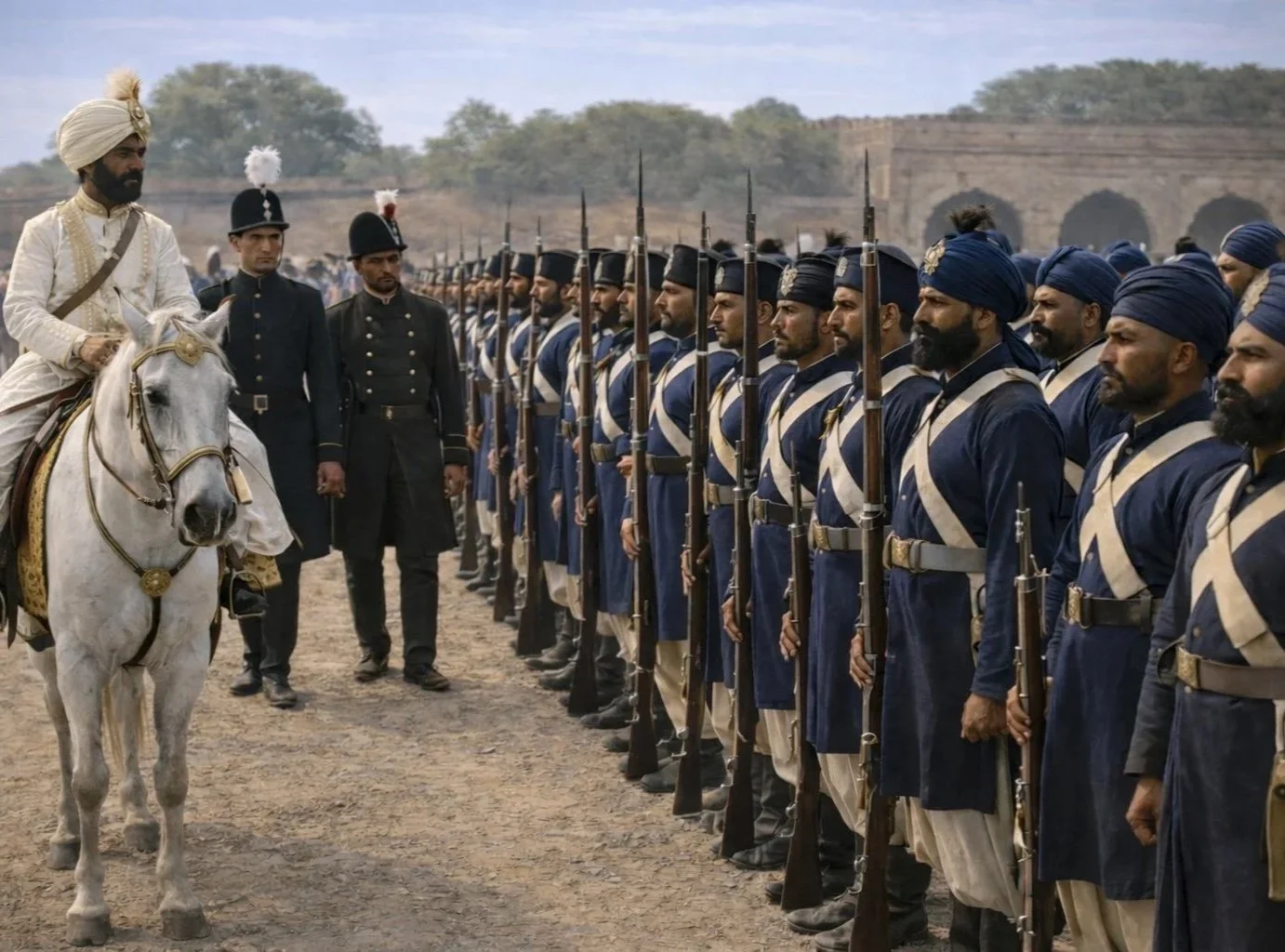
A depiction of the Maharaja inspecting the Fauj-i-Khas