
The Role of Foreign Officers
Foreigners in a soveriegn empire
Foreign presence was generally seen as a sign of weakness, or indication of colonial takeover in India, however, in Punjab this was not the case.
The Sikh Empire, under Maharaja Ranjit Singh employed foreign officers in its court, army, and frontier administration - but on strict terms.
This was not the Sikh Empire falling to foreign influence.
It was Punjab’s rise through selective modernisation.
Why Ranjit Singh Invited Foreign Officers
After a century of battles, uprisings, and warfare, Punjab learnt what other rulers had overlooked - the future of warfare was dynamic.
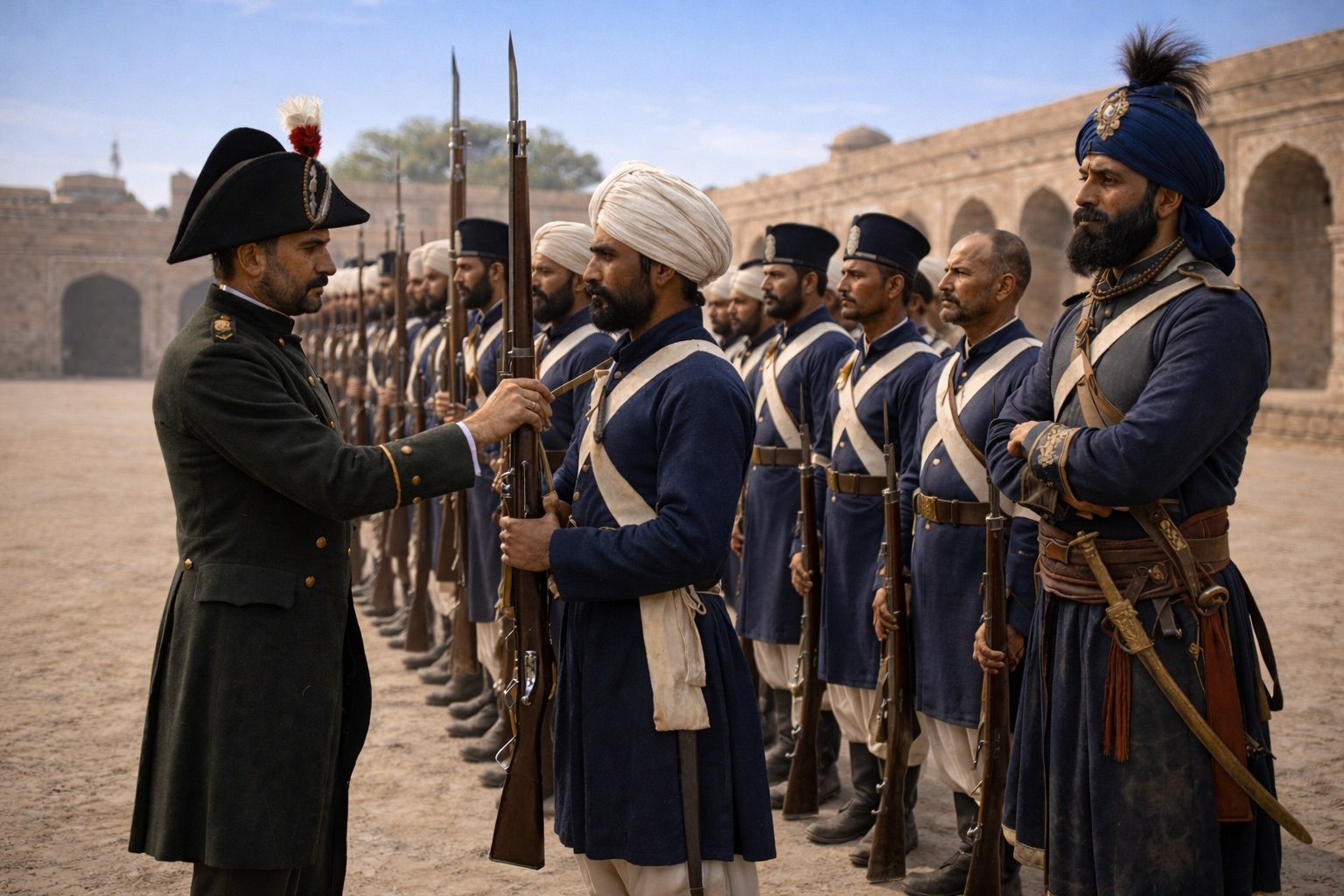
Being forced to prove its courage in the outskirts of the Punjab region, through guerrilla warfare, and on horseback, the Punjabi forces knew that courage alone would not withstand the artillery, discipline, and warfare tactics of the British East India Company. Nor would courage guarantee dominance over the Afghan borders. Resultantly, Ranjit Singh sought out veterans of Napoleonic Europe - men trained in modern warfare, who were now displaced after the fall of Napoleon. They entered Punjab as craftsmen; engineers of infantry, architects of artillery, and specialists in militia.
Specifically, the British East India Company bought systems that were not widely used in Punjab:
Professionally drilled infantry - tight formations, and firing techniques
Mobile, advanced artillery
Bureaucratic supply chains
Punjab already had courage and cavalry strength, the British East India Company had the advantage of industrial style warfare.
After Napoleon’s defeat, many of his trained officers were unemployed. Europe didnt hire them for a number of reasons:
They were politically suspicious: Many of Napoleon’s officers rose ranks during the French Revolution and were loyal to him, not other Kings/ leaders. European monarchies did not trust them.
Armies were downsized: After many years of war, European armies were downsized and no longer required as many officers.
It was risky: The officers were capable of inspiring unrest or future resistance.
Contrastingly, Punjab was independent, wealthy, expanding, and strategically important so the officers moved eastward.
It is important to note that Maharaja Ranjit Singh still employed Punjabi troops, and the European officers did not replace native ones. The European officers were employed to train, organise, and modernise the Punjabi artillery and infantry.
Their role was to import expertise into Punjab.
Who they were - What they did
The following became the architects of Ranjit Singh’s military transformation:
Jean Baptiste Ventura - A French officer who trained and restructured the Fauj-i-Khas - elite corps of the Khalsa army. He introduced strict infantry discipline, drill formations, and uniforms that mirrored European armies.
Jean Baptiste Avitabile - A French officer who brought expertise in military police and civil order. He was later positioned as the Governor of Peshawar by Maharaja Ranjit Singh, where he exercised control over the region though discipline and strategy.
Claud Augustus Court - Maintained the empire’s artillery divisions, trained gunners, built foundries - workshops used to cast metal, and created specific battle maps of Punjab’s shifting frontiers.
Paolo Di Avitabile - alongside other officers, handled battlefield commands, frontier intelligence, general governance, and internal surveillance. This specifically helped maintain stability in volatile regions like the Khyber corridor.
Each brought with them both military skill, and an understanding of logistics, communication, and empirical administration. They spoke French, Persian, and Punjabi.
Power without surrender
As Maharaja, Ranjit Singh was not blind to the risks of foreign involvement in his administration. In other regions of India, like Bengal, Awadh, Mysore, and the Maratha confederacy, foreign alliances quickly turned to foreign dominion.
As a result, the Sikh Empire welcomed foreign skill, but kept the ultimate control with the Maharaja.
Within the empire:
No foreign officer held supreme command.
No foreign officer was granted influence over religious or state policies.
Despite high salaries, their political voice was limited.
The foreign officers were often paired with Punjabi commanders, ensuring that the military and reforms introduced remained grounded in Punjab.
What their presence meant
The presence of European officers in Punjab changed how the empire was perceived. The British saw a stable and modern kingdom, especially when compared to the prior uprising of the Punjabi confederacy. The neighbouring Afghan and Central Asian empires saw an empire with structure, and the people of Punjab saw a ruler who adapted strategy and leadership.
The Khalsa army had transformed from guerrilla warfare to one of the strongest armies in Asia.
1. The Sikh Empire:
70,000 - 80,000 troops overall
25,000 - 30,000 cavalrymen - the core strength of the Khalsa Army was in its cavalry units.
35,000 - 40,000 infantrymen
owned 300 - 400 artillery guns, including field artillery
organised troops with a centralised, modern system
2. The British East India Company:
200,000-250,000 troops
20,000 - 30,000 cavalrymen
150,000 infantrymen
owned over 500 systemised artillery guns
organised troops through a high bureaucratic, regimented system
Note: The numerical strength of the British East India Company did not consist primarily of soldiers from Britain. A large number of the company’s troops were Indian sepoys trained and commanded under British officers.
It is important to distinguish that 80,000 Punjabi troops did not face 250,000 British-born soldiers; rather, the company mobilised local forces within their structure.
3. Afghan Forces:
consisted of 40,000 - 60,000 troops
Note: Afghan strength and numbers varied greatly, as the army relied on tribal mobilisation.
4. Mughal Empire:
By the time of the Sikh Empire, the Mughal forces and military power had reduced to regional forces and did not pose any threat to other authorities in Asia.
The foreign officers of the Sikh Empire became symbols of Maharaja Ranjit Singh’s vision - a Kingdom open to the world, yet rooted in Punjab.
Legacy
Following Maharaja Ranjit Singh’s death in 1839, many of the foreign officers remained in Punjab for the following years. The legacy of the foreign officers in Punjab lives beyond battle records, for it shaped the army manuals, barrack structures, and military drills that impacted how the Sikh Empire prepared for war.
To the Maharaja who built an empire that invited the world in, without giving his kingdom away.
With admiration - TrishSaab. 