
The Early Challenges of Establishing an Empire
The road to an empire did not begin with Ranjit Singh’s coronation. It began with exiles gathering by firelight, planning guerrilla attacks and their survival.
AFTER THE GURU
Guru Gobind Singh was assassinated in 1708 in Nanded. The details of his death/ assassination remain unclear with some sources saying it was orchestrated by Wazir Khan - The Governor of Sirhind; a Mughal stronghold in Punjab, and others believing it was the act of a lone assassin. This was the first time in history, since the founding of Sikhism by Guru Nanak that the Sikhs were left without a spiritual leader. As a result, a dark and violent era of bloodshed, betrayal, and exile preceded the community’s rise to self-governance.
Banda Singh Bahadur was a disciple of Guru Gobind Singh. Alongside the Panj Piyare - first five to be baptised as sikh, Banda Singh led a powerful but short rebellion that shook the Mughal Empire’s footing in Punjab. His early victories were paramount - The Fall of Sirhind and Samana, land redistribution, and the first signs of a Khalsa Raj in Punjab. However, in 1716, Banda Singh and his army were captured in a siege at Gurdas Nangal, and eventually brutally executed in Delhi.
Note: The execution of Banda Singh and his army was extremely brutal, part of the reason for this is that the Mughal emperor at the time - Emperor Farrukhsiyar was losing power to factions within the Mughal court, and the empire was losing its dominance. The brutality of this execution was to send a message - rebellion would be annihilated by the Mughal Authority.
HUNTED, SCATTERED, DEFIANT
In the following decades, the Sikh were targeted by Mughal figures of authority in Punjab. The Governor of Lahore, Zakariya Khan was particularly infamous for his brutality - placing bounties on Sikh heads. As a result, entire villages in Punjab were targeted and the community was driven out of the urban centre.
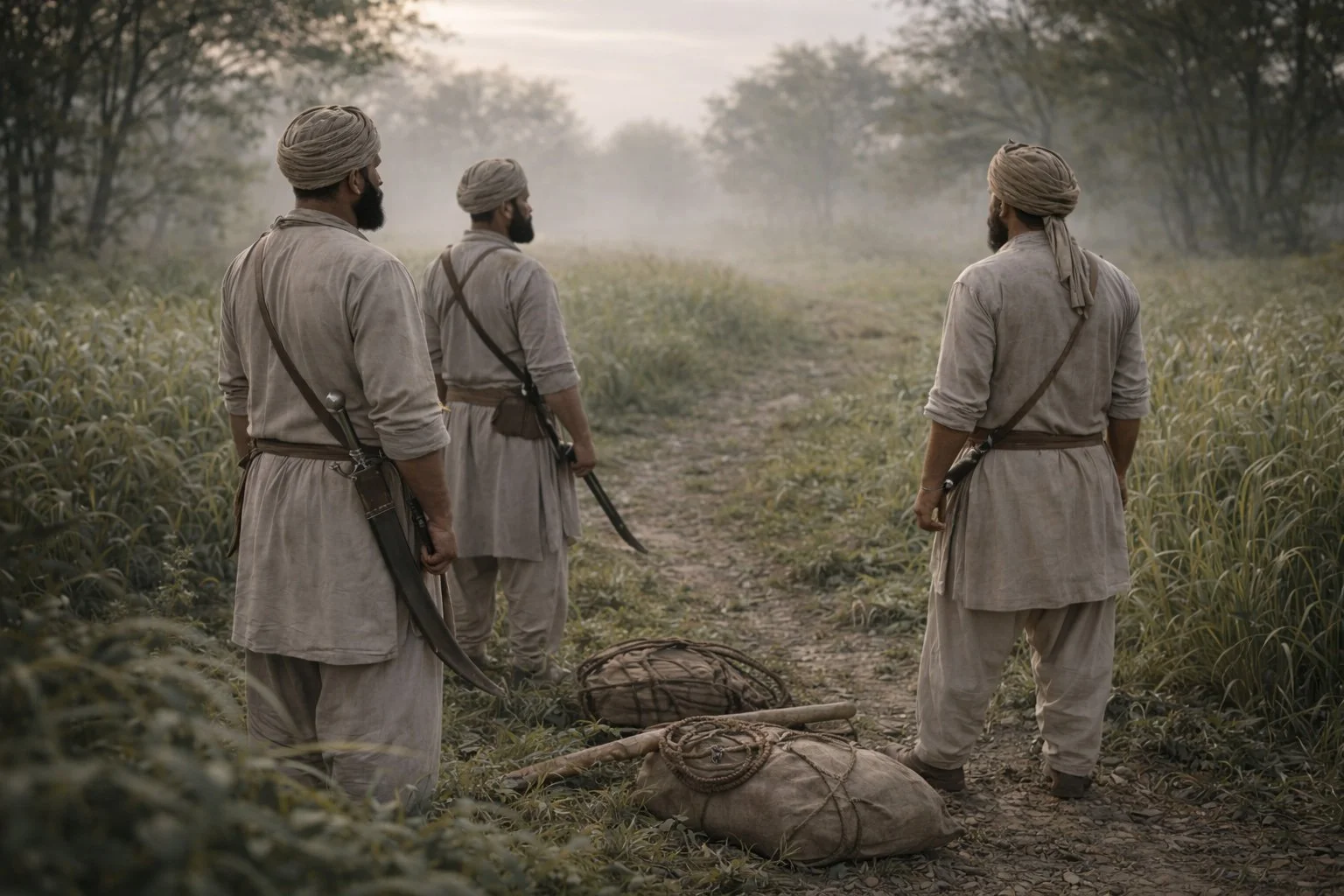
But exile did not mean erasure - not to the Punjabi spirit. The Sikhs of Punjab became guerrilla warriors - raiding supply lines, rescuing prisoners, and fighting running battles with imperial troops. They continuously resisted those who tried to suppress the Punjabi rebellion/s of the early 1700s. Faith became resistance, and resistance became the Punjabi identity.
THE WORLD BURNS AROUND THEM
The Mughal state may have been an enemy, but it was also collapsing. In 1739, during the reign of Emperor Muhammad Shah, the Persian ruler Nadir Shah sacked Delhi, looting immense wealth including the Peacock Throne and Kohinoor Diamond. This initially exposed the weakness of the Mughal empire, and a decade later, the Afghan ruler Ahmad Shah Durrani attempted multiple invasions, turning Punjab into a battleground.
The constant warfare weakened the Mughals, but devastated Punjab. Cities were looted, populations displaced, fields burned. There was no true ruler of Punjab, and in this vacuum of authority, Sikh warriors began to emerge as the protectors of the land. The offered safety to traders, peasants, and pilgrims. This was the beginning of the foundations of the Punjabi Confederacy.
THE RISE OF THE MISLS
By the mid 1700s, the Sikhs had organised their community in autonomous warrior bands knows as Misls - derived from the Persian word Masl - مثل, meaning equal or alike.
Each Misl was led by a sardar - chief, however as the confederacy grew in size and power, some larger Misls like the Bhangi had multiple leaders. The chiefs often competed for land and influence, but were united by faith and survival.
The Misls were not a standing army - they were mobile, loosely federated, and deeply local. They employed both cavalry and infantry, and all operated with the goal of defending Punjab.
BEYOND BORDERS OF FAITH
It is easy to assume that the Sikh Empire, which would eventually emerge from this confederacy, was purely Sikh in nature - but that is a simplification.
From its earliest days, the Sikh rebellion was fuelled by the principles of justice, and the empire that followed reflected that. Under Maharaja Ranjit Singh, the empire was secular, and all religions in Punjab were given due respect and importance.
The Sikh Empire was built on decades of resistance - by communities that refused to leave their homeland, by warriors who fought for survival.
To those who led from the shadows - and refused to fall silent.
With reverence, TrishSaab