The Empire’s Influence on Modern Punjab
Throughout history, empires rise and fall. But their legacies remain - in stone, in soil, in spirit.
1. Unity and Administration
Before Maharaja Ranjit Singh’s political and administrative reforms, Punjab was a fragmented region of competing misls, regional powers, and foreign invaders. His unification of the region led to Punjab becoming a singular territory as an independent state - prior to this, Punjab was a Mughal province.
Even after the annexation of Punjab to British India, the British administration retained many of the structures from the Sikh era - particularly the military formations. Many of Punjab’s district boundaries, revenue models, and judicial systems under colonial rule, were adapted from the Sikh Empire’s early blueprint.
2. Military Tradition
The Khalsa Army was not just the fighting force of the Sikh Empire; it was an organised, disciplined, modern military. It used:
Standard uniforms and military ranks.
Artillery divisions and European instructors.
A standing and loyal army
Following annexation, the British acknowledged this military professionalism. Punjabi soldiers were actively recruited into the British Indian Army - especially during the World Wars.
The notion of the Punjabi soldier began in the early rebellions and was solidified in the Sikh Empire.
3. ARCHITECTURE and Urban Design
Amritsar, Lahore, Gujranwala, and other major Punjabi cities still hold architecture of the Sikh Empire. Specifically:
The restoration of the Golden Temple.
The construction of Hazuri Bagh Baradari, Maharaja Ranjit Singh’s Samadhi, and Gurdwara Panja Sahib.
The urban planning of the Lahore city, including the preservation of Mughal-era monuments and Sikh-era additions.
The combination of Mughal, Sikh, and (later) European styles influenced Punjab’s layered identity.
4. Cross Religious Identity
Despite being led by a Sikh Maharaja/ royal family, the empire was not a theocracy. Maharaja Ranjit Singh’s court was diverse, and secular. This pluralism still shapes Punjab’s culture - where diverse communities live together.
5. Regional Pride
Over time, the Sikh Empire became a symbol of Punjabi sovereignty - a time when Punjab thrived under indigenous leaders. This fuelled regional pride, literature and poetry, and nationalist movements.
It became a reference point:
Of an arguably ideal governance system rooted in justice and strength.
A cautionary tale of what happens when the central figure of a system collapses.
And an aspect of cultural identity.
The Sikh Empire lasted only 5 decades, but rose at a time in history when Punjab and Punjabi culture demanded sovereignty. While its fall was inevitable, its influence remains in the soil and spirit of modern Punjab.
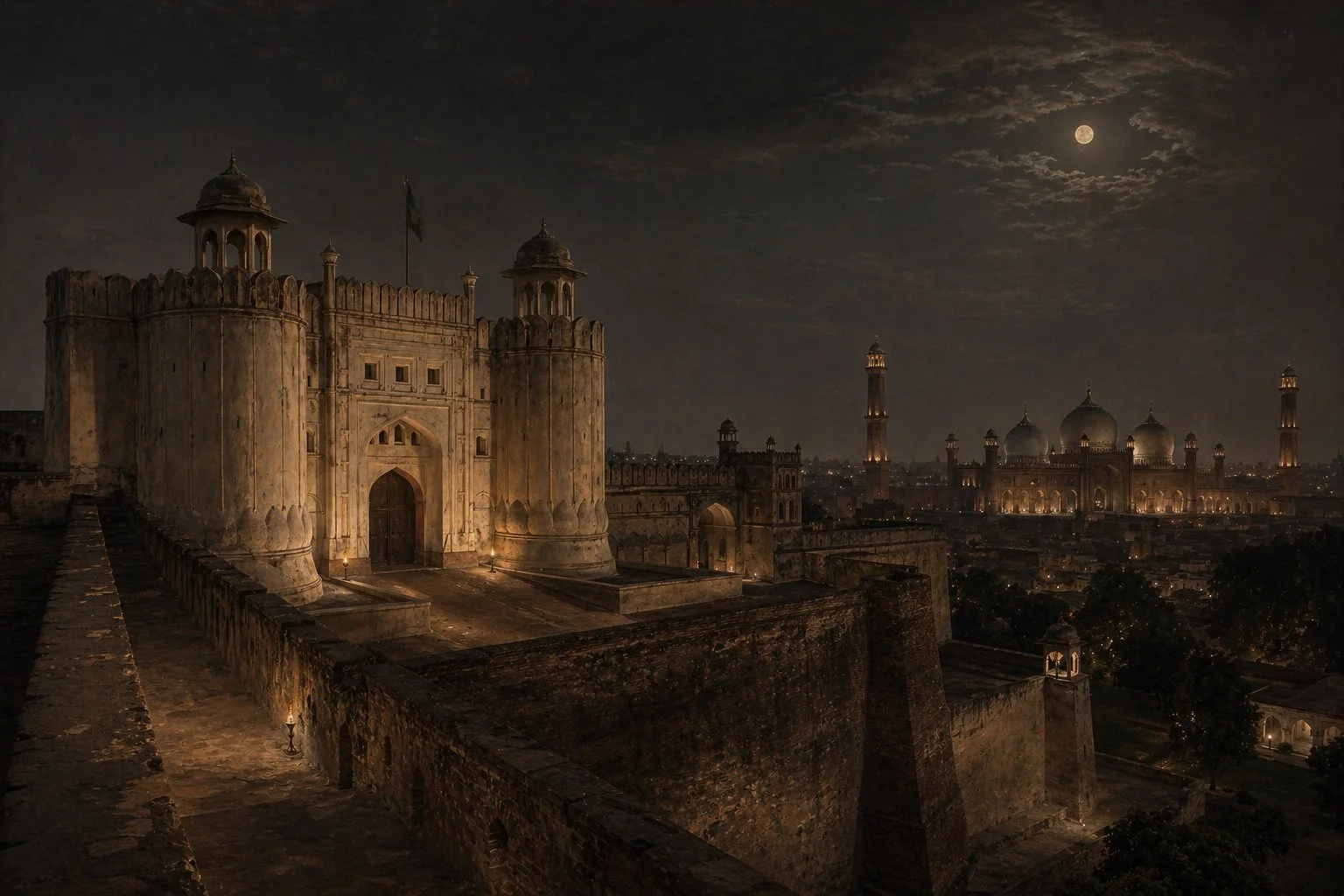
A depiction of the Lahore fort and Badshahi Mosque at night.
To the rise and fall of empires,
To those who left a legacy of independence and native glory,
To the people who still remember,
To the empire that gave Punjab a centre, and to the people who carry its stories forward,
With pride and remembrance, Trish Saab.