The Toshakhana - Treasury of the Empire
The Toshakhana referred to the royal treasury of the Sikh Empire - a secure repository where the state’s wealth was stored. The word toshakhana is derived from Persian; tosha - wealth, khana - store/ house/ room. Under the Sikh Empire, the toshakhana became a paramount institution of the Punjabi state, functioning as a central symbol of sovereignty, diplomacy, and imperial authority.
the Royal Treasury at Lahore
During Maharaja Ranjit Singh’s reign (1801-1839), the primary toshakhana of the Sikh Empire was held in secure chambers within the Lahore Fort - the imperial capital. The fort had serviced as a seat of power through the previous Mughal Empire, and its fortifications made it a secure location for immense wealth.
Within the chambers, the following were stored:
Gold and silver coinage
Jewels
Royal ornaments and regalia
Weapons and ceremonial arms
Diplomatic gifts from foreign rulers
Wealth seized during military campaigns
Administration
The toshakhana was administered by appointed officials responsible for maintaining records and safeguarding its contents. Each item was documented in the empire’s inventory. The officials had the duty to ensure:
The documentation of valuables
The distribution of royal gifts
The safeguarding of state property
The verification of tributes received from subordinates
The treasury contained both state assets and diplomatic gifts. As a result the appointed officers were trusted by both Maharaja Ranjit Singh, and the Lahore Durbar.
Who had acces to the Toshakhana?
Access to the treasury was strict and heavily restricted as it contained the most valuable assets of the state, therefore entry to its chambers was limited to a limited number of statesmen:
Maharaja Ranjit Singh: As the sovereign of the empire, he held ultimate authority over the treasury. The Maharaja had the authority to order the deposit, removal, or distribution of assets. He frequently used items for diplomatic and ceremonial purposes, presenting jewels, robes, weapons to visitors, military commanders, and nobles.
Toshakhana Officials: The everyday supervision of the treasury was delegated to appointed officials responsible for the maintenance of, and guarding the assets. They recorded each asset, oversaw deposits, managed distribution (particularly of gifts), and ensured each valuable was accounted for.
Senior Court Officials: On certain occasions, high ranking court officials were permitted access to the treasury (often under supervision). This could include senior ministers, financial officers, or court officials. It is important to note that they did not have unrestricted authority, and were only granted access when the treasury was open for official state reasons.
Military Commanders: Senior military commanders occasionally received items from the treasury (generally related to battle or rewards), but they did not independently access it and their rewards were distributed under the authority of the Maharaja.
The Empire’s wealth
The wealth in the empire’s treasury was obtained from a number of sources:
Land revenue: The primary source of income for the empire was land revenue collected across Punjab and its territories - Multan, Kashmir, Hazara, Peshawar. The agricultural productivity of the region contributed significantly to the monetary wealth and revenue of the empire.
Tributes and gifts: Received from subordinate chiefs, regional rulers, and foreign envoys, these gifts were often jewels, gold vessels, and weapons.
War booty: The military successes also contributed to the toshakhana. Wealth from regions like Multan, Kashmir, and Peshawar was incorporated.
The Koh-i-Noor Diamond & other jewels
Originally part of the Mughal imperial treasury, the Kohinoor diamond was possessed by Maharaja Ranjit Singh in 1813 after the Afghan ruler Shah Shuja Durrani surrendered it. The diamond was kept mostly within the royal treasury, but occasionally worn by the Maharaja during ceremonies.
There treasury also contained other jewels - emeralds, rubies, pearls, and royal ornaments/ regalia. Many of these were incorporated into ceremonial objects such as swords, turbans, and throne decorations. These items were not merely decorative; they were visible representations of imperial authority.
Modern day Value
There is no exact number for the value of the Sikh Empire’s treasury as it fluctuated alongside the empire’s growth and recessions. The inventories taken at the time of the empire’s annexation in 1849 suggest the following:
The chambers held gold/ silver coinage, diamonds, rubies, emeralds, pearls, jewelled weapons, regalia, gold/ silver vessels, and ceremonial armour in immense quantities.
Based on this, the most accepted estimate is that the treasury was worth roughly $2-4 billion USD in modern value. However the true value may vary as many historical artefacts and precious metals/ stones fluctuate in value.
One of the most recognised objects in the treasury was the Kohinoor diamond. It has a modern value between $500 million - $1 billion USD.
The Empire’s treasury was so vast because the state’s wealth came from several different sources and by 1839, it had become one of the richest royal treasuries in Asia.
Additionally, the annual revenue of the Sikh Empire itself is estimated to sit between 20-30 million nanakshahi rupees in the 1830s, worth between $3-6 billion USD today.
Practical uses of the treasury
The wealth of the toshakhana had a number of practical functions:
Military expenditure: Funds supported the maintenance of the Khalsa Army, particularly in the payment of soldiers/ generals, procurement of weapons, and upkeep of artillery.
Diplomatic gifts: The Maharaja would distribute valuable gifts to visiting envoys, allies, and officials.
Religious patronage: The Sikh Empire used its wealth to support religious institutions, donating to temples, mosques, shrines, and other places of worship across the empire.
An idiosyncratic aspect of the Sikh Empire’s treasury was the way that Maharaja Ranjit Singh treated the wealth within it. Unlike other rulers, he was known for living a relatively modest life despite having ultimate authority over a prosperous state and extremely wealthy treasury. Those who were invited/ visited the Lahore Durbar noted that the Maharaja dressed simply and did not surround himself with excessive luxury. Instead, the wealth of the treasury was employed as a political and diplomatic tool.
After the fall of the Empire
After the death of Maharaja Ranjit Singh, political instability grew within the Lahore Durbar. This weakened the empire and its central authority. After the Anglo-Sikh wars, the Sikh Empire was annexed to the British East India Company. When the British forces took control of Lahore in 1849, they seized the contents of the toshakhana, which were incorporated into British collections.
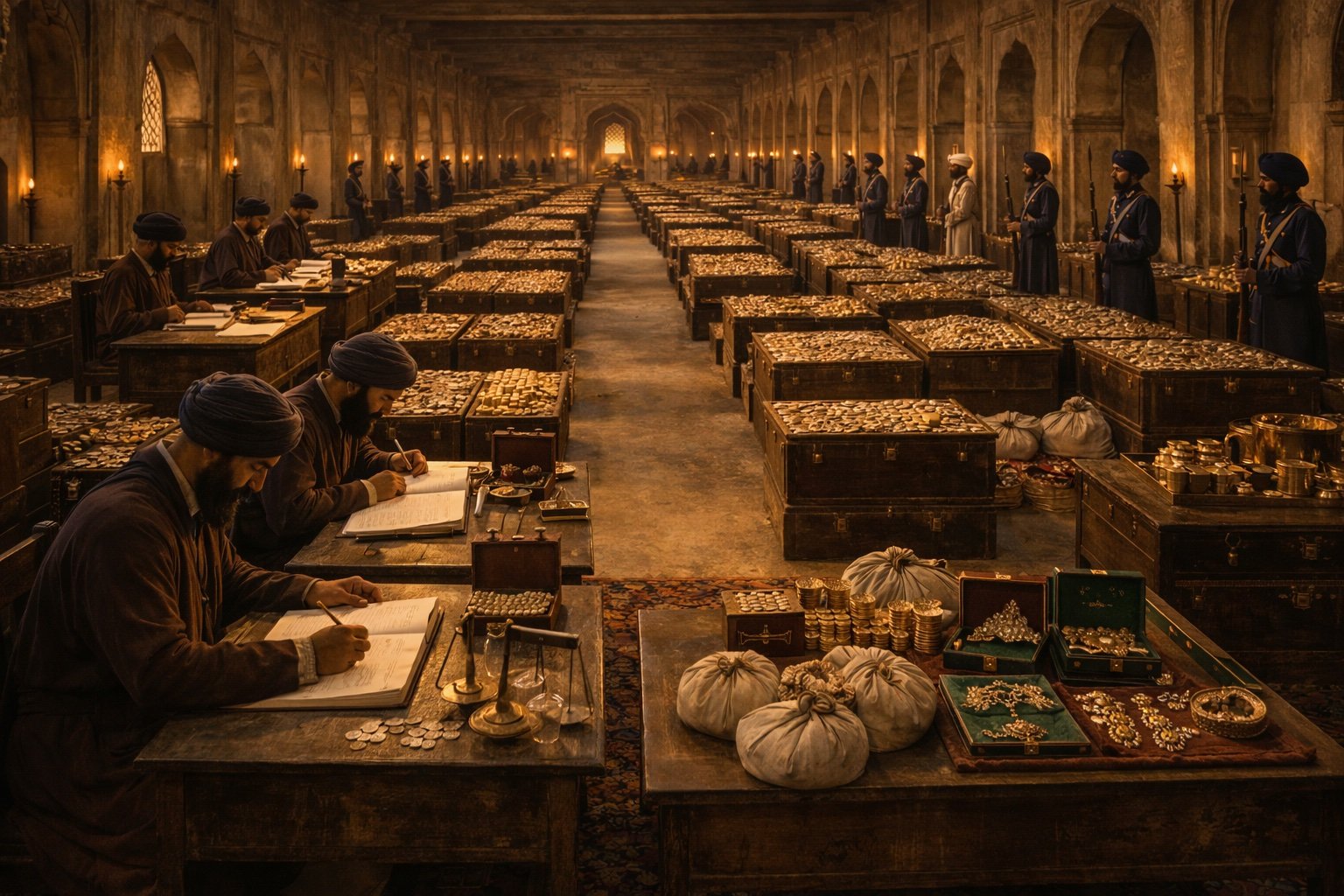
A depiction of the gold chamber of the Sikh Empire’s treasury