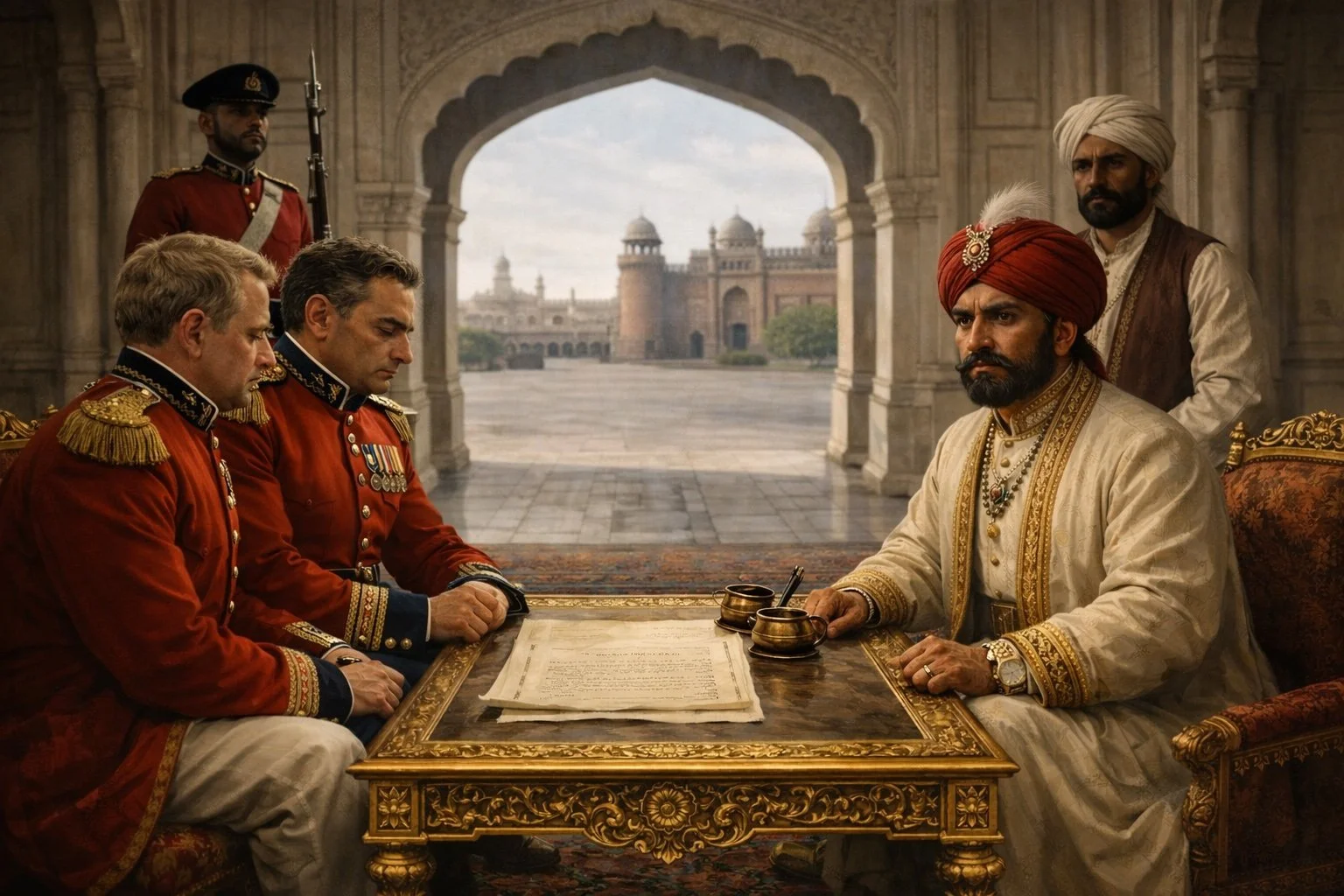
The Treaty of Amritsar (1846)
What was the Treaty of Amritsar?
Signed on March 16, 1846, The Treaty of Amritsar was another agreement between the British East India Company, and Gulab Singh Dogra - a nobleman of the Sikh Empire. It was through this treaty that Kashmir was detached from the Sikh Empire and the Princely state of Jammu and Kashmir was placed under Dogra rule.
Context
Under the Treaty of Lahore, the Sikh state owed the British East India Company an indemnity of 15 million nanakshahi rupees. When the Lahore Durbar was unable to pay the full amount, the British instead took the Hill Territories, and negotiated seperately with Gulab Singh Dogra - who had remained strategically diplomatic during the Anglo-Sikh conflict. For a payment of 7.5 million nanakshahi rupees, Gulab Singh was recognised as the independent Maharaja of Jammu and Kashmir, and the first of the Dogra dynasty.
Why Gulab sINGH dOGRA?
Gulab Singh Dogra was a powerful noble within the Sikh Empire. The Dogra family, notably the Dogra brothers - Dhian Singh Dogra, Suchet Singh Dogra, and Gulab Singh Dogra, had governed Jammu (when it was under Punjabi administration) and played major roles in military campaigns.
During the first Anglo-Sikh War, Gulab Singh avoided direct confrontation with the British and remained diplomatic. As a result, the British chose to elevate him rather than administer the region directly.
Terms of the Treaty & Their Impact
Gulab Singh agreed to pay 7.5 million nanakshahi rupees, in exchange for the title of Maharaja of Jammu and Kashmir. Resultantly, the region became a princely state under British suzerainty.
The consequences of this treaty were the following:
It permanently separated Kashmir from Punjab/ Sikh rule.
It formalised Dogra rule over a region with a muslim majority population.
It laid foundations for future regional tensions.
For the Sikh Empire specifically, it symbolised fragmentation.
A cumulative impact:
Together, the Treaties of Lahore and Amritsar did the following:
Reduced Punjabi power significantly
Allowed British oversight
Detached large territories
Shifted political authority away from Lahore for the first time in centuries.
The empire technically still stood but it was no longer an independent sovereign entity, and in the following years it would fall to British rule entirely.