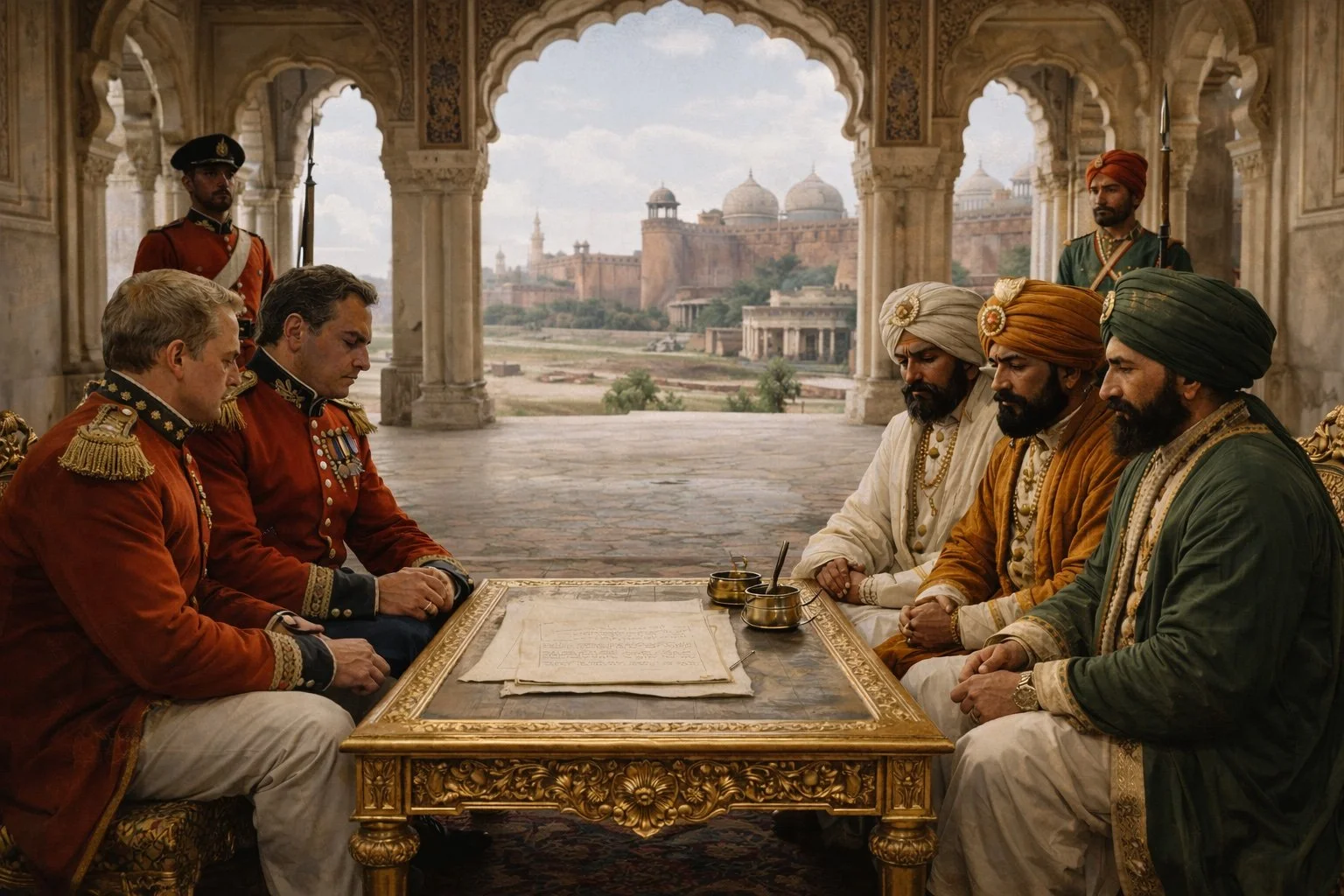
The Treaty of Lahore (1846)
What was the treaty of lahore?
Signed between the Sikh Empire and the British East India Company on March 9, 1846 the Treaty of Lahore marked the formal end of the First Anglo-Sikh War.
The treaty reduced the sovereignty of the Sikh Empire greatly, and gave the British East India Company large stakes in Punjabi politics.
Context
In the 1840s, court rivalries, assassinations, shifting alliances, and political autonomy of the Khalsa Army weakened the empire’s central authority greatly. By 1845, the underlying tensions between the Punjab and the British escalated into open conflict, and the First Anglo-Sikh War ended with the British victory in the Battle of Sobraon. As a result, Maharaja Duleep Singh was forced to negotiate.
Terms of the Treaty
Territorial Modifications
The Sikh Empire ceded the following territories, which were annexed by the British:
The Jullundur/ Bist Doab - modern day Doaba in Punjab, India; located between the Beas and Sutlej Rivers.
All Sikh territories south of the Sutlej River.
Note: In the Treaty of Amritsar (1809), the Sutlej River was agreed to be a boundary between Ranjit Singh’s Sikh Empire and the British East India Company. The Cis-Sutlej Princely States - Patiala, Nabha, and Jind were allied with/ under British protection. As a result, the Sikh Empire expanded north. The Treaty of Lahore reinforced this agreement, stating that any claims or administrative influence that the Sikh Empire held in the Cis-Sutlej region would be handed to the British East India Company. In simple terms, the territorial loss for the Sikh Empire was the Bist Doab, and the administrative loss was any stakes the empire held in the Cis-Sutlej region.
2. Indemnity
The Sikh Empire was required to an indemnity of 15 million nanakshahi rupees. The Lahore Durbar was unable to pay the full amount, and therefore surrendered the hill regions between the Beas and Indus Rivers instead.
This clause directly links to the Treaty of Amritsar (1846).
3. Reduction of the Army
The Sikh Army was reduced in size, and had to meet the following conditions:
maximum infantry of 25,000 soldiers
limited cavalry
artillery restrictions
4. Placement of British Troops in laHORE
British troops were allowed to remain in Lahore to protect Maharaja Duleep Singh.
5. Duleep Singh remains Maharaja
The treaty allowed Duleep Singh to remain Maharaja of the Sikh Empire, but paramount authority shifted to British Officials such as Henry Lawrence who would oversee regency of the empire.
Conseqeunces
The Treaty of Lahore (1846) did not annex Punjab immediately, but the empire was no longer independent and sovereign. Soon after, the subsequent treaty of Amritsar (1846) would further alter the political state of the empire.