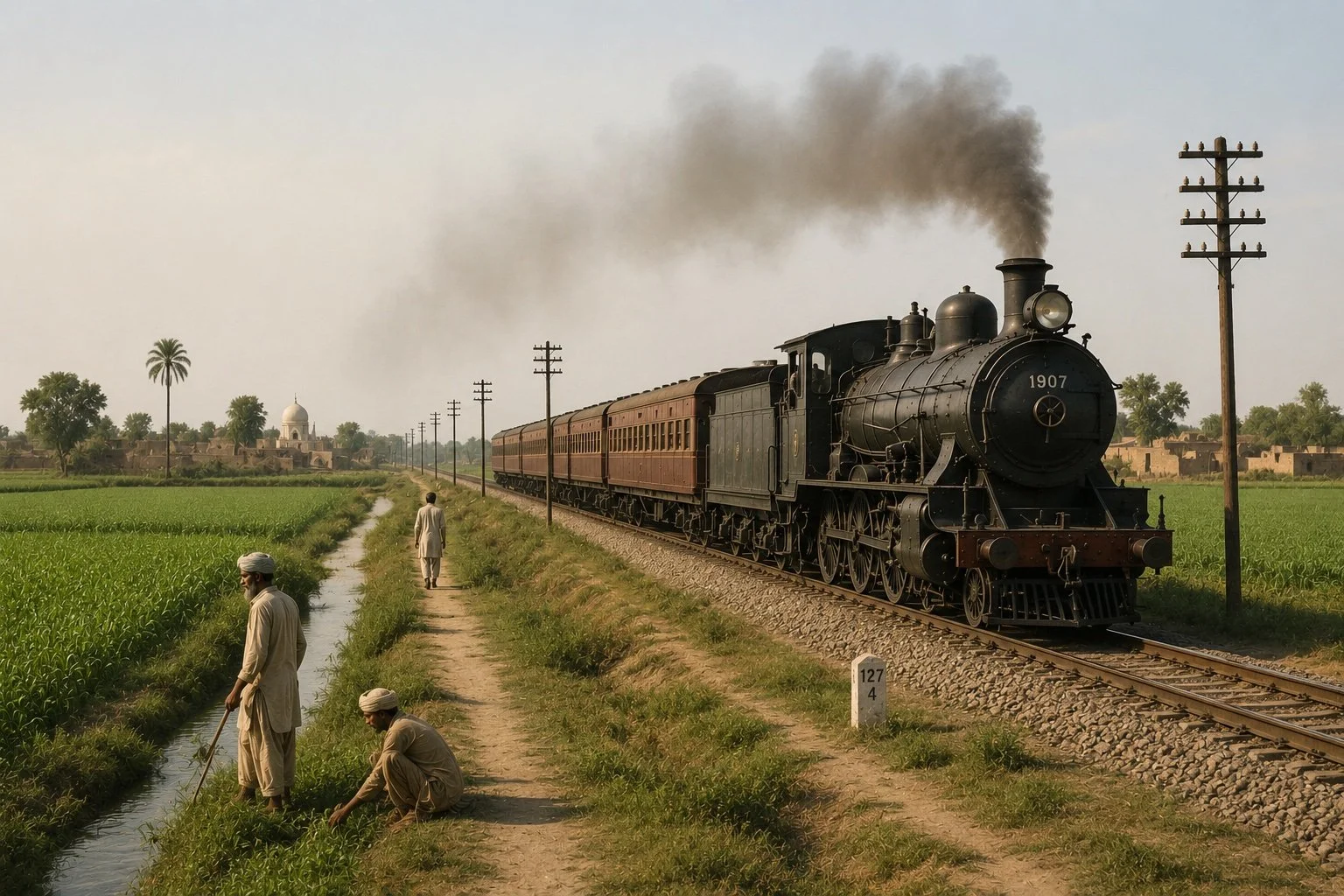
The Railway Network
The transformation of the railways changed Punjab more dramatically than almost any other development of the British Raj. Before the construction of railway lines, travel between cities was slower and dependent upon roads, rivers, animals, and seasonal conditions. Goods could take weeks to reach major markets, and communication between distant regions was limited.
By the late 1800s, however, a growing network of railway lines connected Punjab's cities, villages, military centres, and agricultural districts. The railways reduced travel times, encouraged trade, supported the movement of troops, and linked Punjab more closely to the wider economy of British India.
For the British administration, railways represented a powerful tool of governance. For Punjab, they became symbols of a rapidly changing world.
WHY THE colonial Government BUILT RAILWAYS
The railway system served several important imperial objectives.
Railways allowed administrators to govern vast territories more efficiently, improving communication between provincial centres and the colonial government. They helped transport agricultural products and raw materials quickly to markets and ports, increasing economic output and government revenue.
The railway network also had an important military purpose. After annexation in 1849 and particularly the uprising of 1857, British authorities recognised the importance of moving troops rapidly across northern India. Railways provided a reliable method of transporting soldiers, supplies, and equipment wherever they were required.
Although built to serve both imperial and social interests, the railway system would eventually reshape everyday life throughout Punjab.
LAHORE: THE RAILWAY HUB
As the provincial capital, Lahore held a central position within the growing railway network. Lahore Junction became one of the most important railway stations in northern India, connecting the city to major destinations across the subcontinent.
The city also became home to railway workshops, administrative offices, and supporting industries. Railway employment attracted workers from across the province, while improved transportation strengthened Lahore's position as Punjab's political, educational, and commercial centre.
By the early twentieth century, Lahore had become one of the most connected cities in the region.
CONNECTING THE PROVINCE
The railway system in Punjab was not constructed at random. British engineers generally followed routes that connected major administrative centres, military cantonments, agricultural districts, and commercial hubs. Existing roads, trade routes, river crossings, and strategic considerations often influenced where new lines were built.
The main north-south route linked Lahore with Multan and continued towards Karachi, providing access to one of the most important ports in the region. This connection allowed agricultural products from Punjab to reach international markets more efficiently than ever before.
Another major line connected Lahore with Amritsar and Delhi, linking Punjab to the political and commercial centres of northern India.
To the north, railway lines connected Lahore with Rawalpindi, an important military cantonment and administrative centre. From Rawalpindi, roads continued towards the frontier regions beyond the Indus River.
Additional branch lines gradually connected cities such as Gujranwala, Lyallpur - Faisalabad, Sialkot, Jhelum, and Montgomery - Sahiwal. As canal colonies expanded across western Punjab, new railway connections were built to support agricultural settlement and economic development.
By the early 1900s, much of Punjab had become integrated into one of the most extensive railway networks in Asia.
SUPPORTING THE CANAL COLONIES
The railway network worked closely alongside the irrigation projects that transformed Punjab.
As new canal colonies emerged, agricultural production increased dramatically. Wheat, cotton, sugarcane, and other crops could be produced on a much larger scale than before.
The railways provided the means to transport these products efficiently to markets and ports. Without the railway network, much of the economic potential created by the canal colonies would have remained difficult to realise.
Together, the canals and railways became two of the most significant infrastructure projects of the colonial period.
MILITARY IMPORTANCE
Punjab occupied a strategically important position within the British Empire, particularly due to its proximity to the North-West Frontier.
Railways allowed troops to be deployed rapidly across the province and towards frontier regions when required. Military supplies, equipment, and personnel could be transported far more efficiently than in previous decades. This ability to move forces quickly became increasingly important as the British sought to maintain control over the frontier and respond to potential threats.
The railway network therefore served not only economic purposes, but also formed a key component of imperial defence.
THE IMPACT ON SOCIETY
The railways altered daily life for many Punjabis. Journeys that once required several days could often be completed in a matter of hours. Travel became more accessible for merchants, workers, students, pilgrims, and families.
The movement of people increased, encouraging greater interaction between different regions of Punjab. Ideas, newspapers, goods, and cultural influences travelled more quickly than ever before.
Railway stations became centres of activity, linking towns and villages to wider economic and social networks. While not every community benefited equally, the railways fundamentally changed how people experienced distance, travel, and communication.
LEGACY
The railway network established during the British Raj left a lasting impact upon Punjab.
Many of the major railway routes developed during the colonial period continued to operate long after British rule ended. Cities that emerged as important railway centres often retained their economic significance in the decades that followed.
Alongside the canal system, the railways became one of the most visible examples of the infrastructure projects that reshaped Punjab during the nineteenth and twentieth centuries.
By connecting people, markets, cities, and frontiers, the railway network helped transform Punjab into one of the most economically important regions of British India.