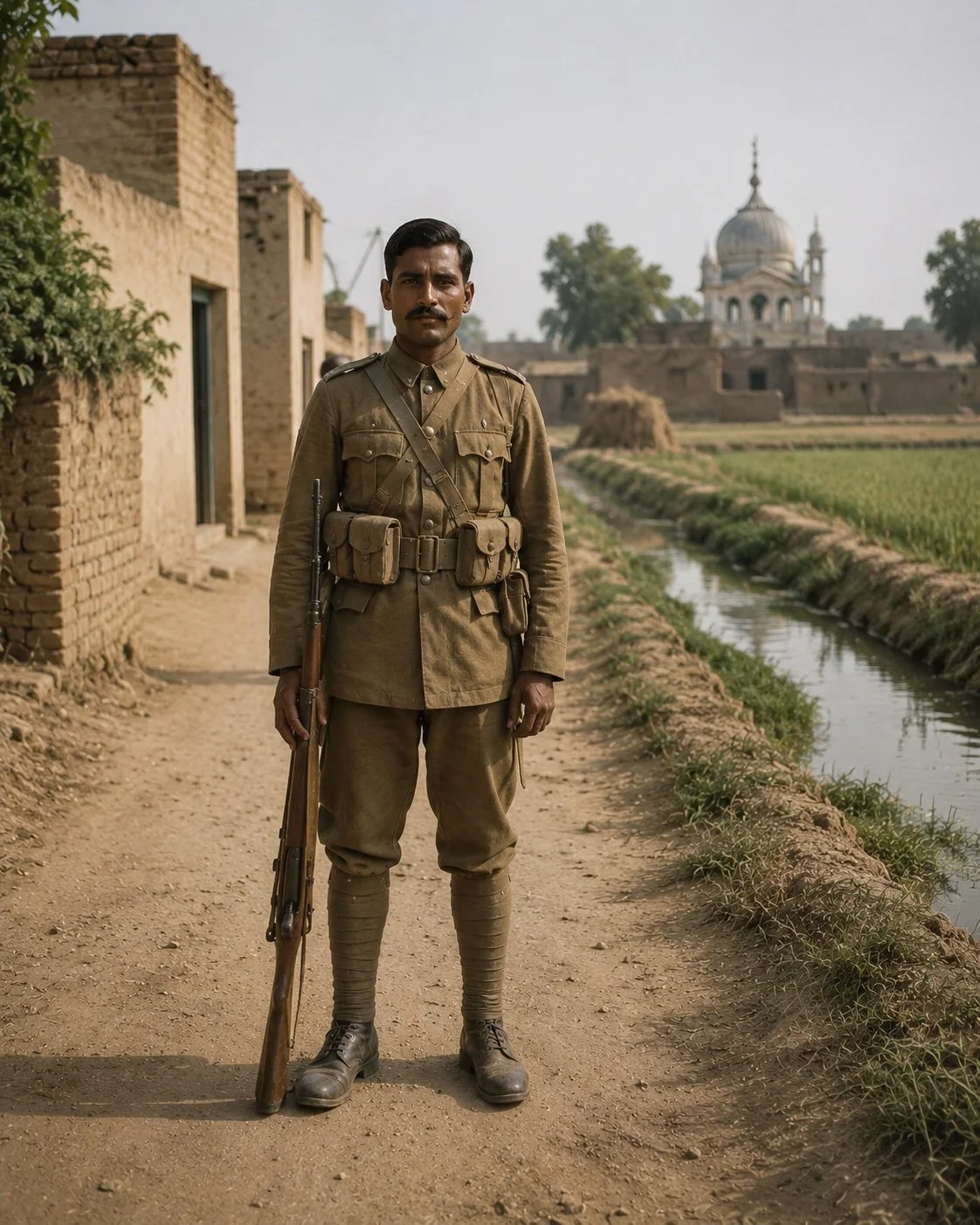
Part IV: The Solider’s Province - Punjab & The British Indian Army
Upon annexation in 1849, Punjab became the newest province of the rapidly expanding British East India Company. Within the next decades, however, Punjab would become something far more important.
It became the military heartland of British India.
From its villages, towns, and cantonments came a disproportionate share of the soldiers who served across the empire. By the late nineteenth and early twentieth centuries, few regions contributed more to the British Indian Army than Punjab.
A Military Province
Punjab's importance to the British - Indian army was not accidental.
The province held a strategic position on the north-western frontier of India, bordering regions that British officials considered vulnerable to invasion or unrest. Beyond its geography, Punjab also had a long military tradition shaped by centuries of frontier warfare, regional conflict, and consolidated by the recent Sikh Empire.
Following annexation, the colonial administration gradually transformed Punjab into one of the most heavily militarised provinces in India. Military roads were expanded, cantonments were established, and recruitment networks linked villages directly to regimental centres. The army became a visible presence across the province.
Punjab was no longer simply an agricultural province.
It was also a military one.
The Cantonments of Punjab
The colonial government established a network of military cantonments throughout Punjab to house troops, store equipment, and protect strategic routes.
Among the most important were:
Mian Mir, Lahore - One of the largest military cantonments in northern India.
Rawalpindi - A major military headquarters and staging point for frontier operations specifically.
Jhelum - A military centre important for recruitment.
Ferozepur - Guarded key routes near the frontier
Ambala - A major garrison town connected to both Punjab and north India.
These cantonments became small military cities, each containing barracks, parade grounds, hospitals, workshops, religious institutions, and administrative buildings. Many remained important military centres after the end of the British Raj.
Punjab's Military units
The British Indian Army was divided into different military units, known as regiments. These were permanent organisations of soldiers that trained, served, and fought together. Several of the army's most important regiments recruited heavily from Punjab, including:
The Punjab Regiment: one of the largest infantry formations in the British Indian Army. Infantry soldiers fought primarily on foot and formed the backbone of most military campaigns. Most recruits came from villages across Punjab, and the regiment served in conflicts throughout the Empire.
The Frontier Force: stationed along the frontier between British India and Afghanistan, the Frontier Force was responsible for guarding one of the empire's most sensitive borders. Its soldiers operated in difficult terrain, conducted patrols, and participated in numerous frontier campaigns.
The Sikh Regiments: recruited predominantly Sikh soldiers and became some of the most recognisable units in the British Indian Army. They fought in major conflicts around the world, including the First and Second World Wars, and helped establish the international reputation of Punjabi soldiers.
Punjab Cavalry Units: unlike infantry, cavalry soldiers fought on horseback. Punjab already had a long tradition of cavalry warfare, and the British-Indian Army incorporated this tradition into several mounted regiments. These units were often used for reconnaissance, rapid movement, and frontier operations.
Dogra and Punjabi Muslim Units: the army also raised numerous units from Dogra and Punjabi Muslim communities. These soldiers served throughout the empire and formed an important part of the army's manpower.
A Global Army
Although recruited in Punjab, the soldiers rarely remained there. Punjabi troops served wherever the British Empire required them. They fought in Afghanistan during frontier campaigns, served in China during the Boxer Rebellion, and participated in imperial operations across Africa and the Middle East. The First and Second World Wars dramatically expanded their international role.
For many rural Punjabis, military service was their first experience beyond their district, province, or even the Indian subcontinent itself.
Life as a Soldier
Soldiers received regular pay, uniforms, training, accommodation, and, after long service, pensions. Regiments often made arrangements to accommodate religious practices, dietary requirements, and community traditions. This contrasted the life of a farmer drastically.
Life in the army was highly disciplined. days revolved around drills, inspections, physical training, weapons practice, and military duties. Promotion through the ranks offered opportunities for prestige and increased income.
For some soldiers, military service became a lifelong career.
For others, it was a temporary chapter before returning to Punjab.
The Impact on Punjabi Society
The army's influence extended beyond military bases. Remittances and pensions brought money into rural communities and veterans often held respected positions within village society.
Eventually, military service became associated with honour, discipline, public status, and entire villages developed strong military traditions.
Yet these benefits came with costs. Soldiers could spend years away from their families, serving in unfamiliar and distant lands. Some returned with injuries, illness, or lasting physical disabilities, while others never returned. Behind the medals and military honours were families who carried the burdens of separation, uncertainty, and loss.
In many areas, the image of the soldier became as familiar as that of the farmer. The two identities often existed side by side, shaping both the economy and social life of colonial Punjab.
Punjab's Contribution
By the early 1900s, Punjab was contributing a remarkably large share of the manpower of the British Indian Army relative to its population. This made the province one of the most important military recruiting regions in the empire.
For administrative officials, Punjab became synonymous with military reliability. For Punjabis, military service became one of the defining features of the colonial era.
Legacy of the Soldier's Province
The connection between Punjab and military service did not end with the British Raj.
Many of the regiments, traditions, cantonments, and military cultures established during the colonial period continued into the armed forces of both India and Pakistan after 1947.
The Raj did not create Punjab's martial traditions, but they expanded, organised, and institutionalised them on an unprecedented scale.
As a result, Punjab became one of the most significant military provinces - a province whose soldiers would serve on battlefields far beyond the boundaries of their homeland.