Akali Phula Singh
Circa 1760s - Sangrur, Punjab. The Phulkian Misl.
Phula Singh was born during one of the most turbulent periods of Punjab’s modern history. The Mughal Empire was greatly unstable, and repeated Afghan invasions had devastated the region. Punjab was officially a Mughal province under Emperor Shah Alam II, but the empire’s weakening authority had created a power vacuum that the Punjabi Confederacy/ Misls had begun to fill after decades of persecution.
Alongside the 12 Misls of the Punjabi confederacy, existed the Nihangs - warriors whose authority was rooted in protecting the Sikh faith. Phula Singh would grow to become one of the most prominent leaders of the Nihang order - a warrior whose loyalty belonged to the Khalsa itself.
Note: The Shaheedan Misl is often referred to as the Nihang Misl, but was not composed entirely of Nihang warriors and functioned differently than the other Misls. Phula Singh was born in the geographical region of the Phulkian Misl, but did not rise through its political structure. Instead, Phula Singh became a skilled Nihang Warrior and led the Nihang forces during the Sikh Empire, after the misls were unified by Maharaja Ranjit Singh.
The Nihangs of Punjab
The Nihangs of Punjab are a distinct Sikh warrior group whose origins are linked to the military tradition established by Guru Gobind Singh in 1699, alongside the formal inauguration of the Khalsa. Those who followed the Khalsa were expected to embody both spiritual discipline and martial readiness - creating a community capable of defending both Sikh institutions and the broader populations of Punjab. Over time, certain warriors within the Khalsa devoted themselves entirely to this martial path, and came to be known as the Nihang warriors.
The word Nihang has a number of interpretations, associated with crocodiles, swords, and fearless warriors. In the Punjabi-Sikh context, it came to describe fearless warriors who were detached from worldly concerns.
Unlike the other soldiers of the Sikh Empire, the Nihangs lived according to a strict martial and religious discipline. They were differentiated through their distinctive blue attire, dumalla style turbans (often adorned with weapons), and a constant readiness for battle.
A key difference between the Nihang army and the empire’s army was that the Nihangs were devout Sikh soliders and defended the Sikh Institutions - particularly the Akal Takht in Amritsar, whereas the empire’s army defended Punjab and was composed of soliders from various religious backgrounds.
Because of this role, the Nihangs occupied a unique place - warriors, but also protectors of Sikh authority.
The Nihang Fauj and the Khalsa Army
During the 1700s, Sikh power in Punjab was distributed amongst the 12 Misls, each housing an independent army composed of Khalsa warriors. The soliders within the misls were not trained or exclusive militia, instead they were farmers, tradesmen, and regular citizens who fought to defend Punjab from the Mughal and Afghan combat.
The Nihangs existed alongside these forces, but their organisation was different. The armies of the misls were tied to specific chiefs and territories, however the Nihangs were more closely associated with the collective authority of the Khalsa Panth - the community of initiated Sikhs and the Akal Takht - highest seat of authority in Sikhism. As a result, the Nihangs functioned as a religious-military order, maintaining their own organisation known as the Nihang Fauj/ Akali Fauj.
The distinction between the Nihang Fauj and the Khalsa Army continued after Maharaja Ranjit Singh established the Sikh Empire. Under the empire, the Khalsa Army evolved into a centralised military force and by the 1820s, it was modernised under European officers and organised into the Fauj-i-Khas and Fauj-i-Ain divisions.
The Nihangs remained seperate from this structure, and preserved older Khalsa martial traditions. They had a higher degree of independence, and despite fighting alongside the forces of the Sikh Empire, their loyalty remained to the Khalsa - not the territorial defence or leader of the Empire.
Phula Singh within the Nihang Order
Phula Singh rose within the Nihang martial tradition. From a young age, he was trained in the discipline and warfare associated with the Nihangs. Over time, he became one of the most prominent Nihang leaders, commanding a group of the warriors known as the Akali Nihangs.
Akali is derived from Akaal - timeless; a reference to the Sikh concept of god as timeless. Therefore, Akali warriors were seen to fight under the authority of the divine rather than any king or Earthly authority.
Under Phula Singh’s leadership, the Akali Nihangs became one of the most respected martial groups in Punjab. They were recognised for their aggressive battlefeild charges, strict adherence to Sikh discipline, and their willingness to fight at the battlefront. Unlike many military leaders of the Sikh Empire (and others that existed at the time), Akali Phula Singh did not hold power through land ownership, politics, or royal appointment. His authority was entirely rooted in the respect of the Khalsa and the devotion of the Nihang warriors.
The Akal Takht & The Khalsa’s Authority
Akali Phula Singh’s influence as an authority extended beyond the battlefield. The close association between the Nihangs and the Akal Takht meant that the akali leaders often held significant moral authority within the Sikh/ Punjabi society. A popular story between Maharaja Ranjit Singh and Akali Phula Singh reflects this.
It is said that Maharaja Ranjit Singh once violated the Sikh code of conduct, and when the matter reached the Akali leadership, he was summoned before the Akal Takht in Amritsar where the Maharaja admitted his transgression before Akali Phula Singh and accepted the given punishment before other senior leaders intervened and halted the sentence. The details of this event remain debated, but the fact that the highest political authority within Punjab was held accountable shows the authority of the Khalsa and the Akali leader, Phula Singh.
the campaigns of the Sikh Empire
Despite their independence from the formal military hierarchy of the Sikh Empire, the Nihang warriors often fought alongside the imperial forces during major campaigns. Akali Phula Singh and his warriors participated in several military operations that helped strengthen and consolidate Sikh authority in Punjab. These campaigns included:
The Battle of Multan (1818): which ended Afghan control over one of Punjab’s southern strongholds.
Various frontier campaigns against Afghan forces and tribal confederacies along the northwestern border.
Operations that extended Sikh authority beyond the Indus River, strengthening the empire’s hold on the western front.
Akali Phula Singh was known for leading the Nihang warriors directly into combat and fighting alongside them.
The BAttel of Nowshera (1823)
In 1823, the Sikh Empire faced a powerful coalition of Afghan tribal forces led by Azim Khan Barakzai who sought to drive Punjabi Authority out of the northwestern frontier. This led to the Battle of Nowshera (1823) which took place near the Kabul River, where the Afghan forces had extremely strong defensive positions.
During the battle, Akali Phula Singh led a direct charge of Nihang warriors against the Afghan lines. His attack pushed deep into the Afghan positions but was met with fierce resistance. It was during this battle that Phula Singh was struck and killed. Historical accounts differ on the exact circumstances of his death, but all agree that he died fighting on the front line.
It was during this battle that the Khalsa lost one of its most fearless warriors, and the loss was felt deeply across the ranks of the Sikh Empire.
Akali Phula Singh in the Lahore Durbar
Despite not being a state official Akali Phula Singh regularly attended the Lahore Durbar - The Maharaja’s royal court. Most nobles and commanders held their authority through their rank, land grants, or position in the administrative office because they were part of the political structure of the empire. Phula Singh attended the court as a representative of the Khalsa and Akal Takht, not as an officer of the state.
Because of this, Akali Phula Singh did not sit amongst the court nobles or behave like a court official. Instead he sat seperately, often with other Nihang warriors. His presence in the Durbar symbolised that the Maharaja ruled Punjab, but the religious values remained the ultimate moral authority.
Phula Singh and other commanders
There are a number of key differences between Akali Phula Singh and the other commanders of the Sikh Empire:
He was not a Khalsa Army officer - despite fighting alongside the forces of the Sikh Empire, he was not part of the structured Khalsa Army hierarchy. This differentiates Phula Singh from Jarnail Hari Singh Nalwa, Misr Diwan Chand, and the European officers.
He did not hold territorial office - his authority was not derived from territorial control, but from leading the Nihang warriors.
The Nihang Army was never absorbed into the state army - even after the Maharaja modernised the army into the Fauj-i-Ain and Fauj-i-Khas divisions, the Nihangs remained seperate by fighting alongside the empire but not integrating into its military structure.
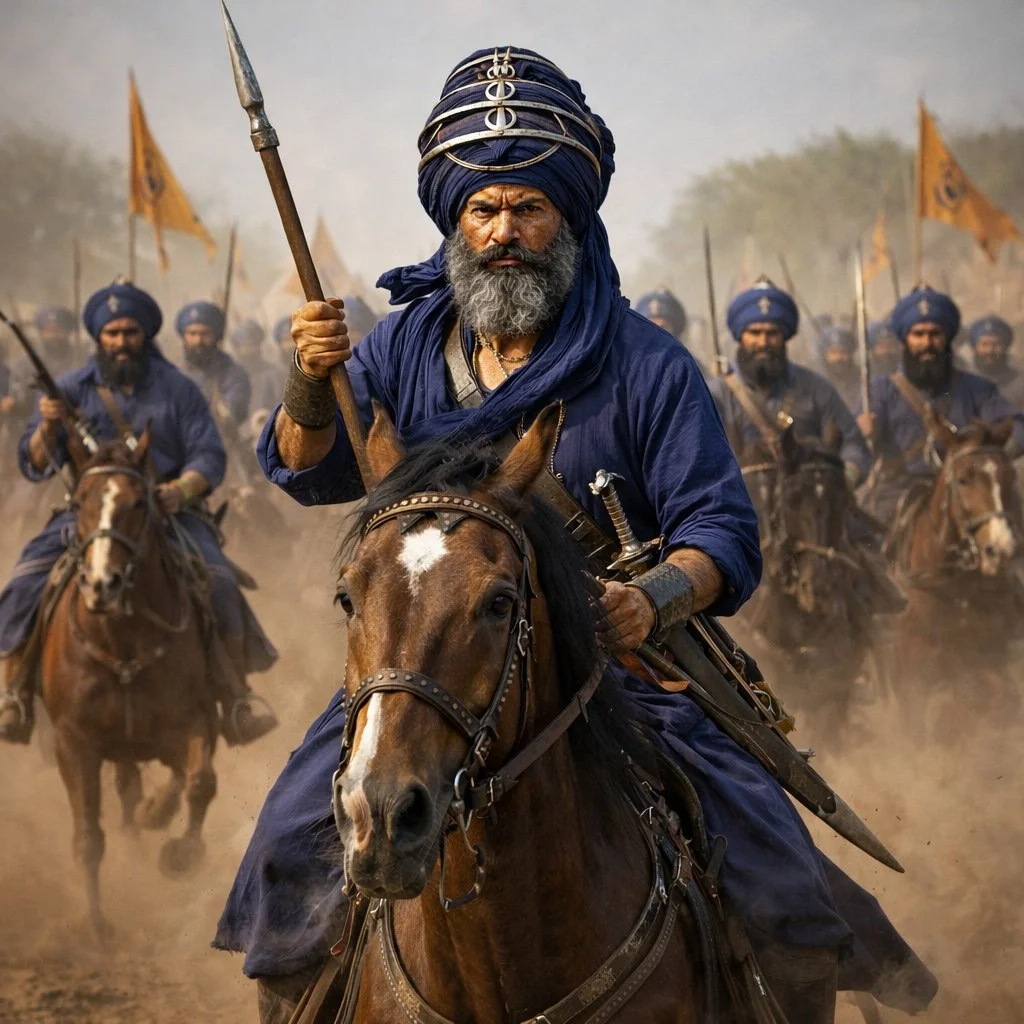
A depiction of Akali Phula Singh leading the Nihang Army.
To the warrior who answered only to the Khalsa,
To the Nihangs who fought beside him,
May your courage live on through the land you defended - Punjab’s fields and its flowing rivers.
With immense respect - TrishSaab.