
Jarnail Hari Singh Nalwa
The story of the General who stood at the edge of an Empire
April 29, 1791 - Gujranwala. The Sukerchakia Misl.
Hari Singh was born into an Uppal Khatri Sikh family. His father, Gurdial Singh Uppal served under the Sukerchakia Misl, but was not a chief. Hari Singh did not inherit a title, territory, or political authority.
His rise would be earnt.
From a young age, he was trained in horsemanship, archery, and arms. By 1804-1805, at the age of 15-16, he entered the service of the Khalsa Army of the Sikh Empire. Historical accounts vary on the exact year of his formal introduction into the army, but all suggest he rose quickly within the growing military structure of the Sikh state.
It is widely accepted that during a hunt, Hari Singh confronted and defeated a tiger, some suggest he was armed with a single sword and others that he was unarmed. The exact details remain debated, but this hunt would earn him a nickname that defined his legacy.
Nalwa - from the Punjabi word nal; meaning claw.
From Misl Soldier to imperial commander
Under the Treaty of Amritsar (1809), Maharaja Ranjit Singh had agreed that the Sutlej River marked the southern boundary of the Sikh Empire, and so the empire expanded north and west.
In these campaigns, Hari Singh Nalwa fought and led key military operations:
The Conquest of Kasur: consolidated internal authority.
The Multan Campaigns: strengthened revenue and commercial control.
The Annexation of Kashmir (1819): ended afghan rule in the valley, brought a strategically critical mountain region under Punjabi control.
Operations in Hazara and Frontier campaigns towards Peshawar: both extended defensive depth towards the Khyber Pass.
It is important to note that frontier control was not achieved in a single conquest. Various regions (such as Hazara) experienced periodic uprisings and Punjabi authority had to be reasserted through both military pressure and negotiated stability.
During these years, Maharaja Ranjit Singh increasingly delegated operational command to capable generals like Hari Singh Nalwa. He was no longer a soldier in the Khalsa Army, he had earnt the respect of the Maharaja, and rose ranks to imperial commander.
Note: The Khalsa Army was divided into the elite corps - Fauj-i-Khas, and the regular army - Fauj-i-Ain. By the time this division was formally organised under European officers in the 1820s, Hari Singh Nalwa had already distinguished himself in multiple military campaigns. His authority was not rooted in the European training of the Fauj-i-Khas, but from prior battlefield experience and early service under Maharaja Ranjit Singh. As a senior commander, he could command both regular and elite units, he worked within the modernised structure of the Khalsa Army but was not trained under it, nor did he rise through it.
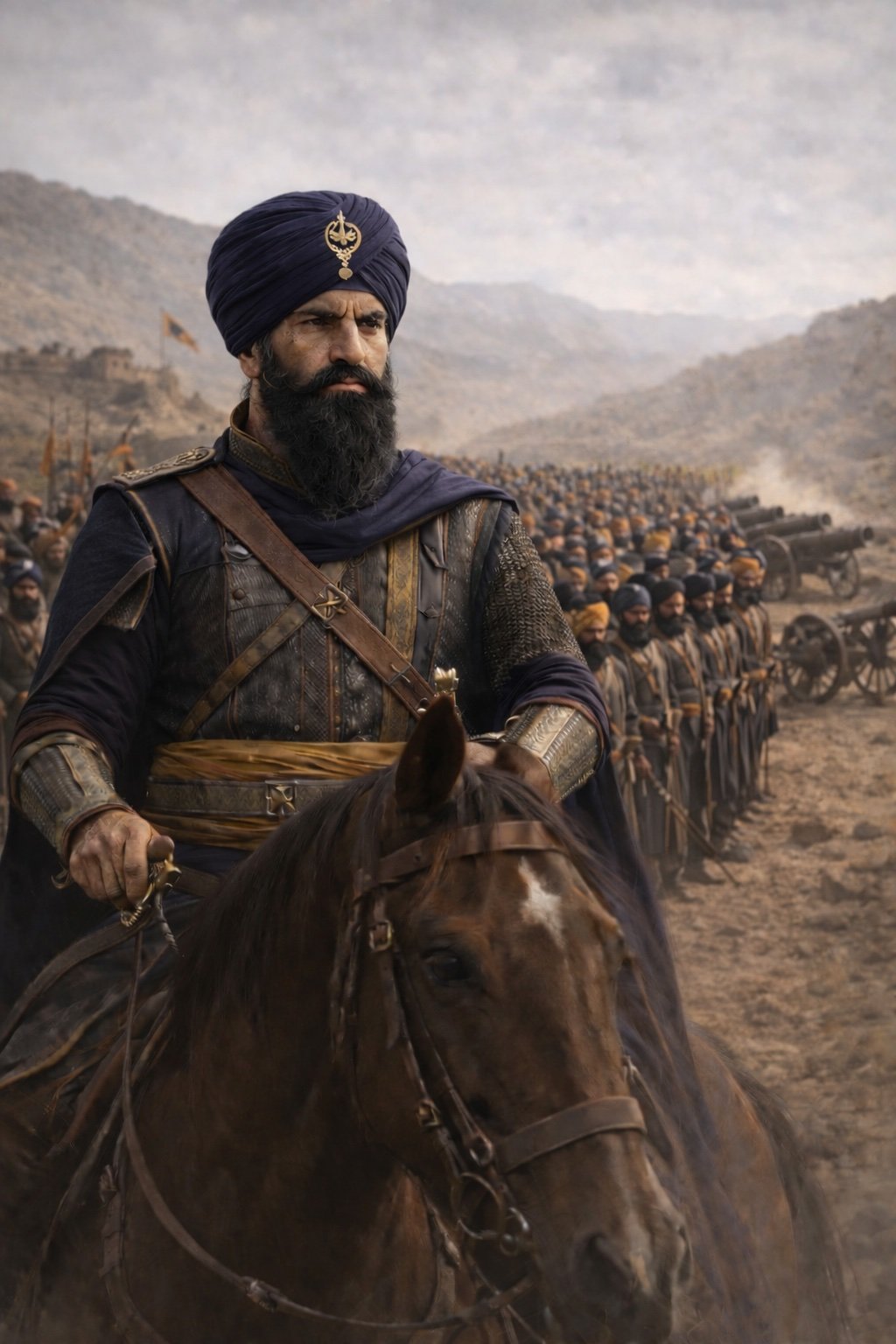
A depiction of Sardar Hari Singh Nalwa as a General - Jarnail.
Governing the Frontier - Hazara
After the annexation of Kashmir to Punjab (1819) and other westward campaigns, Hari Singh Nalwa was appointed Nazim (Governor) of Hazara - a strategic but volatile region between Punjab and the Afghani controlled territories. Unlike Multan and Kashmir, Hazara was not a region won by a single conquest, it required continuous consolidation.
The region experienced periodic uprisings, and the Punjabi Empire had to reassert authority through both military and administrative change. As Nazim, Hari Singh Nawla established fortifications - namely the Harkishangarh/ Haripur fort, reorganised revenue systems, and founded the town of Haripur to increase Punjabi imperial presence. Hazara became a frontier where military power and institutional control shaped Hari Singh Nalwa from battlefield commander into frontier administrator.
His governance in Hazara (1822-1823) shaped his later appointment to Nazim of Peshawar.
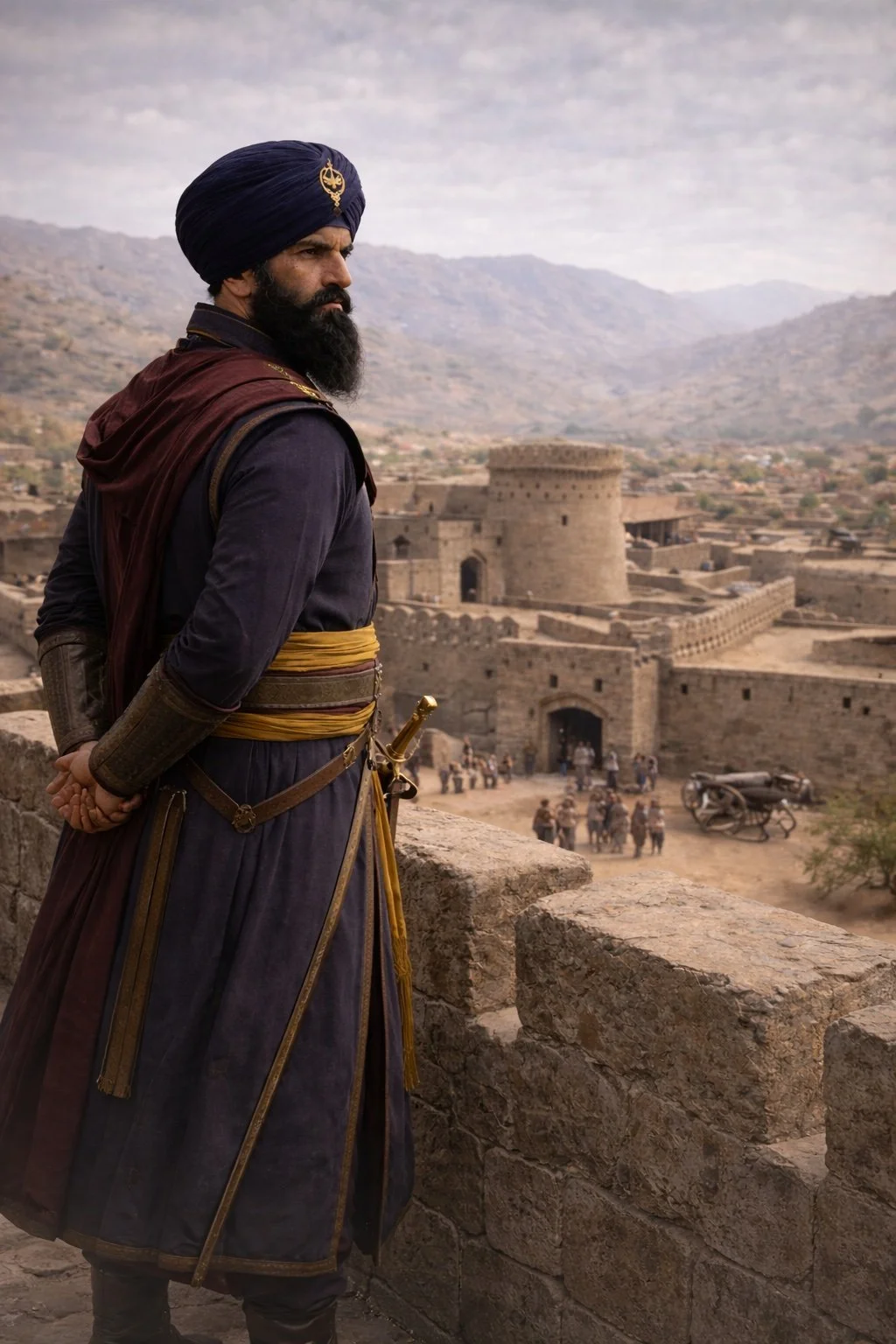
A depiction of Hari Singh Nalwa as Nazim of Hazara, in the Harkishangarh fort.
The Complexity of Peshawar
The Khyber Pass is a narrow mountain passage that connects modern day Afghanistan to Peshawar. For centuries, invading armies entered the Indian Subcontinent through this passage. The Himalayan mountains prevented invasion from the north, deserts prevented invasions from the west, and the Indian Ocean prevented southern invasions. The Empire who controlled the Khyber Pass, controlled who entered Punjab (and the rest of the subcontinent).
Peshawar is a city in the KPK province of modern-day Pakistan, but historically it was the first major city after the Khyber Pass. In the late 1700s - early 1800s, it was the eastern stronghold of the Afghan Durrani Empire. As the Sikh Empire grew in strength and influence, the Durrani Empire weakened due to internal rivalries and the Durrani governors operated with little imperial support, weakening their stronghold.
By 1823, the tensions and conflict between the Afghan and Punjabi forces culminated in the Battle of Nowshera where the Khalsa Army defeated the Afghans and broke the Durrani empire’s influence east of the Khyber Pass. In the following years, the Afghan forces would fight back, and control over Peshawar would remain contested, but Punjabi authority was firmly established in the region.
In 1834, Peshawar was formally annexed and placed under the administration of the Sikh Empire. Maharaja Ranjit Singh appointed Hari Singh Nalwa as governor of Peshawar, who was tasked with maintaining order within the city and securing the Khyber Pass itself. Under Hari Singh Nalwa’s governance, fortifications in the region were strengthened, Punjabi revenue systems were imposed, and any Afghan incursions through the passage were suppressed. Notably, the construction of the Jamrud Fort established a permanent Punjabi military presence and for the first time in centuries, Punjab controlled the northwestern boundary.
The Battle of Jamrud; 1837
After the Battle of Nowshera (1823), The Sikh Empire took control over Peshawar, however, the Durrani Empire still existed and held stakes in the region. In 1834, when Peshawar was formally annexed, the Afghan ruler Dost Muhammad Khan sought to regain the lost territory and reestablish Afghan control. In April 1837, following the construction of the Jamrud Fort - a structure that acted as a physical boundary for Afghan forces looking to enter India, Dost Muhammad Khan delegated his son Akbar Khan to lead the Afghan forces towards Jamrud.
An often overlooked aspect is that in 1837, Maharaja Ranjit Singh was hosting British Dignitary William Hay Macnaghten in Lahore. Afghan leaders may have used this as a strategic moment, where the Punjabi forces and diplomatic focus were elsewhere.
This confrontation between the Punjabi and Afghan forces was the Battle of Jamrud, wherein Hari Singh Nalwa was severely wounded and taken back into the fort to recover where he died from his wounds. Many accounts suggest that the news of his death was temporarily delayed to prevent the Punjabi forces from losing morale, but there is no clear historical proof of this. Despite the loss, Jamrud remained under Punjabi control, and their strategic position was maintained. But the Sikh Empire had lost one of its most experienced frontier commanders.
Although Hari Singh Nalwa did not live to see the instability and decline of the Sikh Empire in the following years, Punjab would lose both it’s (arguably) strongest general and its Maharaja in 2 years, and that loss would be irreparable.
Historical Significance
Hari Singh Nalwa’s legacy can be described through 3 main aspects:
Territorial Expansion: He helped extend the Sikh Empire to its greatest western limits.
Frontier Assertion: While Afghan pressures did not permanently vanish, Punjabi authority under Hari Singh Nalwa’s command changed centuries of invasion patterns by fortifying and institionalising control at the Khyber Pass.
Institutional Consolidation: His governance shows how the Sikh Empire relied on capable military-administrative figures to sustain authority in distant and unstable territories.
He was not an heir to sovereignty.
He was not a Misl Cheif.
He was not Maharaja.
His authority was delegated, but undeniably immense.
He was Jarnail (General) Hari Singh.
He was the Nazim (Governor) of Hazara.
He was the Nazim (Governor) of Peshawar.
He was Nalwa of the Sikh Empire.
After his death, the western front remained under Punjabi control. However, internal politics and court factions began to destabilise the Lahore Durbar.
He was not responsible for the downfall of the Sikh Empire, but he was a pillar holding its frontier.
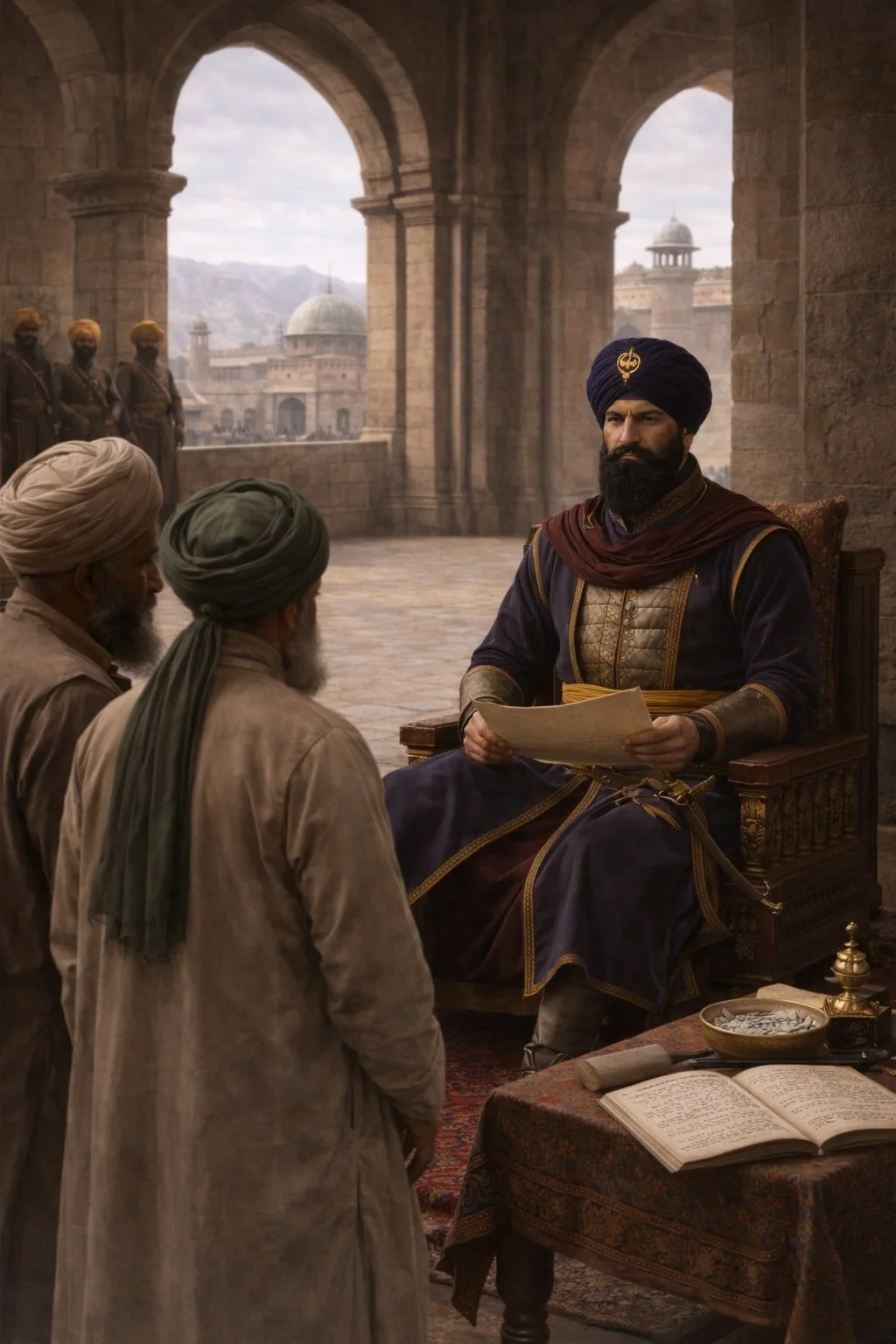
A depiction of Hari Singh Nalwa as Nazim of Peshawar.
To the Jarnail who guarded the western front. To the soldiers who stood beside him. To the land he defended - Punjab’s fields and its flowing rivers. May your legacy be remembered not only in folklore, but in history.
With great respect, TrishSaab. 