
The Lions of Punjab
Punjab is now imagined as an endless landscape of villages, canals and cultivated fields.
But before the wheat spread towards every horizon, parts of the region belonged to a very different world.
Thorn forest. Open grassland. Dry riverbeds.
Antelope moving across the plains - and lions following behind them.
The Asiatic Lion
The lions once found in Punjab were Asiatic lions - the same population that now survives only in and around the Gir forests of Gujarat, India.
They were generally smaller than the largest African lions, with males carrying a shorter, less extensive mane. Their ears often remained visible, and a fold of skin ran along the underside of the body. They were lions adapted to the dry forests, scrublands and open plains of western and northern Asia.
Their former range was enormous. Lions once inhabited lands stretching from the eastern Mediterranean and Mesopotamia through Persia and into the Indian subcontinent. Within South Asia, they could be found across much of northern, western and central India.
Historical naturalists recorded them in Sindh, Bahawalpur and Punjab. Lions were reportedly hunted near the old bed of the Hakra River around Derawar in the early nineteenth century, while other records placed them farther east around Haryana, Delhi and the plains below the Shivalik Hills.
They did not occupy every part of Punjab equally. The wetter riverine forests, mountain foothills and intensively settled districts supported different animals and landscapes. Lions were most suited to the drier plains, grasslands, thorn forests and scrub stretching across southern and eastern parts of the region.
A Different Punjab
For lions to exist in Punjab, the land itself had to be different.
Before the spread of canals and intensive agriculture, large parts of the plains were covered by uncultivated tracts known as bars. These were not empty wastelands. They contained grasses, thorny scrub, scattered trees, grazing grounds and seasonal pools of water.
Closer to the rivers were the belas: shifting belts of woodland, reedbeds and dense vegetation shaped by flooding and changing channels.
Blackbuck, nilgai, wild boar and deer moved through these landscapes. Wolves, leopards, hyenas and, in some districts, tigers lived beside them. Livestock belonging to pastoral communities provided another possible source of prey.
Punjab was therefore not one continuous field waiting to be cultivated. It was a combination of farms, villages, forests, grazing lands, river islands and open country. Lions occupied only part of this world, but that world once extended far enough for them to survive across a broad section of northern South Asia.
The Royal Hunt
The lion’s strength made it a symbol of power, but that symbolism also made it valuable to hunters.
For rulers, killing a lion was more than the removal of a dangerous animal. It demonstrated courage, control and the ability to defeat the most powerful creature in the landscape. Royal hunts brought together horsemen, soldiers, trackers, beaters and attendants, sometimes in enormous numbers. The animal could be surrounded by mounted men, driven from its cover and pursued with spears, swords or firearms. The hunt transformed a living predator into a public performance of authority. This tradition existed throughout time. Mughal emperors hunted lions, and princely courts continued to organise large expeditions across northern India. In Patiala, accounts describe hundreds of horsemen driving animals across open plains during organised hunts.
By then, however, their numbers were already falling.
The Arrival of the Gun
Lions had always faced hunters, but the scale changed during the nineteenth century.
More effective firearms made it possible to hunt them from a greater distance. Expanding military cantonments brought large numbers of armed men into areas where lions still survived. Similar to past nobles, officers during the British Raj treated hunting as sport, competition and proof of personal bravery, keeping records of the animals they killed and displaying their skins and heads as trophies.
Once officers learned where lions could be found, and the prestige associated with those who defeated them, repeated hunting expeditions followed.
Local rulers and landholders also participated. Responsibility for the lion’s destruction did not belong to one community or government alone. Royal prestige, colonial sport and the fear of livestock loss all encouraged the same result: wherever a lion was reported, armed hunters followed.
An animal that reproduced slowly could not withstand such sustained pressure.
The Land Closes Around Them
Hunting was only part of the lion’s disappearance.
Punjab’s uncultivated landscapes were steadily brought under the plough. Forests were cleared for timber and agriculture. Grazing land became privately controlled farmland. Roads, railways and settlements divided habitats that had once allowed animals to move between one tract and another.
Later, the construction of enormous canal networks transformed many of the western bars. Water turned dry plains into some of Punjab’s most productive farmland. New villages appeared, populations moved and land that had supported pastoral communities and wildlife became divided into numbered agricultural settlements.
For people, these changes could produce food, revenue and new opportunities. For large predators, they removed the space upon which survival depended.
Wild prey declined as hunting and cultivation expanded. Lions that turned towards cattle became threats to local livelihoods and were more likely to be tracked and killed. Small groups became separated from one another until they could no longer maintain a stable population.
Punjab’s lions did not disappear in one final, clearly recorded hunt. They vanished district by district.
Reports place lions near Bahawalpur at the beginning of the nineteenth century, around Lahore during the 1830s and in Haryana until approximately the early 1840s. The evidence is incomplete, and exact extinction dates remain uncertain. What is clear is that by the second half of the century, the lion had ceased to belong to Punjab’s living landscape.
Across the subcontinent, the same process continued. By the late nineteenth century, the remaining wild population had been pushed into the Gir forests of Gujarat.
The Lion That Remained
The animal disappeared, but its image did not.
The lion remained embedded within Punjab’s languages, names and ideas of courage. Sher became a title for someone fearless. Sher-e-Punjab - the Lion of Punjab, was attached to powerful political and military figures. The name Singh, derived from a word for lion, became inseparable from Sikh identity.
Not every use of the lion proves that the speaker had seen one. Animal symbolism travels much farther through time than the animals themselves. Yet these expressions preserve something important: the lion was not foreign to the cultural imagination of Punjab.
It represented an animal that had once occupied the same plains, river systems and dry country as the people who invoked its name.
Today, a lion in Punjab is encountered through a zoo, a painting, a story or a title given to a courageous person. The modern landscape offers little indication that wild lions ever belonged there.
But beneath the fields are traces of another Punjab.
A Punjab before continuous cultivation.
Before the canals divided the plains into numbered villages.
Before the forests withdrew and the great animals disappeared with them.
The lion did not leave Punjab willingly. It was hunted, surrounded and deprived of the land it needed until only its name remained.
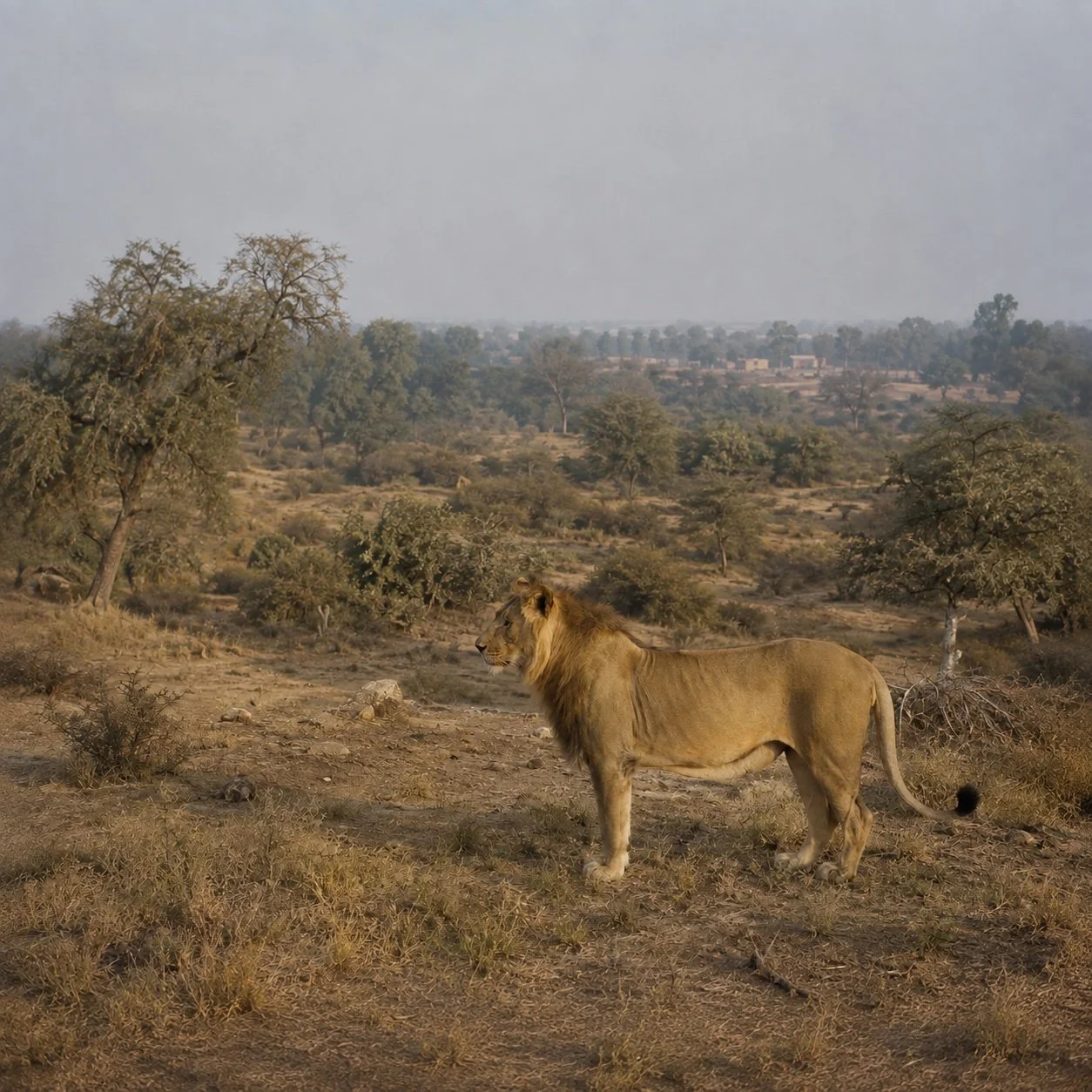
A depiction of the Asiatic Lion in the Punjab Plains
To the lions of Punjab, may your strength live on
With pride, TrishSaab