
Banda Singh Bahadur (1670-1716) and the struggles of Early warfare
Winning a battle would open the road to a city. But holding that city required supplies, defensive positions, and the strength to withstand an army sent to recover it.
In the early 1700s, the Punjabi rebellion against the Mughal imperial authority had started to grow beyond local skirmishes into a regional uprising. This meant that the Punjabi forces were repeatedly facing the difference between defeating their opponent, and establishing lasting control over territories.
Banda Singh and his early followers captured the city of Samana and defeated Wazir Khan at the Chappar Chiri battlefield, opening the way to their capture of Sirhind.
The forces at the time included both mounted and foot soldiers. Their campaigns involved attacks on towns, battles in the open and the defence of fortified positions.
Although the warfare at this time is often described as guerrilla warfare, the Punjabi forces still took over and governed certain territories, rather than surviving entirely through hit and run attacks on enemy territory.
The Rise of the Confederacy (1748-1799) and the value of Mobility
After Banda Singh’s execution, the Punjabi resistance continued through smaller armed groups. These fighters would assemble when circumstances allowed, and disband when seeking refuge. The groups would eventually become the Punjabi Sikh confederacy.
Mounted warfare suited these conditions. Horsemen could carry swords, spears, and matchlocks, allowing them to approach attack and withdraw without remaining in one position.
Mobility helped fighters survive against larger forces, but the demands changed as the misls acquired permanent possessions. Chiefs needed to protect settlements, defend strongholds and confront rivals who held fortified positions of their own.
As the rebellion grew into independent small governments, heavy artillery became paramount to their survival. Cavalry remained valuable, but a large cannon offered a different means of both defence and attack. Possession also brought obligations: someone had to move the gun, supply its ammunition and keep it usable.
Among the weapons drawn into these attacks was Zamzama - the Bhangi Misl’s great cannon.
The Cannon Zamzama
Zamzama was made in Lahore under Afghan authority during the rule of Ahmad Shah Durrani. Shah Wali Khan, his wazir, commissioned it, and the metalworker Shah Nazir is credited with its casting. Accounts differ on the exact casting date, placing it in the late 1750s or around 1760.
Its barrel measures approximately 4.38 metres, with a bore of about 24 centimetres. It is commonly described as an 80-pounder - referring to the weight of its projectile rather than the weight of the cannon itself.
The gun was used at the Third Battle of Panipat in 1761 and subsequently left at Lahore. Sikh accounts associate its capture in 1762 with Hari Singh Bhangi when it became known as Bhangian di Top - the cannon of the Bhangis.
Zamzama was not the first introduction of artillery to Punjabi warfare, nor was it the only cannon/ heavy artillery operated by the Punjabi confederacy. Its significance here lies in the transfer of a major weapon from an Afghan arsenal into the hands of a rising misl of the Punjabi confederacy.
The Bhangis and a contested cannon
The cannon’s ownership was repeatedly contested. Accounts connect it with Charat Singh Sukerchakia, the Chattha chiefs and Bhangi leaders before its establishment at Amritsar. These disputes also show that the Confederacy chiefs could cooperate, compete and fight over valuable resources.
The benefits and drawbacks of heavy artillery
A heavy cannon gave its owners a way to better a defended position from a distance. Yet its usefulness depended on circumstances. The strength of the target, the gun’s condition, its ammunition and the position from which it fired all mattered.
Moving it was a separate military task. A large barrel needed a strong carriage and considerable hauling power. Roads, soft ground and river crossings could obstruct its progress. Powder and shot had to reach the same destination, while crews needed protection as they brought the weapon into action.
This created a practical tension for forces accustomed to moving quickly. Bringing heavy artillery could improve their chances against a stronghold while slowing the march and increasing their supply needs.
The Sikh Empire (1799-1849) builds upon the Confederacy
Ranjit Singh hailed from the Sukerchakia Misl. The military society of the Confederacy was the starting point for his power, and his expansion brought additional territories and military resources under Punjabi leadership.
The Zamzama cannon passed into his possession when he displaced Bhangi authority at Amritsar in the late 1700s to early 1800s.
His wider military changes involved regular infantry units developed alongside the mounted cavalry forces. Artillery expanded, and gun casting and ammunition manufacture received sustained attention.
Ranjit Singh also drew on military experience circulating across the subcontinent. Soldiers from disbanded formations and men who had served the East India Company brought knowledge of drill and organisation into his service.
The arrival of Officers Jean-Baptiste Ventura and Jean-Francois Allard in 1822 added further expertise. Ventura worked with infantry and Allard with cavalry in the development of the Fauj-i-Khas, an elite formation. Claude Auguste Court later contributed to the artillery establishment of the Sikh empire’s army.
The result was an army with several kinds of troops serving together. Traditional mounted forces continued alongside drilled infantry and organised artillery. The empire developed the Confederacy’s military inheritance while changing how parts of it were trained, equipped and commanded.
Multan and the limits of Zamzama
During the 1818 siege of Multan, Ranjit Singh’s forces brought the Zamzama cannon as part of the campaign’s artillery.
Zamzama was damaged during these operations and returned to Lahore. It was no longer fit for active service.
The empire’s artillery continued to develop after its retirement. By the First Anglo-Sikh War of 1845-1846, the Khalsa army could deploy substantial batteries whose fire inflicted heavy losses on opposing troops. At Ferozeshah and Sobraon, artillery formed an important part of defended positions that their opponents struggled to overcome.
That later firepower belonged to a much larger military establishment than the one represented by a single captured cannon. Zamzama had participated in the transition, but it did not define its endpoint. Today the cannon remains on display in Lahore.
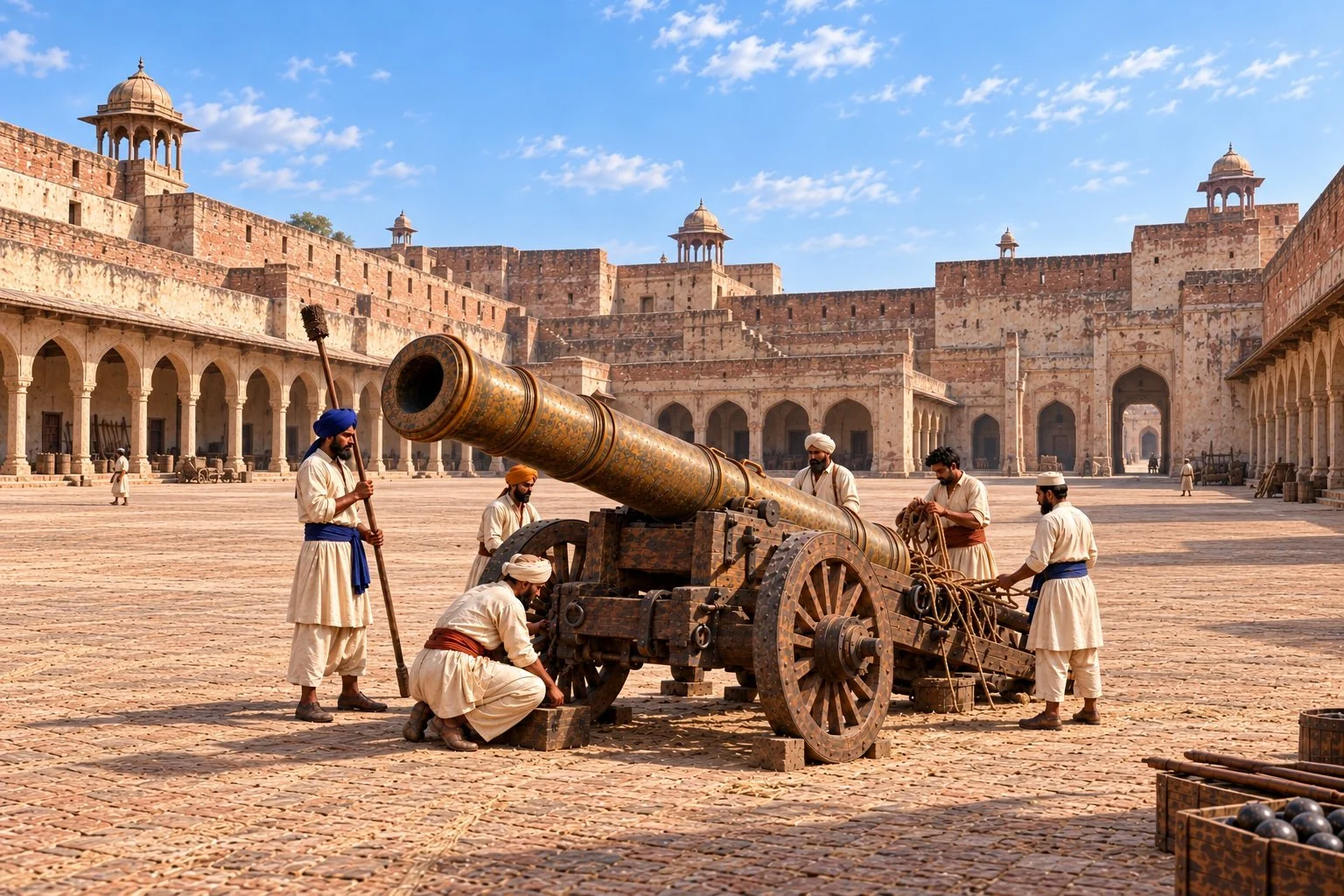
To the craftsmen who cast it, the hands that moved it, and the histories carried in its name.
To the land, people, and heritage it defended.
With Pride, TrishSaab.