
The Battlefield of Punjab
Five rivers. Vanished forests. Open plains. A land built for movement.
Punjab’s rivers fed cities, sustained agriculture and connected distant communities, but they also divided the land into a succession of natural frontiers. Its plains allowed armies to travel at speed, while its forests concealed exiles, outcasts, and rebels. Punjab could welcome movement and resist it at the same time. To understand the warfare that developed here, we must first understand the land on which it was fought.
A Land Divided by Rivers
Punjab takes its name from its five rivers: Jhelum, Chenab, Ravi, Beas and Sutlej - all tributaries to the Indus. The land in-between each river is called a doab.
From west to east, these were the Sind Sagar Doab between the Indus and Jhelum; the Chaj Doab between the Jhelum and Chenab; the Rachna Doab between the Chenab and Ravi; the Bari Doab between the Ravi and Beas; and the Bist, or Jullundur/Jalandhar, Doab between the Beas and Sutlej.
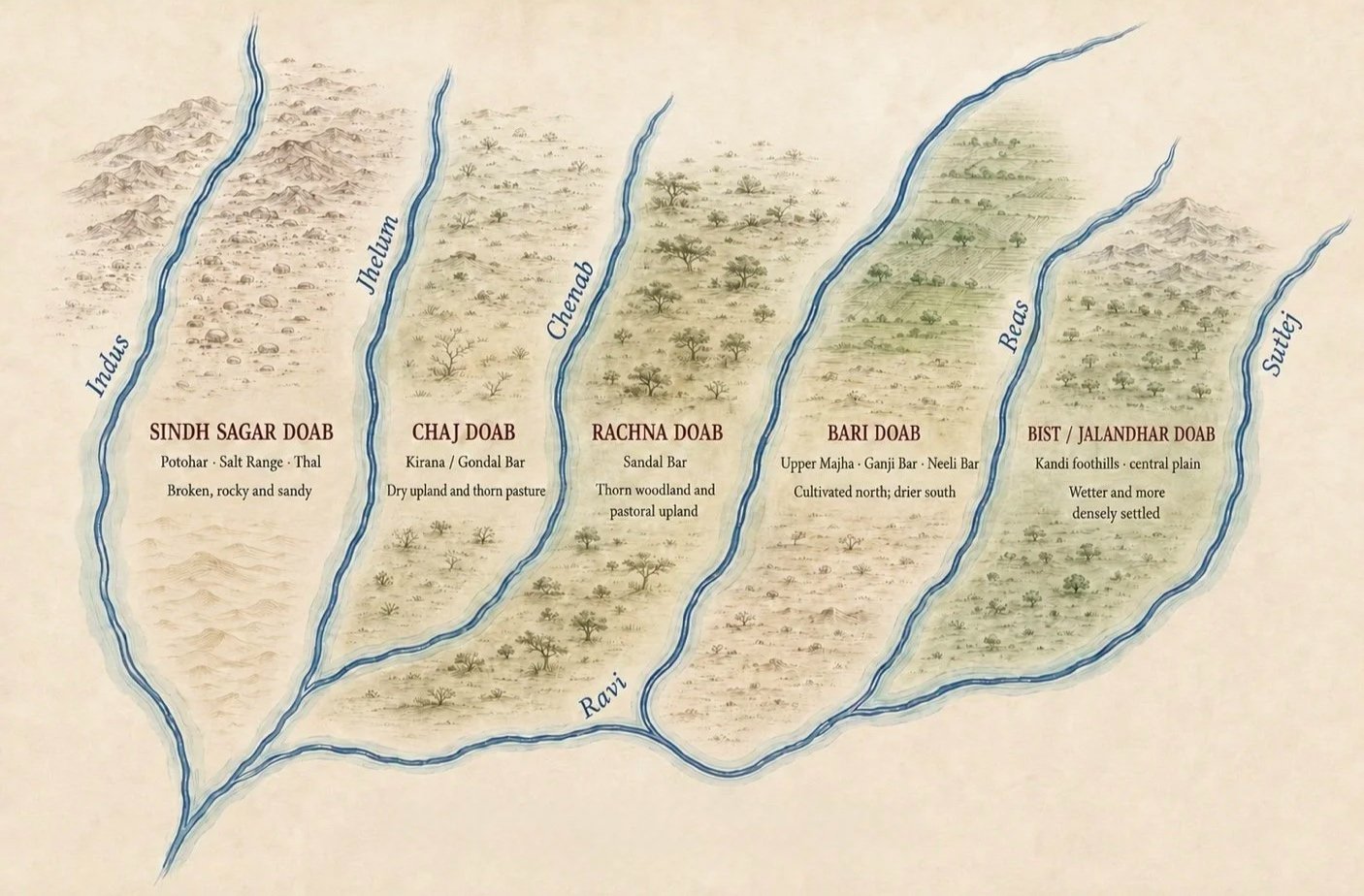
Note: This image is not to scale or an accurate depiction of the course of each river, it is a visual depiction of each doab and their respective terrains.
These were more than geographical labels. Each doab could operate as a distinct political and military zone, with its own settlements, routes, grazing grounds and centres of power. To control Punjab, an army could not simply enter the region and claim the plain. It had to advance from one tract to the next, crossing river after river while protecting its supplies and lines of retreat.
The rivers themselves changed with the seasons. In drier months, an army might cross at a known ford or move men and animals by boat. During the monsoon or after snowmelt, the same river could widen, accelerate and swallow its crossing points. Channels shifted across the floodplain; low-lying ground became marshy; baggage carts sank into mud. A route that was open one season could become impassable in another.
This made knowledge as important as strength. Local guides, boatmen and communities who knew the terrain could determine whether an army crossed safely or was delayed on an exposed bank. Commanders searched for narrower passages, sent detachments upstream or attempted to mislead an opponent about where the crossing would occur.
Rivers could protect, but they could also trap. A force positioned behind one gained a powerful defensive barrier; a force caught against one could lose the space it needed to manoeuvre. Retreat became especially dangerous if boats had been removed, a ford had flooded or the opposite bank was already occupied. Punjab’s waters therefore produced neither permanent safety nor permanent openness. Their military value depended on timing, preparation and control of the crossing.
The Punjab That Has Disappeared
Modern Punjab - densely settled, intensively farmed and crossed by roads and canals - can obscure the landscape in which much of its earlier warfare occurred.
Large parts of the region were once covered not by one continuous forest, but by a mixture of riverine woodland, tall grasses, thorn forest, scrub and uncultivated wilderness. Trees such as kikar, shisham, ber and jand grew according to soil and rainfall, while belts of vegetation followed the rivers and seasonal streams. In the foothills, denser woodland met broken terrain. Across parts of western and southern Punjab, the higher land between rivers formed the bars: broad, comparatively dry tracts used by pastoral communities and covered in grass, bushes and scattered trees.
Historical references to a jungle do not always describe the dense, tropical forest the English word suggests today. The term could also refer to land beyond settled cultivation - wooded, scrub-covered or simply wild. Places remembered as the Machhiwara and Lakhi jungles belonged to this older Punjab, where cultivated villages existed beside stretches of land that were far less controlled.
For warfare, these landscapes changed the balance of power. Thick vegetation restricted the view of mounted troops and made large formations harder to coordinate. It concealed paths, camps, animals and stores. Fighters familiar with the area could watch an approaching force without revealing themselves, strike a small detachment and disappear before a larger army could respond. A forest or scrubland that looked empty to an outsider could contain communities, wells and routes known intimately to local people.
Yet the wilderness was not automatically a refuge. Armies needed water, grain, fodder and reliable information. Remaining hidden for long periods placed pressure on all four. Fire could reveal a camp; hoofprints could expose a route; control of wells could force people into the open. Forest warfare therefore depended on networks of support as much as concealment.
Much of this older landscape receded over centuries as cultivation expanded. Its transformation accelerated under The British Raj, when canal colonisation transformed vast areas of the western bars by settlement, fuel and railway construction. Forests and grazing tracts were mapped, cleared and reorganised.
The straight canals, cultivated fields and planned settlements that came to define modern Punjab were not timeless features. They replaced a far rougher landscape that had once offered refuge to pastoralists, rebels, fugitives and small fighting bands.
Why Punjab Favoured Mobility
Punjab is often described simply as a flat plain exposed to invasion. This is only partly true. The region also contains the Pothohar plateau, the Salt Range, the Himalayan foothills, desert margins and a complex river system. Even across the central plain, rivers, flood channels and forests interrupted movement. Punjab was not an empty field over which every army could travel freely.
What it did offer was space. Between the major rivers lay long distances with relatively little high ground from which the entire countryside could be controlled. Forts defended cities, roads and crossings, but no wall could enclose every village, grazing tract or approach. A commander who remained in one place risked being bypassed, isolated or deprived of supplies.
Mobile forces could respond to this problem. Mounted scouts searched for crossings and watched roads. Cavalry carried news, screened the movement of an army and gathered food or fodder. Fast detachments could raid an enemy’s camp, disrupt its baggage train or attack before scattered troops assembled. If confronted by a much larger force, they could refuse battle, draw it across difficult country and wait for distance, weather and hunger to weaken it.
Mobility did not always mean constant advance. Often, it meant preserving the choice of when to fight. An army that understood Punjab could move rapidly across firm ground, then use a river or forest to break pursuit. It could disperse when provisions were scarce and reunite when an opportunity appeared. The landscape rewarded commanders who treated distance as a weapon and punished those who allowed a heavy baggage train or rigid formation to determine their pace.
Campaigning also followed the agricultural and seasonal life of the region. Horses required grazing and grain; soldiers required food; rivers had to be crossable. Harvests created supplies worth seizing and defending, while floods and extreme heat altered the routes available. Military movement was therefore tied to the countryside it passed through. No army, however powerful, could remain separate from Punjab’s fields, wells, herds and villages.
Horses and Cavalry Culture
Across this environment, the horse became far more than a symbol of status. It was the most effective means of carrying military power across Punjab’s distances.
Punjab stood between the horse-producing regions of Central Asia, Afghanistan and the Iranian world to the west and the plains of northern India to the east. Horses moved through the region with merchants, migrants and conquering armies. Some were bred locally, others were imported because warhorses of the desired size, strength and endurance were difficult and expensive to produce. Control over trade routes, breeding grounds and supplies of good mounts could therefore strengthen an army before a battle had even begun.
The importance of cavalry increased across the ancient and medieval centuries, although mounted warfare did not take one unchanging form. A horseman might carry a bow, spear, lance, sword or shield. He could fight at close range, release arrows while moving, pursue a broken force, escort supplies or carry intelligence between commanders. The horse gave him speed, height and reach, but it did not make him invincible. Woodland, mud, disciplined infantry and defended riverbanks could all reduce his advantage.
Nor was cavalry only the possession of great empires. Maintaining a warhorse was costly, but Punjab’s pastoral traditions, local chiefs and networks of armed retainers spread equestrian knowledge beyond a single royal court. Riding, breeding and the ability to judge a horse became sources of practical authority and social prestige. A fine mount represented wealth, readiness and freedom of movement; losing one could mean losing the ability to fight, escape or carry news.
This culture was repeatedly reinforced by Punjab’s political position. Forces entering from the north-west brought their own mounted traditions. Powers based deeper in the subcontinent needed cavalry capable of meeting them. Local rulers had to patrol open territory, protect routes and respond quickly to threats that might emerge across another river or doab. Over time, horse and rider became inseparable from the military imagination of the region - not because every Punjabi was a cavalryman, but because no power hoping to command Punjab could afford to ignore mounted warfare.
A Landscape That Shaped War
Punjab did not create one army or one method of fighting.
Its rivers demanded preparation. Its forests rewarded local knowledge. Its plains gave speed enormous value, while its distances made slow control difficult. The strongest force was not always the one with the most men, but the one that knew when to cross, where to disappear, how to find supplies and when to move before an enemy could respond.
These conditions existed long before the rise of modern warfare. They shaped the armies of ancient kingdoms, frontier rulers, local chiefs and imperial powers, each adapting to the same land in different ways. The military traditions that later emerged in Punjab were not created in an empty field. They grew from centuries of warfare across a landscape of moving water, vanished wilderness and people on horseback.
