
Women Under The Raj
When Punjab was annexed by the British East India Company in 1849, women were already an integral part of Punjabi society. They worked in fields and households, managed families, participated in religious and cultural life, and helped sustain the rural economy upon which most of the province depended. Their roles varied across communities, regions, and social classes, but women were not absent from public life.
Over the following century, the colonial government introduced new schools, reform movements, urban centres, and professional opportunities that gradually altered the opportunities present for Punjabi women. While change remained uneven and often limited to certain groups, the foundations of modern female education and public participation began to emerge.
EDUCATION FOR GIRLS
One of the most significant developments during the Raj was the gradual expansion of female education. Prior to annexation, formal education for girls was relatively uncommon, particularly outside elite families. Most girls learned practical skills and religious traditions.
During the 1800s, missionary organisations established some of the first schools specifically for girls in Punjab. Government institutions and local reform movements later expanded these efforts. Although many communities initially hesitated to adopt the reforms, attitudes slowly began to change.
By the early 1900s, major cities had become important centres of female education. Institutions offered educational opportunities that would have been unavailable to most women a generation earlier.
SOCIAL REFORM AND CHANGING ATTITUDES
The colonial period also saw growing debates surrounding the role of women in society. Questions of education, marriage, widowhood, and social customs became topics of discussion among religious reformers, community leaders, and intellectuals.
Many of these changes were driven by Punjabis themselves rather than imposed by colonial authorities. While traditional family structures remained strong, reformers increasingly argued that educated women could contribute to the prosperity and advancement of society. These discussions helped shape changing attitudes toward women's education and participation in public life.
WOMEN IN THE CITIES
Urban growth created opportunities that had previously been rare or unavailable. As Lahore, Amritsar, Rawalpindi, Multan, and other cities expanded, a small but growing female middle class began to emerge.
Educated women found roles as teachers, nurses, midwives, writers, and social workers. Women's associations and charitable organisations appeared in many urban centres. Newspapers and literary journals occasionally published female voices, helping women to participate in discussions about society, education, and reform.
Although these opportunities remained limited to a minority of women, they reflected broader social changes within Punjab's cities.
WOMEN IN RURAL PUNJAB
Despite the growth of cities, most Punjabis continued to live in villages throughout the colonial period. Rural women remained deeply involved in agricultural life, contributing to farming, livestock management, food production, and household labour.
The development of the Canal Colonies brought thousands of families into newly irrigated regions of western Punjab. Women played a crucial role in establishing these settlements and supporting the agricultural communities that emerged there.
For many rural women, however, daily life changed more slowly than it did in urban centres. Access to education remained limited, and traditional social structures continued to shape much of village life.
TOWARDS INDEPENDENCE
As political movements gained momentum women also became involved in public activism. Some participated in nationalist organisations, reform campaigns, educational initiatives, and charitable work. Although women remained underrepresented in formal politics, their presence in public life was far greater than it had been at the beginning of the British Raj.
LEGACY
Women had always been essential to Punjabi society, but the Raj period introduced new institutions and opportunities that gradually expanded the ways in which many women could participate in public life. Change was neither immediate nor universal. Rural traditions remained strong, and many barriers persisted. Yet by the end of British rule, female education, professional employment, and public engagement had become far more visible than they had been a century earlier.
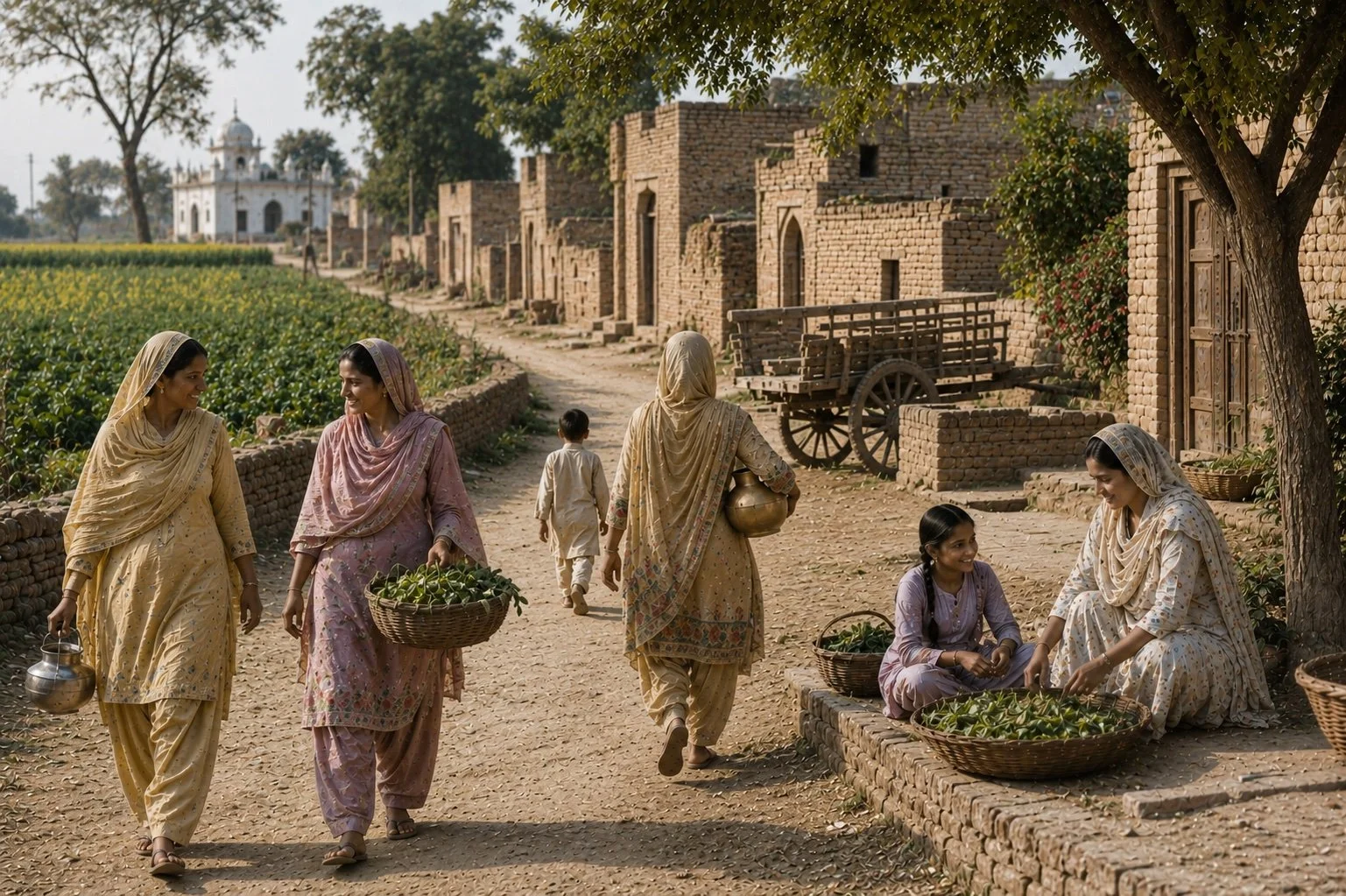
A depiction of women in a traditional Punjabi village
To the empire that increased opportunities for women in society,
With deep gratitude - Trish Saab